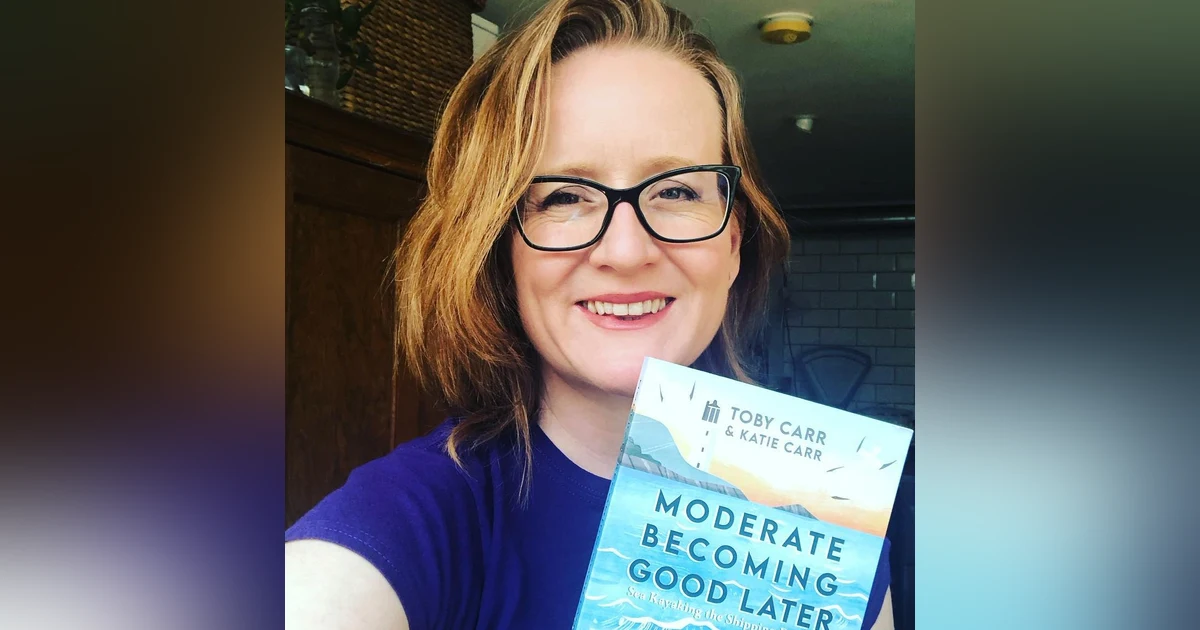
#167 - Katie Carr - Moderate becoming good later kayaking the shipping forecast with Toby Encore


 Apple Podcasts

 Spotify

 Overcast

 Castro

 PocketCasts

 RSS Feed
Today's episode is an encore presentation of a November 2023 interview with Katie Carr about her brother Toby’s ambitious project to kayak in every area of the BBC Shipping Forecast and the books that followed: Moderate Becoming Good Later and Thundery at Times.
Katie describes how she turned Toby’s notes and recordings into a book, took up sea kayaking to finish the remaining regions, and relied on the global paddling community while navigating grief and personal growth.
Get your copy of Moderate Becoming Good Later
Get your copy of Thundery at Times
Connect:
Learn:
- BBC 4 Shipping Forecast
- Attention All Shipping: A Journey Around the Shipping Forecast by Charlie Connelly
- Fanconi Anemia
- The Churchill Fellowship
00:09 - Intro and Encore Replay
02:20 - Toby’s Shipping Forecast Quest
05:06 - Fanconi Anemia and Family
06:03 - Why the Forecast Mattered
09:44 - Toby’s Kayak Appeal
10:51 - Completing the Remaining Areas
13:13 - Writing Toby’s Story
17:56 - Balancing His Words
18:25 - Learning to Kayak
22:50 - Planning the Final Routes
27:51 - Toby’s Boat and New Challenges
31:15 - Community Support
33:07 - Beyond the Book
35:10 - Hebrides and Favorite Paddles
42:56 - What Comes Next
43:58 - Helping Katie Finish
45:23 - Title and Meaning
0:02 Welcome to Paddling the Blue. With each episode, we talk with guests from the Great Lakes and around the globe who are doing cool things related to sea kayaking. I'm your host, my name is John Chase, and let's get started paddling the blue. Welcome to today's episode of the Paddling the Blue podcast. Today's episode is an encore presentation of an interview from November 2023 with Katie Carr. And at that time, we talked about her book co-authored with her late brother Toby titled Moderate Becoming Good Later. It was a thoroughly enjoyable discussion about Toby's life, his impact on the world around him, and his paddling plans. And Katie was working on finishing Toby's life goal to paddle all the areas in the BBC's Shipping Forecast. She's recently released her follow-up to that book, titled Thundery at Times, which chronicles the rest of her story of loss, grief, and unfinished kayak business.
0:51 Before we get to our replay chat with Katie, James and Simon at OnlineSeaKayaking.com continue to produce great content to help you evolve as a paddler and as a coach. You'll find everything from basic strokes and safety to paddling in tides, surfing, coaching, documentaries, it is all in one place. So if you're not already a subscriber to OnlineSeaKayaking.com, here's your opportunity to get started. Visit OnlineSeaKhiking.com, use the coupon code P-T-B-Podcast at checkout, and you'll get 10% off up to 12 months of your subscription investment. For those of us who also enjoy paddling whitewater boats, be sure to check out OnlineWhitewater.com. They're also offering the same discount to listeners.
1:31 Use the coupon code P-T-B-Podcast at checkout and explore. And I would love to help you put those skills to work. I offer a wide range of programs in the Great Lakes and beyond, from paddling skill development, instructor certifications, workshops, CPR and wilderness first aid, guided trips, and more. Visit paddlingtheblue.com, click the Courses and Trips link at the top of the page, and I hope to see you on the water. Enjoy today's replay, and I hope it inspires you toward your own journey. And to pick up the books, you'll find a link in the show notes for this episode. Hello, Katie. Welcome to the Paddling the Blue. Hi, John. Yeah, great to be here. Thank you. So you are certainly helping me tread new ground with Paddling the Blue.
2:12 We're here today to talk about a combination of trips, not necessarily only your kayaking, but your kayaking experiences as well as your brother's experience. But first, let's introduce our listeners to you. Who is Katie Carr? Katie Carr is a new paddler, so feeling a little bit of imposter syndrome being on this podcast, I have to say. But I'm also the author of Moderate Becoming Good Later, which is the story of my brother's trip around the UK shipping forecast, which is a large area that touches most of Western Europe. Okay. All right. And then tell me about your brother, Toby. So Toby was a keen kayaker. He started kayaking when our dad died in 2010 and got his five stars on the British system and traveled a lot around Europe, mostly kayaking.
3:04 And when our other brother Marcus died, Toby decided that he would like to set himself a serious challenge. And he decided to try and sea kayak in all areas of the shipping forecast. This is a large area which is basically all the sea areas around the UK. It reaches from Southeast Iceland in the north down to the very southern tip of Portugal in the south and out encompassing Ireland to the west and hitting the European coast on the east. So he set out to do that. And he was an architect in real life, but enjoyed kayaking and getting out and...
3:52 That connection with nature, and also the special connection that you get with other kayakers. Now, you had mentioned Marcus as well. And so you've had a lot of challenges through life with Toby and Marcus. Tell us a little bit about that. Yeah, well, both of my brothers were born with Fanconi anemia, which is a, genetic disease, meaning that they find out, usually when they're around eight to 12 years old, and the life expectancy, certainly when they were told, was 30. So they knew they had a life-limiting illness, and we all knew from quite early on that they were unlikely to reach middle age.
4:36 So Toby was kind of working within this window of opportunity, and Marcus was as well. So Marcus sadly died in 2017 as a result of what normally happens with Fanconi anemia, which is a development into cancer in middle age, presuming that they've survived until then. And that became a wake-up call, in a way, for Toby to start his trip. So living with Franconia anemia, how did that change them? Or did that? I mean, I know Toby had a special zest for life, and I'm guessing Marcus had the same, but that didn't seem to slow them down.
5:19 No, I think that often people find that they have a choice, presuming that we are mentally healthy, which is a big presumption, but we have a choice when faced with that kind of situation to, sort of take life by the horns and try and do as much as possible, or to maybe take a step back and go, well, I'm going to die anyway. And both of my brothers decided on the first option in different ways. Marcus was a doctor and traveled the world in more conventional ways, perhaps, than kayaking. And Toby, of course, went off on all these adventures in his kayak.
6:00 You mentioned Toby's quest was to paddle all the areas of the shipping forecast. So what was it about kayaking in the shipping forecast that attracted him? Well, I think the shipping forecast was important for us when we were growing up. We had a small boat. It was about a 24-foot boat, catamaran, that you could sleep on and that we sometimes sailed across to France from the UK on. And with our dad, we would listen to the shipping forecast. The shipping forecast is basically the marine weather warning for the UK. And shipping forecasts exist everywhere in the world, really.
6:40 But in the UK, it has a sort of a special nature. There was actually an article on this in the New York Times a while ago. If anyone in the States is interested in finding out about it. But it's this kind of lullaby that is on the radio. So most people don't understand its meaning at all. But we did as kids. And we grew up with our dad turning it up to listen to the weather forecast, whether we were on the boat or not. And so it was something that really connected all of us to our family. And I think when Toby was looking at a way of honoring our family history, perhaps, and Marcus and our dad, it was a good choice of basis for the trip.
7:25 It's also quite a nice structure. There are 31 sea areas and Toby set himself the challenge of paddling in each of them. He didn't say how he was going to paddle in each of them. So, you know, you could have chosen to have paddled entire coastlines, which is obviously a lot. But he didn't decide to do that. He decided to find the nicest places to paddle or to take advantage of different opportunities that came up and kayak in each of those areas. Now, each of the regions or each of the areas within the shipping forecast has its own personality. Is that right? Well, kind of, because they're just sections of land and sea.
8:08 So, if you compare Southeast Iceland with Trafalgar in Portugal, that's obviously quite a big difference just because of the change in the rocks and the history behind those pieces of land. And then some of them have kind of alternate names, I guess I might say, Sea of Flames for Faroe. Oh, those are the titles that Toby was giving them. And that's to do with the fact that in a book that he read about the Faroe Islands, Faroe Islands being the kind of place that not that many paddlers go to because it's a little bit scary. I have met quite a few people now who've been there, but I've been hanging around with quite a few paddlers.
8:53 But in this book, it was called Sea of Flames, basically because of the tidal flows around the island. So there was this drawing, this map drawing, and all of the red tidal flows sketched on there, and it just looked like a big sea of flames. All right. And things like Humber welcomed in the gates of hell. Sounds like a lovely place to paddle. Well, exactly. But he basically went to Den Helder, which is a city in the Netherlands. And the reason it's called Den Helder is allegedly that it was something to do with the gates of hell. In fact, I think the translation is the gates of hell. And he sort of dug around to try and find out where that came from, because it was actually quite a nice place.
9:38 So now, why did kayaking attract Toby? I think mostly because it was something he could do on his own. It was something he could do in connection with other people. And there's a special thing about kayaking, isn't there, where you're so close to the water that you are almost on it. It's probably the closest thing ever. To sort of swimming without actually swimming. So you can drift around in that space between the sea and the land. And I think he was quite interested in that. He was also a whitewater paddler. So he loved a bit of tide race, a bit of a challenge.
10:18 And I think there's a lot of variety. So I would say, and I didn't actually speak in great detail with Toby about this. I sort of got this out of his notes, that it was the variety, it was the connection with the water, with nature, and also this connection with other people while also maintaining that autonomy and being able to do things on your own and build up your skills and do more and more fun stuff. Okay. Now, Toby didn't finish all the areas of the shipping forecast, so you're continuing the quest, correct? I am, yes. This is rather more of a challenge than it was maybe for Toby.
10:59 Now, how many of the areas did he complete? He completed 17 of the areas. Okay. So there, well, I say completed, he paddled in 17 of them in Lundy, which is the area he ended in, which is a sort of, it's an area that encompasses a bit of Ireland, a bit of Wales, a bit of England. And he marked that as uncompleted. So that's where I decided to start. And there are 10 areas that he didn't kayak in as part of the trip. So I'm working on those and also Lundy, so 11 in total. There are another four areas that have no land.
11:41 So if anybody has any idea of how I can get out to these areas and technically kayak in them, that would be quite interesting to hear. At the moment, I'm ignoring them. What was his plan to be able to to get to those four areas he didn't have one but he was definitely more crazy than me as i said he was a very experienced kayaker i i only got into a kayak for the first time this year so it was january this year that i thought okay if i'm thinking of doing this i ought to try it out and so, He'd spoken to his friend Mikal about helicopters, oil rigs, this kind of thing.
12:22 I've had some ideas from other paddlers about going on cruise ships, but they're a little bit of a challenge. One of them, Bailey, is right out in the middle. It's underneath Southeast Iceland. And yeah, basically kind of pretty rough area where there must be a massive fetch that just comes right across the Atlantic, and I got no idea how to do that, really. Now, what are those four areas, just in case any of our listeners know of a way to be able to get to them? Yeah, sure. They're Bailey, Dogger, Viking, and Forties. Okay. If you want to look them up on the map. Yeah, I did have a chance to look at the map, so I happened to see those.
13:04 Now, Moderate, Becoming Good and Later. this is the book that you've written about toby's journey and and you've written that from his notes and from his from his voice recordings and video recordings and such tell us what that's like for you. That's a big question what it was like in the process was initially extremely difficult because i was listening to his voice i was reading his handwriting. And this is the handwriting that I've seen my whole life on birthday cards and Christmas presents and parcels and things. So it was very emotional to dig into that and.
13:46 But as time went on, I started to realize that I was getting to spend time with Toby at a time when he was experiencing immense joy and just out there adventuring, doing this wonderful thing that he loved. And that was truly special. So it was hard and it was emotionally very challenging. But at the same time, I feel like it gave me an extra year with Toby and it made me feel like I was doing his story justice. So he spent a lot of time recording things in many different ways. He had three different video options, a GoPro, an iPad, a phone, actually four, and his waterproof camera.
14:29 And then he was recording sound. He was making notes every day. He was using the notes in his phone. So there were lots of different things that I needed to bring together. But it was almost like unveiling the depth of this trip that he'd done which he'd, absolutely loved and was probably one of the best things he did in his life, so it was special and then actually writing the book it became more of a creative challenge, I wrote it in his voice obviously I don't know exactly what he would have written so I had to make a creative jump there based on all of the information I had and based on how well I know Toby.
15:11 And then kind of trust my own judgment. I did interview a lot of people who were involved. I went and tried to do primary research on other parts of the book, obviously plotted everything out on a map, sat in a kayak to figure out how it worked, all of this kind of stuff. So it's been a journey in itself for me to do that. I feel delighted that I've been able to because it was so obvious that Toby wanted to tell his story and such a shame not to use all of this quality information, these descriptions that he had of these places, these special experiences, moments in time.
15:51 And also, I hope that it kind of passes on other messages about living life to the full, about choosing adventures and, you know, getting out there into nature and doing what you want to do, really. So by all the recordings and all the notes that he kept, it's clear that he had planned to write the book but did not get the chance. Yeah he he basically when he started the trip he didn't know whether it would be a book a podcast a radio show television whatever he, had had quite a lot of contact with the bbc they'd done a little tiny documentary on him so he had that in his mind he also needed to write a report for the people that sponsored him initially which was the winston churchill memorial trust which is now the Churchill Fellowship.
16:42 And so he knew that he needed to do something. By the end of his life, he had got a book deal. So there is a sort of a key here, and it was that he died having signed a contract with some publishers, which he was obviously delighted about being able to do, but it came at a time when he was in a serious health decline. So he wasn't really able to do it. Now, you mentioned the BBC documentary. Is that something that's available online that I could link to so folks could see that? Yeah, it is available online. Okay. The easiest way to find it, I think, is to go to my website and get it from there because it was in 2018, so it's quite far back in their archives.
17:33 I'll give you all of that information afterwards. All right. We will make sure we collect that information and we'll add that to our show notes. So you've done a wonderful job of capturing the stories. How much of the content is Toby's own words and how much of it is yours? Ah, that would be telling. It's actually very difficult to say because Toby had written three chapters, as part of the book proposal. So there are those. He'd also written blogs. So there were bits of the blogs. Over time, it got edited and edited and edited. So I don't really know what the proportion would be.
18:13 It's fairly low if you look at sentences toby actually wrote okay if you look at descriptions toby alluded to in his notes obviously that's going to be much higher, you had never been in a kayak at the time you wrote the book that is right how did you capture the essence of that and and and really be able to grab the stories not having experienced a kayak, So, I mean, I'd been on a sit-on-top, but I think we can all ignore those. And I got in in November, so I'd written most of the book but was still doing edits. I went to Jersey, Channel Island, Jersey, and met my aunt and uncle who were mentioned in the book. They're sea kayakers since the late 1960s, I think, so pretty well known.
19:05 And there was a point where there was an opportunity to go to the local swimming pool and try out a kayak this is obviously not really testing it out properly but I went there and sat in a sea kayak, just to kind of get the feel of it which is kind of a weird thing to do the weather wasn't good enough to go out as a beginner for real so I did that but mostly what I did, was speak to people in detail about it and get other people to check what I'd written. So Toby obviously had a lot of kayaking friends and we've got Nikki and Kevin in our family who are, you know, very experienced sea kayakers.
19:46 And at one point I just sat down with them at the table and asked every single question I had about kayaking from, you know, what's it like? Is it a sport, which way round do you hold this? If I'm sitting in the cockpit, can I get something out of the rear hatch? These kind of questions. And they sat there for two hours and answered all my questions. How have you developed your skills? My kayaking skills? Yes, yes. Okay. So I started in January and I just went out with my aunt here in the Costa Brava. I live in Barcelona, so it's a little bit warmer and you can definitely paddle in January. In fact, it's one of the best times. And we just went out. She showed me some of the basic stroke skills and that was just kind of a start, just getting used to it.
20:34 As I said, I grew up partly sailing and I've sailed as an adult as well, doing sort of dinghy sailing. So I felt comfortable on the water. I just didn't really have any kayaking skills. So yeah, she helped me out there. And then I got in touch with a school that's here in Palamos on the Costa Brava and started working with them whenever they went out on, a little tour or whenever they did any training, I went along to that. And then I just got started. There was a moment when I realized that people learn to kayak in all these places. People learn to kayak on the West coast of Ireland, which is obviously one of the scary places that everyone's like, oh, you're going to the West coast of Ireland. It's going to be big waves.
21:21 And it is big waves, but there are also sheltered places. So I got started and where Toby did a lot of his paddles solo, I'm not doing that at all. So I'm always going out with qualified coaches, with very experienced paddlers and having them help me and coach me as I go along. So in every paddle I do in or out of the shipping forecast, I'm learning new skills and being corrected in different ways to the point where the other day I was paddling in Scotland and Nicky and I went around an island just near Oban in the Hebride region, sorry, in the Malin region.
22:02 I'm going to show up my lack of knowledge here, in the Malin region of the shipping forecast. I was sort of paddling and the sea got a little bit more challenging for me. And as I was doing it, I was sort of hearing the voices of all of these different people in Ireland, in the UK, in Wales, all of these different pieces of advice that were kind of helping me to keep going. And that's interesting. That's a nice way of learning, I think. It's not a conventional way, but it's a nice way. Which areas did he leave for you to paddle? Not that he left them, but were remaining. Yeah, so Toby left basically the cold and wet ones, which is Wales, Ireland, Scotland, essentially, a little bit of England, but he hadn't done those.
22:53 I think he was saving them for last because they do have bigger seas and maybe more challenging conditions. So he was probably looking forward to doing that, I suspect. He might have tried to paddle all the way around Ireland and, you know, do some of these, the big paddles that other people like to do. But yeah, he didn't get time. So I received those and then decided to put a plan together. I wanted to do them in two years. I want to be able to finish the project in two years. I mean, one would have been great, but I've got a family, I've got responsibilities. I live in another country, so it's a little bit of a challenge to be able to do all of it.
23:35 So I basically started in Lundy near Bristol. And then I went up to Wales. So the South Wales, Pembrokeshire area, absolutely beautiful. Anglesey, that's moving into a different shipping forecast area, which would be Irish Sea. Then I took the kayak on the ferry over to Dublin. I left it there for a while and picked it up and did a paddle just south of Dublin. Then on the Copper Coast and the bottom of Ireland basically absolutely stunning coastline really beautiful and then over in Skull so the Copper Coast is Fastnet Skull is also Fastnet and then up near, Kerry in the Shannon region I had one failed attempt at kayaking on.
24:20 The on the River Shannon where I got everything ready it was a grey miserable day and it was going to be difficult but I was there with two other people who were extremely skilled and thought you know I'll give it a go let's see how it goes I got everything ready you know even the dry suit on everything, I saw the first lady launch just thought oh that looks really difficult she was struggling and she's you know got years of experience, and then I said to the second person who was there well you go out and see how you find it and he also struggled a bit and I just thought I don't want to just smash the boat up on the beach. I've got a fiberglass boat, which is a tide race exceed. And I just wanted the boat to survive and myself to survive.
25:03 So I didn't do that paddle. But I was told that that's actually a very good learning to be able to say no, even when you're all ready to go. From there, then I went round to further up the north of Ireland. And then after putting the boat on and myself on the ferry to Scotland. I left it in Scotland and then picked it up just a few weeks ago and. Did then the Malin and Hebrides area, which is basically the Hebrides area of the shipping forecast and the Hebrides islands, not the outer Hebrides. So you're right, that learning, that experience that you just had, I mean, that's the one question that we should all be asking every time we go out and paddle, which is, should I be doing this today?
25:49 And we really need to be honest with ourselves. And you took that opportunity to ask that question and to be honest with yourselves and then say, no, this is not what I should be doing at the moment. Yeah. It's a difficult one though, isn't it? Because you want to push yourself. As a beginner, you don't actually really know what your skill level is, really what you can deal with. So you want to push yourself forward, but at the same time, not get into any dangerous or difficult situations. I try to look at the sea and go, okay, is that right at the end of my comfort limit as I'm getting on it? Because if so, I don't have any room for maneuver if it gets worse, because it probably will.
26:33 So that's what I did with that one. And usually I kind of go, well, you know, actually, it's fine. I just need to get used to it. And I'm with someone who's really good. So no problem. But yeah, that one was definitely beyond my capabilities. The cold and wet areas are the ones that are remaining. And so you've done about half of those areas and another half you'll do next year? Yeah, exactly. So next year, I will do the Tyne, Forth, Cromartie areas, which is up the east coast of northern England and Scotland, and then finish in Fair Isle, which is the Shetland Islands. So I wanted to put probably the most challenging place last.
27:13 It's also one of the places that Toby saw from the ferry that he went on as he went from the Faroe Islands to Norway. So it's quite nice to connect it up that way as well. He didn't actually paddle there, but he saw the Muckleflugger Lighthouse, which is a lighthouse right on the top of the British Isles. Now, you mentioned the boat, the Tide Ray Succeed. That was Toby's boat? It was Toby's boat, yeah. Toby had three boats and in varying stages of, let's say, usability. And i i got some help to decide which one to take obviously one of them had no skeg was quite broken that was the one he used for the first part of his trip in 2018 so that one is now being mended so that we can continue to use it and he also had an more of a play boat for the sea which i quite fancied because it was red but i was told by many people that it would be really difficult to paddle as a beginner so I took the exceed and I've loved paddling it it's brilliant and I feel much more comfortable in that than any other kayak now, all right so it feels kind of part of me, so what's the biggest challenge for you as you as you go about this remaining quest.
28:30 So I think the biggest challenge is probably to do with frustration. A lot of the people I know and a lot of the people who are helping me have spent years kayaking and they're really good at it. I've obviously only been doing it for a few months and I can't do it every weekend and all of that. So I find now that I'm getting to the point of being frustrated with myself for not having as much skills and experience as I would like. And that's something that I'm having to mentally manage. So there's that. There's also obviously still the ongoing grief to do with losing Toby and losing the rest of my family.
29:15 Sometimes there are moments on the water where it is such a special place and you can be drifting in the calm or whatever, maybe got seals popping their heads up all around you, that it just brings to the fore that toby isn't doing this and and i'm doing it and it it was toby's thing to do it wasn't really mine, it's obviously helpful for me to do it as well as part of that grieving process but it's a challenge, now you mentioned that it's it was toby's thing not really yours has it become yours. Yeah, I think so. It's like I was saying, the kayak now feels more and more like it's my kayak. It never will be really because it's Toby's.
30:00 It's got all of the scratches that he put into it, rock hopping and things like that. So it is yeah becoming more and more my challenge and actually one of the nice things about going to ireland was that most people there, hadn't met toby they'd heard of him perhaps but they hadn't met him and so they met me for the first time and were kind and helpful and wonderful with me and that just felt amazing to feel that support of the community of paddlers in another country, who knew a bit about my story, but essentially were just willing to take me out and have a great time.
30:41 And that's something really special. And I think it's special in the community of paddlers that there are around the world and something that I don't think that I'll want to let go of. How are you being supported along the way? Basically, I'm reaching out to people in different places to each different area. I've got a bit of a different plan for. So in Ireland, I didn't know anybody and I basically connected with the Irish Sea Kayaking Facebook group and explained my story. I also joined the Irish Sea Kayaking Association and people sort of just came along and were wonderful and wanted to help and, I said to them oh you know I'd like to be doing a paddle here on this day or around this time and they basically came along with a whole group of people from their clubs.
31:31 Or on their own and came to help me do it. And that was amazing. And that's the same thing I found in the UK as well. I've relied maybe a little bit more on people who Toby already knew, some of his friends. Like I said, when I went up to Mallon and Hebrides in Scotland recently, I went with my aunt and she came in to help, I mean, help kayak with me and enjoy being in nature. So it depends on what the situation is. I'm keen for it to continue to be a connection with people. So Toby's trip, even though he set off solo, was never about doing it alone. And mine obviously can't be about me doing it alone.
32:13 But the strategy for it I'm coming up with and then getting different bits of help in different places whatever's available and I've had people offering to take me out, and they run kayaking schools or just do you want me to come and help you sort out the boat was one one friend of Toby's really gave me massive help by telling me what bits of kit I needed in the beginning yeah lots of different ways people have been helping it's been really lovely it truly is an amazing community where people will come together, and help in any way they can. Yeah. Now, the book Moderate Becoming Good Later, the book's not about paddling. What's it about? Yeah. So basically, with me not being a paddler, it couldn't, when I wrote it, it was never going to be about paddling. In fact, Toby's synopsis of the book stated that quite clearly.
33:04 It's about enjoying nature. it's about overcoming loss or difficult circumstances, it's about going out and doing what you want to do, it's also about the history of places and connections across the seas so the importance of maybe looking at land masses not as different countries but as. Places with different history and different idiosyncrasies, but also places with a lot of things that connect them. Yeah. He was doing this solo, but as you mentioned earlier, solo, but not alone. And he was really fully immersing himself into these regions.
33:45 How are you doing the same? So basically every region I go to, I'm contacting and being in, being connected with people who live there, who work there. And really, I think it's more of a sense of curiosity of just being able to go, oh, that looks interesting. Let's find out a little bit more. The book never tried to be a guidebook to any of the regions. So, you know, there may be things that are missing out of those areas that haven't been mentioned that are pretty important. But it's about kind of looking and being aware of what's going on, where you are in that moment and asking, okay, what else is there?
34:26 What else can I find out? Who else can I talk to? And also at the same time, being able to take those moments of reflection in nature and just sit there or float there, looking at the beauty of small things that perhaps we don't make time to look at. What was the last region that you paddled? It was Hebrides. All right. Tell us about that experience. So I flew over to Scotland, well, into Liverpool and then drove up to Scotland. I hadn't been in Scotland for quite a while, so I'd sort of forgotten a bit what it looked like. And we, first of all, went for a paddle out to a place where I could wild camp.
35:12 So this was something that Nikki decided that I needed to be able to experience wild camping, which I hadn't actually done before. I'd done some camping, whatever. And we wanted to do a journey of several days, but the weather forecast was not great for that, mostly due to rain rather than wind in this case. So we didn't just really want to be out with all the wet camping gear for ages. So we left from Plockton. So paddling out from Plockton, just around the coastline, very close in, looking at everything that's happening, looking at the rock formation. Nikki, my aunt, is quite an expert on geology. So she was explaining to me how all of these rocks were formed and why they were quite different in different places.
35:56 And we were joined by seals we were joined by lots of different birds it was very calm sea just absolutely stunning to be surrounded by massive mountains beautiful water, it wasn't sunny I think sometimes we think that as doing water sports we need to go out when it's always sunny maybe that's me because I live in Spain. But actually getting on the water can be one of the best things you can do on a. Rainy or gray day rather than sort of sitting at home and watching Netflix or whatever. So we just took it really easy. This is probably an example of a paddle that didn't particularly challenge me as a paddler, but was just about taking in nature and taking in the beauty of it.
36:44 Later on, we were paddling around this island where it was the island of Kerara, which is further south. That's in the Malin region. And this was more of a challenge just because the sea got a bit more choppy. There was a bit of a tide race that we didn't expect. The tide had changed at a slightly different time from what we expected. And yeah, you've just got to suck it up and deal with it. Like many things in life, I think. Sometimes life gets a bit choppy and you've just got to paddle on through it. And I felt really good about that paddle. It was the longest one I've ever done. I mean, it's only 22 kilometers. So, you know, anyone thinking, wow, not very impressive.
37:27 But anyway, it's quite impressive for me. And it had lots of different conditions and absolutely stunning scenery. At the bottom of the island, there was a castle standing in front of this massive green mountain, emerald green. At that point, there was a bit of sun. The sea had calmed down a bit, but there were massive ocean waves flowing in that Nikki and I looked at later that were probably a storm that had come all the way from Florida, just straight across the Atlantic. Just that amazing comfortable ocean wave where you're just sort of going up and down and you don't even realize you're on it until you see it smashing into the rocks a bit further over.
38:07 So this was some of my experience of paddling in Scotland recently. There's something mysterious about a gray day that just makes those days kind of wonderful. Yeah, I think partly because not so many people are out. And it feels more like an adventure. There was one day in the Shannon region where I went out in Kerry and it was a very gray day. It was also quite windy. There was also quite a lot of tide. I went out with one other person who was extremely skilled at sea kayaking and we basically paddled out into the wind against wind and tide.
38:48 I was like, well, this isn't very much fun. Got out to the place where we wanted to get to and the sea was massive. And I just had to say, I'm not comfortable with this. I think we need to go back. And so he just said, okay, well, let's just raft up and go back. And we rafted up the kayaks. He put a small sail up on the front of his kayak and we zipped down that river so fast. It was so much fun. It made it worthwhile having paddled against the wind and tide. And that was just a very, very gray day. And that day, I just thought there was absolutely nothing better I could have done with this day. So again, I realized that each region has its own personality and each is wonderful in its own way. What has been your favorite region to paddle so far and why?
39:34 I would say my favorite one so far has been Fastnet, and that's the bottom of Ireland, essentially. And I did two paddles in Fastnet, one which was on the Copper Coast, which is near Waterford, and one which was out from a beautiful loch near to Skoll. And what made the first Paddle Beautiful was just this amazing rock stacks and, just absolutely stunning scenery, a little bit of a challenging sea, and a great group of people who were fun and very normal and.
40:20 Just out there to enjoy a day out and help me as much as they could. But really, they were all enjoying it as well. And I remember sitting on the beach with them, as you do. I've noticed as kayakers, you spend a lot of time sitting on beaches in the middle of nowhere eating your lunch. And they were sort of sharing out all of their homemade cakes and talking about their homemade jams. This was a group of guys. And I just thought it was such a nice community. They were obviously friends as well as paddling buddies. And they just made me feel part of it. So that was great. And then in Skoll, the weather was bad for me. I think it was like a 4.6 or something like that. The waves were maybe three meters, way beyond what I could do.
41:07 And I joined the Irish Sea Kayaking Association meet. So I went along to their meet and met loads of people from all over Ireland who just welcomed me with absolutely open arms. And it was amazing. And two of them set up a paddle specially for me, but didn't sort of say it was, this is for you because you're a beginner, but they did it as part of the meet. So it was one of the options that anyone could have joined, but it was one that they knew was sheltered enough for me to do. And it started off in this loch called Loch Ein. And it's very calm. And then it's got a little rapids that you can go down, which was quite a fun thing for me to try out.
41:48 And then you can paddle out to the open sea as well and play in those massive waves for about two seconds before the leader of the trip just went, you know, we could, I think we should probably go back. At which point I just did my best sweep stroke, turned the kayak around and paddled as fast as I could back in. You were just fine with that. I was just fine with going back. And then we did some rescue practicing. So it was just brilliant. And obviously absolutely stunning scenery as well. This is Southern Ireland. It's green and it's rugged and it's, yeah, just amazing. Will you continue kayaking after completing the shipping forecast? I expect so.
42:33 I've already been thinking about whether to bring the kayak back to Spain or not. We have some really nice paddling here on the Costa Brava, so a bit further north of Barcelona, or whether to just keep renting them. But it's in my mind as something I don't really want to stop doing. And one of the things that's been wonderful about starting was that you know I was starting something very new and I'm 46 now I started last year so 45 starting and I was thinking you know, I'm not sure about starting a new sport at this age you know whatever but what I found with sea kayaking is that actually most people are quite a lot older than me a lot of people started when they were my age.
43:15 A lot started very much younger, but it's very welcoming and very much something that you can use to explore no matter what age you are. So I think I'll definitely keep doing it. To get some reference for our listeners here. So we are talking right now in 2023 when you've been completing a portion of the trip and then you'll complete the remainder of the trip planned in 2024. So for those who are listening before that time, how can Paddling the Blue listeners help you? Well, you could follow me on Twitter, which is I'm at Kayak Forecast, or on Instagram, which is at Moderate Becoming Good Later.
43:58 If you follow me in either of those, when I come up with some issues that I need to be able to solve, I'll be sharing them on there, like the what we were talking about before about what do I do with these four areas so, they can come up with ideas for what to do with these four areas and just supporting buying a copy of the book if you if you can find it and I think that's probably it okay now where can people find the book. So it's available on Amazon. It's available in all good bookshops in the UK, in Australia, New Zealand, and Ireland. And yeah, and then you can get it online in different places.
44:39 In the US, I know it's available on Amazon as a Kindle book, but it's not been published as a paperback there at the moment. Okay. Well, we'll hopefully see that in a bookshop soon. Yeah. Now, I understand the title came from the way that the forecast is presented. Is that correct? It is, yeah. So the forecast is, like I think I said earlier, that it's quite poetic. It's something that people listen to when they don't necessarily understand what it's saying. So moderate becoming good later is actually, it refers to the visibility on the water. And so it's just that the visibility is moderate and it'll be getting better later, basically. And Toby wanted to make a play on that a little bit associated with his kayaking skill.
45:25 And also this idea of optimism. Like we may not be in a great place right now, but let's hope that we're going to become good later. Now, how can listeners reach you? So yeah, they can follow me on Twitter on, Kayak Forecast or on Instagram on Moderate Becoming Good Later. I also have my own website, which is www.ktneastcar.com. And on there I post anything about any events I'm doing and just information about the book and other stuff that I'm working on. All right, well, we will make sure that we put links to your website and to some of the other pieces that were on that website, like the documentary, and we'll make sure we get your social media outlets on there so folks can.
46:17 Connect with you and offer that help and then just learn more about your journey along the way. Great, thank you very much And we'll certainly encourage everybody Pick up the book, it's a great read And you will really enjoy it. Now, one other question that I have for you, it's a final question that we ask for all of our guests, and that is, who else would you like to hear as a future guest on Paddling the Blue? Well, there's one person that really comes to mind because I met him for the first time while I was in Scotland, and that is Nick Ray. Nick Ray has recently completed 360 days paddling around the whole of Scotland. He's a great guy, and I think he'd be a really interesting person to talk to on the podcast.
46:59 Fantastic. Well, I've had a couple of other guests that have made reference to Nick and I've followed his journey along the way. And he's recently completed the journey. So we'll certainly connect with him and see if we can get him on the show and enjoy his message as well. Brilliant. Again, Katie, this has been wonderful learning from you, learning about your journey, learning about Toby's journey and the book, Moderate, Becoming Good Later. And again, we'll encourage everybody to pick up the book and then read the stories and experience it for themselves. But I really appreciate your time today and your being with us. Well, thank you so much for having me on Paddling the Blue. It's been brilliant. Thank you. If you want to be a stronger and more efficient paddler, Power to the Paddle is packed with fitness guidance and complete descriptions, along with photos of more than 50 exercises to improve your abilities and enjoy your time on the water.
47:48 The concept and exercises in this book have helped me become a better paddler, and they can make a difference for you, too. The exercises in the book can help you reduce tension in your shoulders and low back, use the power of your torso to create leverage and use less energy with each stroke, use force generated from your lower body to make your paddling strokes more efficient, have the endurance to handle long days in the boat, drive through the toughest waves or white water, protect your body against common paddling injuries, and while you're at it, you might even lose a few pounds. And who wouldn't mind that? So visit paddlingexercises.com to get the book and companion DVD. I hope you enjoyed today's Encore episode with Katie. Moderate Becoming Good Later was a fantastic read. I can't even imagine how difficult it was for her to write that book.
48:31 I've not yet read Thundery at times, but it's definitely on the list. You'll find a link in the show notes for this episode at peddlingtheblue.com slash 167, so you can pick up your own copy of both books. Thanks as always to our partners at onlineseacayking.com for extending special offers to you. Visit onlineseacayking.com and take advantage of the great programming from James and Simon and other talented guests, including many previous guests of Paddling the Blue. Just enter that code PTBpodcast at checkout and get 10% off just for being a member of the Paddling the Blue community. As always, until next time, thanks again for listening, and I look forward to bringing you the next episode of the Paddling the Blue podcast. Thank you for listening to Paddling the Blue. You can subscribe to Paddling the Blue on Apple Music, Spotify, or wherever you find your favorite podcasts.
49:18 Please take the time to leave us a five-star review on Apple Music. We truly appreciate the support. And you can find the show notes for this episode and other episodes along with replays of past episodes contact information and more at paddlingtheblue.com until next time i hope you get out and paddle the blue.


