#133 - Environmental Conservation and the Rich Paddling Heritage of Ireland's Causeway Coast with Robin Ruddock

 Apple Podcasts

 Spotify

 Overcast

 Castro

 PocketCasts

 RSS Feed
Robin Ruddock is a respected advocate for sea kayaking and environmental conservation on Ireland's picturesque Causeway Coast. In this episode, we delve into Robin's extensive career, during which he has introduced over 20,000 young people to the joys of paddling and the unique natural history of Ireland's North Coast.
Robin shares his personal paddling story, the rich folklore, and the breathtaking beauty of the Causeway Coastline, including insights on the area's geology, wildlife, and historical significance.
We'll also explore the amazing opportunities for visitors to experience the kayaking wonders of this vibrant region, complete with local resources and guides to help you navigate the scenic coast.
00:09 - Introduction to Paddling the Blue
01:38 - Meet Robin Ruddock
04:40 - Exploring the Causeway Coast
08:28 - Favorite Paddles on the North Coast
10:18 - Tides and Challenges
14:28 - The Rich History of the Area
17:04 - Promoting Community Through Paddling
23:47 - Professional Life and Contributions
26:56 - Learning from Patagonia
31:18 - Crafting Connection with Kayaks
35:27 - The North Coast Sea Kayak Trail
37:43 - Resources for Paddlers
53:55 - Future Guests Recommendations
01:00:46 - Preserving Kayaking History
01:03:08 - Conclusion and Thanks
0:01 Welcome to Paddling the Blue. With each episode, we talk with guests from the Great Lakes and around the globe who are doing cool things related to sea kayaking. I'm your host, my name is John Chase, and let's get started Paddling the Blue. Welcome to today's episode of Paddling the Blue. Robin Ruddock has dedicated his considerable time and talents to introducing more than 20,000 youth to paddling and to the history of the region in which they live. And by teaching them about the beauty that surrounds them, he's been successful in growing the next generation of stewards who are entrusted with serving the world around us. Join us today to learn what makes Robin such an amazing resource and what makes the Causeway Coast so rich in wildlife, history, folklore, and paddling beauty.
0:45 Before we get to today's conversation with Robin, James and Simon at OnlineSeaKyaking.com continue to produce great content to help you evolve as a paddler and as a coach. You'll find everything from basic strokes and safety to paddling in tides, surfing, coaching, documentaries, expedition skills, incident management, and more. So if you're not already a subscriber to OnlineSeaKayaking.com, here is your opportunity to get started. Visit OnlineSeaKayaking.com, use the coupon code PTBpodcast at checkout, and you'll get 10% off just for being a member of the Paddling the Blue community. And for those who also like paddling small boats, their newest offering is Online Whitewater. And they're also making the same discount available to listeners.
1:28 So check out Online Whitewater at OnlineWhitewater.com. Use the coupon code PTBpodcast to check out, explore, enjoy, and learn. Enjoy today's episode with Robin Ruddick. Hello, Robin. Thank you for joining Paddling the Blue today. Hello, you're very welcome. Yes, it's a pleasure to have a chance to get to talk to you. We have bantered back and forth by email now for probably a couple years now to try and get in touch with each other. And it's nice to finally make that connection. I like to make it hard for you. I live a very busy life, but now is the time. It's taken a while. I appreciate that. Well, thank you. I appreciate you. So tell us, you've been paddling, you've got quite a history paddling. So tell us a little bit about you and how you got your start as a paddler.
2:15 My introduction to paddling actually didn't take place until I was about 17. So I was quite a late starter by modern standards. And I won a scholarship to go to an outward bound school in the Lake District in England. I live on the north coast of Ireland, currently up in Port Rush, up near the Giant's Causeway. At that stage, I was in school in Belfast. And my PE teacher recommended that I got the chance to go away. And it was actually with the Outward Bound School in Eskdale in the Lake District so that was my first introduction to kayaking which was, pretty rapid, isn't it? We went from raw beginners to paddling white water in the space of a couple of days.
3:00 I'd always been interested in the sea. As a kid, when I was a young child in primary school, I actually grew up in the Republic of Ireland, in the south of Ireland. Our summer holidays were always spent on a beach swimming and snorkeling. I suppose an inspiration for me regarding kayaking was a godfather who had been in the Royal Navy during the Second World War. When he finished in the war, he came out and became a Church of Ireland minister. But he was a real wildcat and took up kayaking in a canvas kayak. And my memory is seeing him offshore in a leaking kayak, feeling it a cup, a tea cup.
3:43 But little things like that actually stick in your memory. And it was influences like that and interesting to see that then when i got the opportunity to start kayaking with the outward bound folk as soon as i came back to northern ireland and i bought a second hand cyber glass one of the early designs a cyber glass kayak and that that got me started, that's that's great and you never stopped since no and what's interesting is that kayak came with a left-handed paddle and at that stage in my career i just assumed that's what you used, i started off so i'm quite ambidextrous now with kayak and i'm quite happy to paddle left or right i'm naturally right-handed but it's funny those little things that you just take for granted nowadays you know it was what you could pick up from a newspaper advert here this kayak came up for sale it was a kayak called a knox.
4:40 People back in 50 years ago would recognize all right so now you mentioned that you you grew up in the in the south of ireland the republic of ireland and so now you're in northern ireland and you are in the the causeway coast area you mentioned port rush and near giants causeway so tell us a little bit about the the causeway coastline and why it's a must visit paddling destination now i've talked to many irish paddlers and we've rarely had a chance to talk about that north coast. Yeah, we have beautiful geology up here. We have limestone cliffs, I suppose like smaller versions of the Cliffs of Doher. So you have the white cliffs that cause the white rock.
5:24 You have castles perched on cliff tops because this area was an integrated part of Scotland. Dalriada, a Scottish-Irish kingdom back in sort of Elizabethan times. On the geology side, We have then the contrast of jet black basalt rocks, which were volcanic, and that's the Giant's Causeway. We have Rathlin Island offshore, about four or five, three to five miles, depending on where you leave our coastline. We have tide races that are significant tide races. The tide can run up to five, seven knots at times at headlands.
6:06 We're only at the shortest crossing we're 12 miles from Scotland to the Mullifkin Tower from Torhead and Islay the island of Islay which is famous for its distilleries and its whiskeys it's about 25 miles north of me, in my early short of sea kayaking career one of the journeys I did was across from Torhead to Islay and it was probably the first time in recent history that that had been kayaked back and I think it was about. 1980 did that journey. So we were sort of involved in the early stages of sea kayaking expeditions and crossings.
6:48 Not many crossings had taken place back at that stage when I was getting involved. But the geology of this coastline is just superb. You have sea caves, arches, sea stacks, all sorts of stuff along the coast, all in a very short distance. So in the space of 30 miles. You have an incredible variety of beautiful golden sandy beaches, which are brilliant for surf. You have the headlands and the offshore passages as well. So why do you suppose the area with its rich paddling resources doesn't get as much press, I guess, as the rest of Ireland?
7:29 It's probably quite exposed because we're a very exposed coastline and there's not much shelter up here so to plan to come here that's very hit and miss you know you could travel a long way and find that you can't actually get on the water safely okay i guided sea kayaking when i left my job working in an outdoor center i did guide for a while but it was so difficult you know to get clients right along the coast because of the exposure to the North Atlantic and very little shelter. In the west of Ireland, there are many places where you would have alternatives. You know, you could paddle on the inside of an island chain or something like that, whereas we don't really have that.
8:14 It's a very, as we would talk about in the past, an iron-bound coastline. So, you know, pretty steep cliffs and not much shelter in between passages. Okay, so a very committing coast. Yeah. Okay, all right. So tell us about some of your favorite paddles along the North Coast. Right on my doorstep, I live within walking distance of a beautiful beach in Portrush, so I can literally walk down to paddle. And from here, if I go east, it takes me along by the White Rocks. There's a chain of islands just off Portrush called the Skerrys, which is a Viking word for an offshore set of islands.
8:58 So by the Skerrys Islands, you have seed colonies, bird colonies there. You then, in another mile or so, you're onto the White Rocks where you have caves and sea arches and tunnels that you can paddle through. And then on along towards the Giant's Causeway, you have obviously, it's a World Heritage Site. So you have the columnar basalt, the hexagonal stones that people travel from all over the world to come and visit. So that's literally on my doorstep, all within five or six miles. We have surf on our doorstep as well. We have some really good surf breaks. We have about five really good surf beaches along within 20 miles.
9:44 And there are a couple of reef breaks as well. I would actually spend quite a bit of time surfing with surf kayaks. I have quite a collection of surf kayaks. But I find that to be paddling on the sea at any moderate to high level, Really, you need to be a competent surf kayaker or have those skills that you can transfer into your sea kayaking. Certainly, the headlands and the areas that we have here, you can end up in breaking surf waves off most of our headlands. Sure. So I know that many times when I've talked to folks who've circumnavigated Ireland, they've mentioned that the tide races and the commitment of that north coast can be a challenge.
10:28 Yeah, you can use it to your advantage. I mean, obviously, if you work with the weather and the tides, and I like the fact that you have to do that in this area, you know, to be dictated to by nature. That's important to me. And I think it does come with experience, you know, to be able to make correct judgments. It's really all about judgments about when to paddle and where to paddle. Yeah. So we talked just a moment ago about the Giant's Causeway. And so tell us, so for those who might not be familiar with the area, tell us a little bit about what it is that makes that particular area so unique. The geology is such that about 65 million years ago when we had volcanic activity here very similar to Iceland today and you have an area the causeway itself is significant because there was a lake of lava formed cooled underground allowing it to cool very slowly so that allowed the basalt to form into these almost perfect hexagonal shapes and then when the surface is taken away by glaciers it exposed a very lovely pattern that is found on our coastline and replicated across in Scotland on the island on Staffa there's a cave there, Fingal's Cave where you find the same formation of rocks and that's where we get the legend and this area is steeped in legend as many,
12:00 there's no part of Ireland you can go to that doesn't have it. But the legend was that a Scottish giant and Irish giants in Macauld fell out and built this causeway to war with each other. And this area has been in conflict ever since. But it really was, because of the importance of the area, on some of the first maps of the world, Rathlin Island and this part of Ireland is marked on some of the earliest maps of the world. We had visitors coming here from the Middle East, from the Norse Viking settlers and invaders, and then constant toing and froing between Scotland and Ireland, as far as who owned the Grafland Island in particular, but also this corner of Ireland.
12:53 So now we have a very rich history, a lot of evidence of it too, with castles on significant headlands all the way along this coast. So it's lovely when you're on a journey, you know, to come round the headlands and to find now they're in ruins. They're not livable. And most of them were destroyed back at the time of the Elizabethan Wars and so on here. So go back 500, 600 years, you know, and any place you could live was basically knocked to the ground. Yeah. So that's, I live here in the U.S. in the Great Lakes area. We don't have any castles. So that's not something that we see very often at all, I should say.
13:37 And it must just be fascinating to be able to see that and experience that kind of heritage. It is, but there's also an earlier heritage, as you have in America as well. We had the indigenous people that lived here. So my crossing across from Islay, or from Torhead to Islay and back, was only in modern times. The first settlers that came into Ireland came in onto this coastline. And what's lovely is there's the archaeology there from that period as well. So if we go back about 9,000 years, you have the caves on the sea caves on the coast that we're settled in. You'll still find evidence of flint tools because in the limestone, you have nodules of flint.
14:23 And from that, they fashioned their knives and their arrowheads and so on. And I use kayaking and I've used canoeing in my work to introduce both young people and adults to the whole archaeology. the area, and obviously the geology as well, because that's so evident. So I suppose this is maybe digressing a bit, but my passion with kayaking and other water-based activities has been about, I suppose, exploring, beachcombing, and introducing others to our natural history and our actual history, but also in this part of the world about bringing people together.
15:08 A lot of what I have done in my life has actually been about bringing the community, using adventure activities, a whole range of adventure activities, but canoeing and kayaking in particular, to build bridges between our communities that have been divided at times. Yeah. So tell us a little bit more about that work. I suppose one thing that came out of my kayaking was that I developed a real interest in our skin boats. In Ireland, we have a unique type of craft called a curragh that is basically very similar to the Inuit Umayak. It's an ocean-going or coastal rowing craft.
15:52 And back in 1997, there was a significant anniversary of St. Columba, who should really have been the patron saint of Ireland, St. Patrick. He was a migrant, but Columba was born in Donegal, and eventually ended up moving across to Iona, one of the Scottish islands. But back in 1997, it was the 1400th anniversary of his death. And I had had a couple of Currucks made since I got a special one, a big 38-foot Currack, and 12 of us, mostly sea kayakers, actually crewed that across North Channel and up to the island of Iona, a journey of around 100 miles.
16:36 But that was a terrific opportunity to bring people from all different faith backgrounds. My crew was made up of people from Protestant, Catholic, non-believers, and really reflected, I suppose, what diversity of people in Ireland is today. So I've used projects like that and other traditional boat projects as well as canoeing and kayaking. But what I love about the Irish sea kayaking scene is it's a terrific community that borders don't exist. For us, there's a technical border between the North of Ireland and the Republic of Ireland, but really as far as sea kayaking goes, it cuts across all those barriers.
17:25 This little country of ours is highlighted on the news for, but quite often when you dig behind what's going on in the media, there's an awful lot of positives. Kayaking and canoeing has been a big part of that. Yeah, it certainly does bring people together. Tell me about your professional life prior to retiring. My first full-time job was as a teacher of physical education in a high school. And in that job I saw that, you know, I obviously taught a range of sports but I also built Canadian canoes with open Canadian canoes and we had general purpose sort of kayaks in the school and to give you an idea of where I started with canoeing there were no Canadian canoes open Canadian canoes in the province really, maybe one or two so what we did was we bought a kit plywood, made a KL canoe took a mold off that and then started fabricating fleets of these things to get that sport started in the province and with that you know we did quite good expeditions we have beautiful inland waters as well here in in Ireland so the lock iron system and so on and the major rivers with the school kids I did a lot of work with that but after four years then I left that job and managed to get a job in an outdoor education, outdoor pursuit center in Bushmills,
18:56 which is again renowned for its whiskey. But no, in Bushmills, then I worked there for about 40 years. And with a range of activities, I mean, it covered pretty much everything. We sailed, we rock climbed, did archery, orienteering, kayaking and canoeing. And with canoes, I probably introduced, I think I worked it out one time, something like 20,000 young people to trips down the River Ban, visiting the first settlement site in Ireland and using the canoes to look at the history of the river and through the town of Coleraine primarily, but obviously much wider afield as well.
19:40 And then we also ran sea kayaking expeditions for teenagers up in Donegal and Guidoar. And that area is just absolutely outstanding, you know, for any visitor to come across. It's just beautiful to explore the islands and to camp and live on them, camp wild. I also then taught many teachers and youth workers through training courses that they could then work with their kids back at source. Because obviously one person can only do so much, but if you teach other people to teach, then it spreads the word much wider. So I did that for about 40 years and probably hundreds of teachers and youth workers were trained up to a basic to a moderate level to get other folk on the water.
20:31 But what I did John through most of what I was involved in I also promoted and I would say as well in the national coaching scheme I would have promoted the environmental aspect. Of adventure sports of, you know, within canoeing particular, kayaking but also in the mountain and mountaineering the value of if you bring people out into the environment to understand as a coach for you to be able to explain what people are seeing but also to develop in them an interest and a love of the environment so that they in the future look after it and conserve it for you know the following generations and i've been involved in a couple of national schemes to do with that as well we have a scheme for boat operators or people who go in the ocean to care for wildlife called the wise scheme so it's wildlife safe eco-tourism and when you encounter dolphins or whales or basking sharks which we have locally seabirds and seals as to how to interact with them so that you're not causing major disturbance.
21:47 It's impossible not to have some effect on them, but it's how do you minimize that and yet still get the best of it. I mean, I have had some incredible encounters with wildlife, a paddling career, particularly with dolphins on our coastline. We have common dolphins, bottlenose dolphins, and more recently, a lot of whale activity on our coastline. We're getting thin whales, humpback whales much more regularly so that's sort of getting off to the subject again but from a professional point of view I did that and then. In there, sadly, the government closed down the centre that I worked in only a year or two before I left.
22:32 I just couldn't bear to see the work that I had done and other people had done over the years to develop a fantastic resource where young people could come and stay for a week at a time and explore this area, this beautiful part of Ireland, and learn about it and learn to live together. So I actually resigned rather than wait until they closed the place. And I'm in sort of semi-retirement. A friend and I set up a company to continue that sort of work so that young people would still get that opportunity locally. So it's not quite as easy for them or for us, but at least we're continuing with that work for the minute.
23:17 Well, that's great work. And you mentioned that, I think you said it's kind of off topic, but I don't think it's off topic at all. I mean, the opportunity to use paddling and use other adventure sports to introduce over 20,000 youth to canoeing in the history of the area and teach them to love and conserve the natural resources about them, that's amazing. That's a good pursuit. And then to also extend that to hundreds of teachers and youth workers, that's quite a contribution. So thank you very much for your contribution to the sport and to preserving nature. Back in 1998, there was a very interesting sequence of events took place.
24:00 A gentleman from Argentina, from Patagonia, came across. His father was, just to introduce this, his father was an admiral in the Argentine Navy. And had retired before all the terrible activities were taking place in Argentina, you know, where people were being disappeared and so on. But anyway, this lad, Marcos Oliva Day, came across Ireland. He was a sea kayaker. He met Ossian Hallisey down at Strangford Lock, down south of me in County Down. He knew that he was coming. He was coming up to visit the Ends Causeway, and Ossian, who is a well-renowned sea kayaker in Ireland, He said, look, if you're up on the North Coast, look, Robin Ruddocko.
24:45 So in February of 1998, this knock came to a window where I worked of this gentleman from Argentina. And he had traveled over with his wife. But Marcos, I found afterwards, he came to me as an environmentalist, as a sea kayaker, as somebody who was having a huge effect on the life of young people in Patagonia, down in Argentina. And I realised what he was doing in Argentina was basically very similar to what I was trying to achieve here up on the north coast of Ireland and with that he invited me to go out to Patagonia and I applied then for Winston Churchill a travelling fellowship which I was awarded and that gave me the funding to spend a month down in Patagonia teaching the children in Argentina what I knew.
25:40 And to be honest, they taught me more than I could ever learn. But what they had was a beautiful scheme called getting to know your home or knowing your home. And this was Marcos's brainchild. He had actually paddled Cape Horn back with a group of teenagers back in probably the 1970s. And those teenagers then went on with him to form this kayak group in Patagonia in Puerto de Seattle. And what I loved was the teenagers taught the primary school children how to kayak but also taught them all about the local penguin colonies geology, the indigenous people those primary school children when they became teenagers then went back into their primary schools and they taught the next generation and this had been going on for 30 or 40 years such that the local politicians had all come through that kayak club The local fishermen had come through it.
26:42 The local guys were now making a living taking foreign visitors out and explaining all about the local wildlife and the history of the area and so on. And to me, it was just a perfect model to follow. And we have been following that model ever since of knowing your home. Working with, I still go into primary schools and do talks and so on about the local wildlife and the history of the area and try to keep that ethos going. Yeah. Yeah. I mean, you've proved that if you teach people to love the area that they're in, that they will in turn share that with others and find ways to preserve it and protect it.
27:25 Yeah. Yeah. Wonderful work. No, I'm not, I'm not setting myself. I just do what I believe I'm meant to be. You know, I don't do it for any, to be honest, I don't. What I've done has been, I think, to be honest, because I grew up in Belfast I started my life up to the age of 10 in the south of Ireland and that was a very different life to coming up and living in Belfast my father came to the north because of work and also for education he realized that to give us the best opportunities for education he brought us up to Belfast and we actually grew up during the worst of the troubled period when bombs and killings and so on were at their worst and that has always formed in me a desire to work as hard as I can to break down those barriers and through that you know through adventure that has been my way of doing it so that's been my motivation and, But I've also enjoyed, I mean, it's not all about serious things either.
28:31 No, I've enjoyed developing, particularly because of my interest in the Irish boats, the skin boats and so on, and also the boats that we have in this area derived from Viking, basically from Viking boats. I've always been interested in the Inuit kayak and the skin-on-frame kayaks. And it's only recently that I've been able to realize my dream to actually make one and paddle it and I get probably the most satisfaction now out of paddling that kayak. For years I have studied about these boats, I have been to museums and it may be of interest to some of your listeners that there's a very good example of a Ninyat kayak and reserve collection of the Belfast, the Ulster Museum.
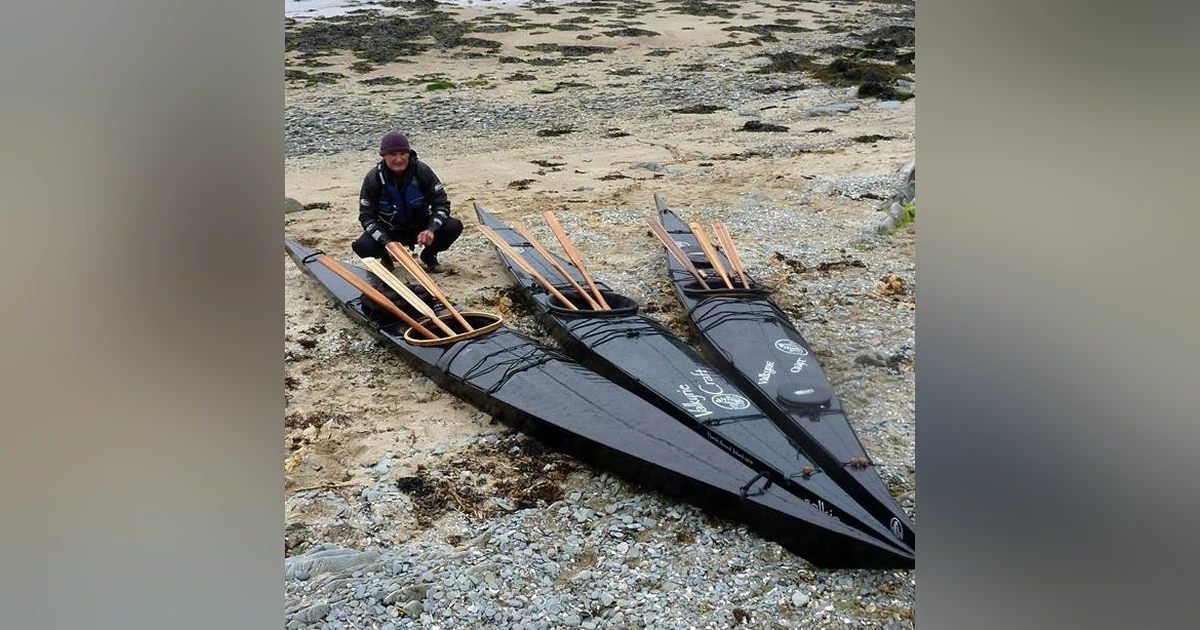
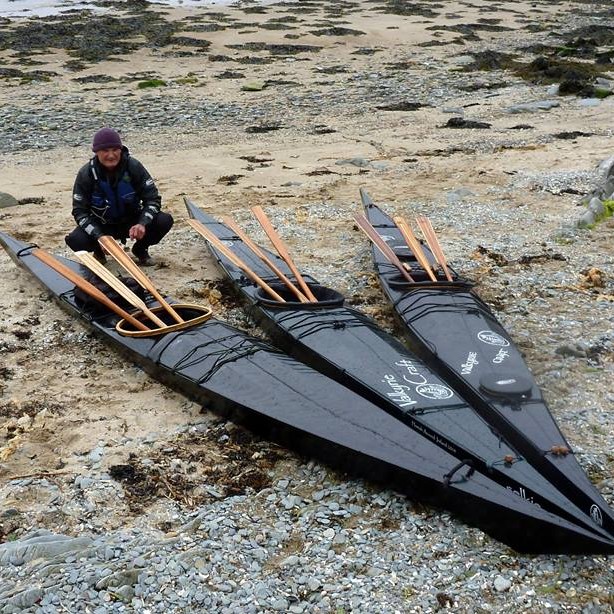
29:22 And it would be from the Labrador-Baffin region, which was on her, you know, nobody knew about this, but we discovered that that was in storage. And more recently, we've come across three beautiful examples of kayaks in the National Museum of Ireland in their storage. So we're in the process of getting those surveyed and, you know, try to find out exactly where they were made and what region they came from. But with my interest in that element of kayaking, there's a local friend of mine, John Wilkinson, who's very skilled with his hands, and he actually now manufactures commercially and you had Kayak, Greenland-style kayaks, Valkyrie craft, and he also makes open Canadian canoes in the traditional fashion.
30:12 So it's lovely having a craftsman in the area. I never had the ability to do that. I would have had an element of inspiring John to do this sort of work where he has the hands to do it, such that his son Hamish was probably one of the youngest people to circumnavigate Ireland. And he did it. Hamish did it in a skin on frame in a new style kayak. Then when I had the opportunity to make mine, John guided me through the building process. So I feel I have as authentic a boat, you know, a kayak as you probably could have. And it's absolutely delightful to paddle, you know, until you paddle a boat like that or a kayak like that.
30:58 Paddling hardshell kayaks is one thing, but you feel so much more in tune with the ocean when you're in that boat. I also have feathercraft Cazzolano, which I had that for, you know, I've had that for a good few years and enjoyed paddling it. So then to go ahead and build with my own hands literally every part of this kayak there's something unique and special about that yeah when uh never having paddled a skin on frame myself what tell me tell us about that connection that you feel and then how that's how you feel that connection yeah i think because it's so directly connected to the roots of what we know of as kayaking.
31:45 I like that and the fact that I have studied and read so much about it but until you actually feel it the different you cannot it's hard to explain it's one of these things that you actually need to experience to really understand it's silent, it moves with the sea, it, it's almost like a stealth kayak you know, you do feel like you can actually approach maybe wildlife, my kayak is black and it tones in with the ocean with our coastline it tones in colour wise, it tones in with the rocks that we paddle along and so on, but I don't know I just find it lovely it's light as well as you get older.
32:33 It's easier to put on the roof and take off the roof, it changes with the temperature you know whenever it tightens when it gets hot and it slackens when it gets cold and there's just something organic about it yeah so you mentioned Ulster and you mentioned that history and you were bestowed with an honorary doctorate from Ulster University for your contributions to the community and environmental conservation and marine history. Tell us a little bit about that, Otter. Congratulations. Over the years, whenever I started working up here on the North Coast, I actually formed a kayak club called the Causeway Coast Kayak Association.
33:23 And that was a way to keep local coaches and people and push their limits a bit so that folks weren't taking risks when they had children or young people under their watch. With that group too, we also did an awful lot of community work where we did coastal cleanups in remote areas into caves and storm beaches and things. We would have provided safety cover for. Fundraiser events like with a local raft race for the lifeboat association things like that we've been doing that for 50 years things like triathlons you know coastal triathlons providing safety cover we also provide safety cover for long-distance swimmers we had a dozen swimmers swim to rathlon and like that was quite a major you know commitment safety wise but there's been all that sort of thing going on as well as my interest in local wildlife cetaceans whales dolphins porpses and so on i suppose it was a nice recognition to get whenever i finished with training as a teacher i i said to my wife like i'm never going to go any further with academic qualifications i just want to spend my time doing things and i suppose to the the pilgrimage we did to Iona on the big cura and developing traditional sailing skills locally things like that they all pile up and it was really nice for
34:57 somebody local to be given that accolade you know it's actually handy at times sadly to be able to use the title doctor when you're dealing with authority. They do actually sit up and take a bit more notice I treat you with a bit more respect. Well, it's well-deserved for your contributions. So you mentioned the Causeway Coastline Kayak Association. And tell us about the North Coast Sea Kayak Trail. Yeah, back in 1985, when I did my coach award, you had to do a project. And I actually rode up a kayak trail for the whole North Coast back then.
35:39 But more recently then, the Countryside Access Activities Network. They formalized that and produced a lovely brochure, and you can look it up online, along with a number of other trails. We have a trail on the East Coast, we have a trail on the Foyle, which takes you up into the city of Derry, London Derry. And there are a number of inland trails as well. So, you know, there are great opportunities for people to do research. It makes it an awful lot easier for visitors coming across here. But the trail, you could paddle our coastline. People circumnavigating Ireland, obviously they pass this way.
36:21 Some of them will do the entire causeway coastline in a day, but you could actually divide it up into probably a two-day trip nicely, taking a break halfway along. If you want to explore the beauty of the area, then to explore the caves and the sea arches and so on and get close to the coast. I would allow two days, really, to do this bit of coast from McGilligan Point at the entrance of Loch Fowl around as far as the glens of Antrim. So you would be paddling the north coast and the northeast corner of Ireland. If you wanted to take in Rathlin, then you would allow a day, really, to explore Rathlin properly, to circumnavigate Rathlin.
37:06 But it's quite funny I would encounter most of the circumnavigators in this area and you'll try and say don't miss seeing the cave, the castle and the beauty and they nod and they acknowledge your advice they are happy to get your title maybe title information but then they'll just go out, directly offshore and go like a rocket to not even see the coastline yeah. But, you know, it's quite interesting. It is an interesting enough area to explore. Yeah, from what you've described, you know, you mentioned you could do it in one day, you could do it in two, and it sounds like you could do, you could take weeks and not experience the same thing in any one of those paddles.
37:54 Yeah, no, you definitely could easily spend a week up here, you know, to do each area properly. And also then to spend time, you know, you could vary your paddling. If the weather was too bad to do a section of coastline, you could always surf, spend a half a day or a day in the surf. So there's plenty to be doing. Yeah, it's funny when I've talked to folks that have circumnavigated, I often ask the question, what would you do different if you would do it again? And the most common answer to that question is I would slow down. I would take more time and really experience the coastline. Yeah, yeah. It's always been a dream of mine to circumnavigate, But I have so many different things that I suppose I put ahead of paddling.
38:40 You know, ideally, I could have paddled all over the world and explored so many different places. But I also put family as a priority. And I've been able to do a lot. I've explored a lot of the west coast of Ireland. And, you know, I love to get out onto the islands on the west coast and Connemar and Donegal and so on. But it's also important for me, for the next generation for my grandchildren, my children had the opportunity, now my grandchildren are getting the opportunities and I want to share as much with them to do that. I have also other things going on in my life regarding the sea you know, I keep an active group of traditional boat folk going, we call them dronthem boats, they're a Norwegian designer boat, so, Back about 20 years ago, they were going to be in decline and really forgotten about.
39:38 And I realized, having seen wrecks of them on some of the islands in Donegal, that this was probably a whole history that was coming to an end. And I managed to get permission off an old fisherman to take his wreck of a boat. and a friend who builds kayaks took a mould off that boat, a 22-foot open rowing sailing boat. And now we have, I think there's 17 of them in existence. So had we not taken a step back then, over 20 years ago, that particular type of historic boat would have probably disappeared. So I'm involved in projects like that and of an old sailing vessel, so quite a famous yacht that was built in 1936, and I was given permission to salvage her.
40:30 And she's actually part of the maritime history of Ireland, in that books the previous owner circumnavigated had written books about the coastline of Ireland and so on. And when Boris Yeltsin was in power in Russia, and Russia was starting to open up to the west a bit, This man actually got permission to take the yacht from the White Sea north of Norway through the canals and lakes and rivers of Russia into the White Sea, or sorry, from the White Sea to the Black Sea, and then on back round to Ireland. So after that voyage, this yacht actually foundered on our coastline, and I was given permission to raise her.
41:15 So quite a few things going on. Regarding the ocean. Now, do you sail that boat often? I do. I use her to keep up contacts with the folk in Scotland. I would have a lot of connections up in the islands in Scotland. And again, I love that because in the past, there were terrific connections between the islands of Scotland and this part of Ireland. And it's a way of keeping those connections alive. It's quite a classic old yacht. Yeah. You mentioned keeping those connections alive and inspiring the next generation to love the environment and protect what's around them.
41:59 Now, how do you continue to do that with the sailing craft as well? I'd say with the traditional boats we have, the fishing boats, tronthons, that's a great way of keeping up those connections. And because it was in boats like that, that the fishermen literally, you know, if a gale came, quite often the boats from the north coast of Ireland would get driven across to Scottish islands and people would stay with the islanders. They would stay with the folks in Scotland and vice versa, so that as Scottish men or Donegal folk, so out to the west of us as well, that often happened. If there was a westerly gale, which was quite common, boats would get blown across onto our coastline.
42:44 Families would take care of the fishermen until the weather settled enough that they could go back to their own community. So there's like a triangle. You talk about the Bermuda Triangle. We have the North Channel triangle where, you know, you have Donegal to the west, you have the north coast of Ireland, and you have the south, the islands and the inner Hebrides to the north of us. And that triangle is actually very strong because the connections within that historically are very strong. And in a way, I sort of feel like we're keeping those connections alive. During the troubles those connections were broken because it was just a risk who was going to come here you know from scotland you avoided the place people from the south of the republic of ireland didn't come north because of fear basically and now we're in a situation thankfully in the last sort of 20 years for that has settled and we're we're able to work below the radar that's what i I like is that, you know, you don't have to make a song and dance about it.
43:53 You just quietly get on with building those connections and keeping those links alive. And what's lovely is where the sea in the past was seen as a barrier. In actual fact, it's a connection, it's a bridge. And all you need is a kayak or a boat or a car to, you know, to make use of that bridge. Speaking of connections you had mentioned folklore earlier and some of the rich folklore in the area and i think you'd mentioned finn mccool well tell us tell us that story. Yep, back whenever, and it would be before written history in Ireland, really writing only came and recording of events only came with the advent of Christianity.
44:42 And that took place about 1400, 1500 years ago. So anything before that was kept in lore in the oral tradition. And the tradition was that the Scottish giant was jealous, Ben and Donner in Scotland was jealous of Finn McCool across in Ireland so in order to come and fight him he built the causeway, a footpath across the ocean over the 30 miles and whenever Ben and Donner came across on the causeway Finn's wife Una And in Ireland, we revere our women. Una, being why, saw that Ben and Donner was twice the size of Finn, her husband, the Irish giant.
45:28 So what she did was got him to get into the cot, the bed of the baby, and pretended that Finn was her baby. So when Ben and Donner came and saw the size of the baby of Finn McCool who was actually thin he then hightailed it back off to Scotland, he didn't want to fight, father, and he tore up the causeway link between Ireland and Scotland. So that's the local sort of gen on him. But there are many different... Finn was attributed with creating the Isle of Man. We have a large lake in the middle of Ulster called Loch Ney, and it's almost exactly the same shape and outline as the Isle of Man.
46:15 The legend, again, attributed to that is that Finn lifted it up. He lifted the shot of Ulster and threw it over towards Britain and it landed as the Isle of Man. So he was quite a powerful giant not to be messed with. Well, while that causeway may have been torn up, it certainly doesn't sound like the relationships between the people were torn up. So thank you for the effort that you've made in continuing those connections and continuing those relationships. You had mentioned wildlife earlier. Tell us a little bit about the wildlife in the area. Yeah, we have on Rathlin in particular, on the west end of Rathlin Island, there are superb colonies of seabirds.
47:04 And it's as good as you would see anywhere in the world, where you have razorbills, guillemots, and puffin colonies, kittywakes, and fulmer. So we have about five major species of seabirds that in springtime, in another month or so now, they'll be starting to come back in off the ocean and gather on the cliffs. And that's as good as you will see anywhere in the world. Dotted along the coastline, again, we have kittawake colonies. Guillemots and razorbills. There's a unique sort of situation at Carrick or Reed Island, which is a fishery. It's an old salmon fishery.
47:46 So this coastline would have been very famous in the past for salmon fishing, where the fish coming back from Greenland, where they fed to find their rivers that they were born in, they were netted along the coastline. And in the last sort of 15 years that fishery actually has had to close because the numbers were in decline to such an extent that the wild salmon the wild Irish salmon was under threat but certainly in the past salmon and eels the other significant I suppose marine species will have in a way is the European eel and that lake I talked about Loch Nye that Finn Macool made.
48:34 There's a very thriving eel fishery there, but the incredible lifestyle of the eel is such that it then goes off into the ocean and crosses to the Sargasso to breed. So it goes almost across to the Caribbean from Ireland to hay eggs, and the elvers then make their way back across the ocean to come back into the rivers and up in the lakes of Ireland and of Europe, which is an incredible journey. So in a way it's almost the reverse of the salmon what the eel does is in its adult form it's in the lake and as its egg stage, larval stage it's in the ocean the salmon is the opposite the salmon is born in the mountain streams and then goes to the ocean to become an adult and to grow in size but the other, I suppose on marine cetaceans We have porpoises, the harbour porpoise.
49:37 We have a local colony of those. We have bottlenose dolphins that have been coming back to the area now regularly. And, you know, all summer you have a good chance of encountering dolphins. The other part, we get gannets. The gannet comes from Scotland. There's a colony of gannets about 50 miles away. And we get them on our coastline all summer. When the weather is particularly bad, the gannets will come across a seed along our shoreline. So we see those very spectacular bird plunge diving. They'll go into a glide, hover, and then crash into the sea very spectacularly.
50:22 So those would be the main marine end of things. Of course, we have common seals, the harbour seal or common seal. And grey, the Atlantic grey as well. On Rathland, there would be quite a lot of Atlantic grey seals. Locally on the Skerry Islands, we would have common seals. So you've got cliffs, you've got surf beaches, you've got sand, you've got castles, you've got bird life, you've got marine life. What else could you ask for there? In the history of the area. In the history of the area, yeah. And amazing geology. Sounds like a wonderful place.
51:02 It is, yeah. I could do it a few more islands offshore to break the swell day on time, but you can't have everything. I mean, where I live, Donegal is only an hour and a half away to drive to some of the most, I honestly think, from a sea kayaker's point of view, it probably is the Mecca, where you have fjords, basically you have sea locks, big sea locks that are full of interest. You have committing headlands, you have offshore islands, and you have the wildlife and the history as well, but that's only a few hours away. So now we're up in quite an exposed area here, but you do have sheltered water not that far away or more sheltered water, yeah.
51:51 So if someone were coming to the area, what resources might you recommend that someone check into or are there numerous guide services in the area that can help folks out and have them really experience the area? Yeah, probably the easiest way is there are folks I have finished with guiding, but there are others have taken on the responsibility. So there's at least one local operator, Paddle North, a lad who's in the kayak club with us, Steve Smith. So for somebody wanting to paddle locally, he's probably the best contact on this coastline. This is his home ground, and he knows it intimately. And the same with Donegal, who's James O'Donnell. I forget the name of the company that he works with, but he has his own business as well for guiding up and around Donegal.
52:44 And tragically, we lost one of our top paddlers to a cruel disease, motor neurone disease. Adrian Harkin, who you may have come across. Adrian would have been probably the most able of any of the guides up in this area. But sadly he lost his life a few years ago just to that cruel disease, but one positive if I just put this in that came out of that is that his friends and his brother, his family we arranged to circumnavigate Ireland in a day but it was actually a terrific, way of bringing everybody together and we did successfully complete that for every bit of the coastline of Ireland was paddled within a 24 hour period and we linked up and a lot of money was raised for that, the Mother Neuron Society or whatever of Ireland out of that.
53:45 But no, a tragic loss, cruel, cruel disease. We lost Adrian. That was a great effort. And I wished I had the opportunity to speak with him. We were trying to connect and we did not have time, unfortunately, to put that together. Well, we'll put some of those links to resources, including the North Coast Sea Kayak Trail and Causeway Coast Club. and we'll put those in the show notes so folks can find that information and make their own connections to the area. So how can listeners connect with you? Probably through Messenger. I'm of an era where either through email or probably through Facebook Messenger or something.
54:30 I do have a Facebook page. I did have a website, but to be honest, I closed that down because it was just becoming, in a way, you know, it's quite a tie. I know at this stage of my life, value every day. And I didn't want to be tied down to commitments to guiding and so on at the time of year that now I could be sailing or, you know, taking my family out on the ocean. So I've sort of stepped aside. I'm quite happy to give advice to folks. Somebody was really stuck for a kayak or something, although most of my kayaks, I have a collection of early sea kayaks, which I've gathered up over the years.
55:16 So almost like the first model of each of the family of kayaks that were produced in fiberglass, they have a collection of those. So they're not that suitable. They're all quite, you know, ocean cockpit and that side. The kayaks that I used for guiding I actually sold off which would have been more suitable for people to borrow but no, quite an interesting collection of boats, what will happen when I go I don't know but even down to early skin on frame Percy Blandford, kayaks, I have shingles and doubles of those, I have plywood shingle kayaks and doubles I have a number of folding kayaks that were either donated to me or that I rescued.
56:01 And one particularly interesting one I'll just say to you is that a family gave me a double folding kayak, an East German design. And about 10 years after they donated it, they asked me, would I put it together and take out an elderly lady in it? And it turned out to be a fascinating story. This woman who had owned this kayak with her husband, she had grown up in Germany during the Second World War. Her husband was a British soldier. After the war she married, she was a nurse in Germany as a young teenager. As in her teenage years and early adulthood. And after the war, she married a British soldier. She came to live in Northern Ireland.
56:45 But with this kayak, she had paddled in the lakes of Poland, probably in her 70s. On her 90th birthday, I took her kayaking locally in the kayak. And she had thought that the kayak had been destroyed. She didn't know that I had it. And the family brought her to our harbour where I was sitting with her kayak built up ready to go in the harbour they brought her down and she couldn't believe it she nearly had a heart attack. She couldn't believe that her kayak was still on the go but what's fascinating is she wrote a diary as a young German girl growing up under the Third Reich which she then, the family gave me a copy of her diary which I treasure, but it's almost like the mirror image of the Anne Frank diary, which many people will be aware of.
57:43 Now, I think that lady, this is about 15 years ago. She's probably dead now. I'm sure she's passed away. But it's really interesting, you know, to have something like that. I'll bet. Yeah, a story, and to have met somebody like that, you know. Yeah. And, and for you to have been able to, to recreate that experience for her is wonderful. One final question that i have for you who else would you like to hear as a future guest on paddling the blue there's a couple of people that i have in mind who i would need to get their permission but i would love to hear or to have there's a local kayak raymond rowe who worked in the national outdoor centre in Wales, Plaza Brennan.
58:32 Raymond had a huge influence back in the 1980s through the 90s on the development of safety features in kayaks. He was also a very capable, competitive racing paddler, expedition paddler. He also edited the coaching handbook for kayaking in Britain and so on and so Raymond would be one that would have a terrific story to tell. There's another lad, Howard Jeff, who lives in Nottingham. Howard worked with Valley Canoe Products and other canoe building companies but also designed and developed his own kayaks and wrote guides to sea kayaking.
59:22 So Howard would be another, you know, from the whole fabrication sort of point of view and development of sea kayaking design. And then locally, there's a lady, Sonia Keeney. Sonia circumnavigated a number of years ago, and I would have, you know, known Sonia before that. But also to get the story of a female, you know, very capable lady paddler. And not just these people are not just paddlers but they're also good people, and you know I wouldn't recommend anybody that I didn't feel no but you know what I mean that they have real character and have contributed a huge amount to the whole development of something that I I love and That's fantastic. Thank you. Thanks for the referral. So I'll work with you and we'll make connections with Raymond, with Sonia and Howard.
1:00:17 This has been wonderful. Thank you for the opportunity to hear from you and to learn your history and your contributions to the sport. Congratulations on making those contributions. And thank you for that. And thank you for the years to come. I do appreciate the effort that you put in to generating these podcasts. And there are stories that need to be retained and told. And sadly, we have lost so much in the past. I had the privilege, because of the period that I was coming through and seeing almost a progression from canvas kayaks through to plywood, through to cyber glass, through to plastic, through now back to canvas again.
1:01:05 But also I had the privilege of meeting people like Oliver Cock who was one of the founders of canoeing in Britain and so on I actually have a, Rob Roy kayak that I managed to get that was going to be destroyed from a castle down in County Antrim and somebody managed to save that from being destroyed and passed it on to me and that was made back in 1890, literally about 1890. So I have that that I want to restore. It needs to be fixed a bit, but it's pretty much 99% intact. But all those characters, you know, through the years and the whole development of sea kayaking in Britain and Ireland, it's been a real privilege to meet folks that are now, you only see their names on books, you know, like literally the history of kayaking and so on.
1:02:02 Yeah. Yeah, for me, that's really been a fun part of this entire process is documenting that history and making sure that those stories are all heard. Yeah. Okay. Awesome. Thank you. If you want to be a stronger and more efficient paddler, Power to the Paddle is packed with fitness guidance and complete descriptions, along with photos of more than 50 exercises to improve your abilities and enjoy your time on the water. The concept and exercises in this book have helped me become a better paddler, and they can make a difference for you, too. The exercises in the book can help you reduce tension in your shoulders and low back Use the power of your torso to create leverage and use less energy with each stroke Use force generated from your lower body to make your paddling strokes more efficient Have the endurance to handle long days in the boat Drive through the toughest waves or white water Protect your body against common paddling injuries And while you're at it, you might even lose a few pounds And who wouldn't mind that?
1:02:55 So visit PaddlingExercises.com to get the book and companion DVD. Thank you, Dr. Robin Riddick, for your contributions to the sport of kayaking, your community, marine history and conservation, and for your family-first approach. Visit the show notes for links to the North Coast Sea Kayak Trail, the Causeway Coast Kayak Club, Giants Causeway, and more. And thanks again to our partners at OnlineSeaKayaking.com and now OnlineWhitewater.com for extending a special offer to you. Visit OnlineSeaKayaking.com or OnlineWhitewater.com and to the code PTBpodcast to check out and get 10% off just for being a member of the Paddling the Blue community. Until next time, thanks again for listening, and I look forward to bringing you the next episode of Paddling the Blue.
1:03:39 Thank you for listening to Paddling the Blue. You can subscribe to Paddling the Blue on Apple Music, Google Podcasts, Spotify, or wherever you find your favorite podcasts. Please take the time to leave us a five-star review on Apple Music. We truly appreciate the support. And you can find the show notes for this episode and other episodes, along with replays of past episodes, contact information and more at paddlingtheblue.com. Until next time, I hope you get out and paddle the blue. Music.


