#176 - Kayaking the Falkland Islands and Norway collecting plastic with Marcus Demuth

 Apple Podcasts

 Spotify

 Overcast

 Castro

 PocketCasts

 RSS Feed
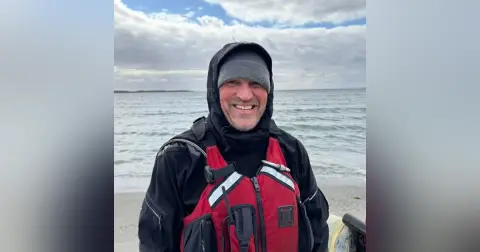
Today’s guest on the Paddling the Blue podcast is Marcus Demuth.
Marcus has amassed an incredible list of significant paddling accomplishments worldwide, from Ireland to Tierra del Fuego and so many places in between. Today we talk about his experience as the first to circumnavigate the Falkland Islands in 2009 and his most recent trip, paddling along the coast of Norway collecting plastic garbage.
00:09 - Paddling the Blue
02:12 - Discovering Kayaking
07:35 - Circumnavigating the Falklands
18:01 - Falkland Hospitality
24:08 - Norway’s Coast and Plastic Cleanup
30:55 - Microplastics and Cleanup Data
38:23 - Paddling Norway’s Rugged Coast
46:04 - What’s Next for Marcus?
47:50 - From Drumming to Blue Man Group
55:16 - Staying Connected and Future Guests
58:09 - Paddling Fitness and Farewell
0:02 Welcome to Paddling the Blue. With each episode, we talk with guests from the Great Lakes and around the globe who are doing cool things related to sea kayaking. I'm your host, my name is John Chase, and let's get started paddling the blue. Welcome to today's episode of the Paddling the Blue podcast. Today, my guest is Marcus DeMuth. And Marcus has amassed an incredible list of significant paddling accomplishments worldwide. And today, we'll talk about his experience as the first to circumnavigate the Falkland Islands in 2009, and his most recent trip paddling along the Norway coast collecting plastic garbage. Before we get to today's conversation with Marcus, James Stevenson and Simon Osborne at OnsLineSeaKayaking.com continue to produce great content to help you evolve as a paddler and as a coach.
0:47 You'll find everything from basic strokes and safety to paddling in tides, surfing, coaching, documentaries, expedition skills, and incident management, and much more. If you're not already a subscriber to OnlineSeaCyaking.com, here is your opportunity to get started. Visit OnlineSeaCyaking.com and use the coupon code PDBPODCAST at checkout, and you'll get 10% off just for being a member of the Paddling the Blue community. And for those of us who also enjoy paddling whitewater boats, be sure to check out OnlineWhitewater.com. They're offering the same discount to listeners with that same code PTBPODCAST. At checkout and explore. And I'd love to help you put those skills to work. I offer a wide range of programs in the Great Lakes and beyond, from paddling skill development, instructor and leadership certifications, workshops, CPR and wilderness first aid, guided trips, and more.
1:37 Most recently, I led a trip to Alaska, and we're working on some cool future trips as well. So visit PaddlingTheBlue.com, click the Courses and Trips link at the top of the page, and I hope to see you on the water. Enjoy today's interview with Marcus DeMuth. Hello, Marcus. Welcome to Paddling the Blue. Thank you so much, John. I'm so pleased to be here. Thank you for asking me to join. You're welcome. I'm pleased to have you joining us. We've talked on and off here for the last year or so, and I appreciate the opportunity, to have you join me and share your list of amazing expeditions. So before we get to that, what got you started as a paddler? What was it that made you say, paddling is my thing?
2:18 I was at a trade show in New York at the John Javits Center at the loading dock, taking a cigarette break. And these long trade show days, they just wouldn't end. You just had the feeling it's like 40-hour days. And I saw on that tiny sliver of river between two buildings, I saw a group of kayakers. And I thought that this is what I will treat myself when the trade show is over to a kayak class on the Hudson River, which I knew they existed. And this is what I did. I signed up for Paddle Basics 1 class with the amazing Eric Stiller of Manhattan Kayak Company.
3:03 So that was your founder, your start, your beginning. Yes. Excellent. Excellent. Now, what was the trade show? The trade show was a pro-audio trade show. I was selling microphones, German microphones in the U.S., distributing them. And yeah, it went. Some trade shows were not that great, but we gained that one customer. So yeah, I still owned a drum shop at the time in Brooklyn. But I knew from working in a drum shop in Germany that my early mornings or the mornings will not be very busy. And I thought I could do something else rather than going bankrupt and just relying on that drum business.
3:48 So I did the music distribution and I had a couple of products I was trying to sell in the U.S. in the mornings. All right, and then off paddling other than that, that's fantastic. Now, from that kayak one class, how did you grow from there? It was all with the help of Eric Stiller. And I'm pretty sure if I would have taken paragliding class or a chess course, and that coach would have been also Eric Stiller, I would be now a paraglider, or chess player. Because the enthusiasm and the teaching about the forward stroke from Eric was so, it was intense. I think Eric is a very intense person in a good way.
4:40 So we were sitting for that class, we were sitting for about two hours on the grass. And he was teaching the Olympic forward stroke to absolute beginners. So he had that Greg Barton kind of forward stroke in mind. And yeah, we were sitting there for two hours on the grass. And I loved every minute of it because it made so much sense. The mechanics and then going onto the water and all that, what we learned on the grass. And also a couple of strokes the draw stroke and the sweep stroke they work just so amazingly and surprisingly well on the water and.
5:25 And on top of that was eric stiller's fantastic support and enthusiasm for the for kayaking which made me an instant kayaker, and i thought like i need to come back i need to buy a boat and i need to get into this and a week later the season was already over at manhattan kayak but manhattan kayak had a, season ending tour for their staff for their guides it was a night circle navigation of manhattan, and eric invited me to be a part of that paddle an eight-hour paddle around manhattan at the night, when we returned at 6 a.m to the boathouse and there was a huge buffet and an open bar waiting and it was just it was really really good introduction to see kayaking.
6:17 So one week after your first class you jump in a boat and do an eight-hour night circumnavigation of manhattan yes wow as eric put me in a double with a. More experience or with an experience not more experience with an experienced paddler so i so i wasn't i wasn't doing the entire eight-hour thing on my own and he was pretty smart and. Creating a positive outcome for this amazing experience. Well, even with being with another paddler in a double, that just kind of speaks to your commitment for doing hard things as a paddler.
6:58 I mean, you've got a pretty impressive list of expeditions from the Falkland Islands to Ireland, the UK, Tierra del Fuego, Iceland, Australia, Norway, Canada, so many others. And so a mere six years after starting to paddle, you became the first to circumnavigate the Falklands. So why the Falklands? Why the Falklands? I paddled around Ireland before and did a couple of other trips. And I found that obviously fascinating, and I wanted to do another trip. And the Falklands were really interesting because there was so little back then.
7:40 This was before the internet took really off. There was very little information about the Falklands out there. I knew that others tried to go around the Falklands. The logistics were also not that easy to get a boat down there and to get food to the food drops on these islands. So it was all the preparation was a lot of fun. And when you do these preparations, you meet already a lot of people and. So and the yeah the the unknown and then no one else did it before when you go around other places, you realize in the end there are these logical places where people stop for the night and camp and you end up on these similar spots, And there was a fantastic guidebook about most places I paddled.
8:37 And I thought this would be really interesting to go around the Falklands where there's no kayaking guidebook, no kayaking blog or website or outfitter. So this was the main draw for the Falkland Islands, and the Falklands were much more. Beautiful and welcoming than I could possibly expect, both in the nature and the people I met there. It was fantastic. Yeah, it certainly is an unknown area of the world. Was that your first big expedition, or were there other larger expeditions prior to that? I was in southern Patagonia before that, which was similar remote and similar beautiful, but I didn't meet a lot of people down there.
9:29 And in the Falklands, they are also not very densely inhabited. I spent more time on some islands at my refueling stops where I had food dropped. And the islanders were just amazingly welcoming. So yeah, we had a good time. But this was the major, yeah, this and Patagonia before, where the logistics and the wildlife and the remoteness were quite a little challenging at times. Okay. So how do you get boats down there? There is a company called, I think it's called Fortland Shipping or Fortland Logistics.
10:13 And it went really, really well to get a boat shipped from Nigel Dennis Place, to the Fortlands by ship. So we had it, and it was also pretty cheap. I think it was subsidized by the UK government. And when, and this was done by email already. And then I got a phone call from that guy. And he emailed me, said, can I call you? I just want to thank you for the order. And I have a question or two. And I said, yeah, no problem. Just give me a call. And minutes later, the phone call rang. And he asked if my plan was to paddle around the Falklands, to circumnavigate the Falkland Islands with that boat.
11:01 He was shipping. And I said, yes. And his answer was, okay, I do not support suicide missions. Consider the order canceled. Wow. The problem was that the three previous expeditions ran into problems and the kayakers didn't make it. So in the end, Nigel Dennis was able to bring the boat, or Phil Clack, who used to work for Nigel at that time, brought the boat down to Southampton. And the boat was shipped with the help of Nigel on a MOD, military of defense ship, to Stanley. And it made it in time to the Falklands.
11:50 So when you say that the three prior expeditions did not make it, and I mentioned suicide missions, did they not come back or did they just not make it around? I think I know of one person who didn't survive, and I think it was mostly former military staff, which were, on the Falklands, based on the Falklands. I don't remember. I just remember that one report, but it also said that he didn't wear a dry suit. I just remember this one particular person. It was a two-man team, and one of them perished. Yes, I was thinking the only three prior expeditions, nobody came back from those expeditions.
12:41 I'm like, why would you be the fourth? But I get it. Okay. Just one in this case. So when I hear Falklands, I mean, I don't know the territory well, but when I hear Falkland Islands, I think of just a few islands, but there's almost 800 islands in that archipelago. Is that right? Yes, it's a fantastic archipelago. And looking at the map online is interesting. But when the charts finally arrived, it looked like paddling paradise with many, many islands, Very few inhabited, mostly by sheep farmers and serviced by little plains, by these islander plains, two-engine plains.
13:25 And the Falklands had always that reputation of these barren islands in the Southern Ocean. And yeah, they are quite barren. There are not a lot of forests and fjords or high mountains as in Norway, but the wildlife is just fantastic. You have all the wildlife you have. In Antarctica you experience are in the Falklands with the penguins, seals, sea leopards, orcas, whales, albatrosses. And they are all not very used to humans. So if you turn up on a beach with a lot of seals or penguins, they don't move. They don't move.
14:12 They don't run away. They completely ignore you, and you are in that incredibly rich wildlife habitat. That sounds amazing. It really does. Now, the majority of the population lives in pretty much one city? Yes, it's Stanley, yeah. Okay. And so as you're paddling, as you're circumnavigating the 600-some-odd miles around the archipelago, do you end up seeing many people? Thank you. You don't see too many people, but you know where the camps are. They call the farms the camps. So there are, it's hard to say, I would probably say there are 15 inhabited islands. So on the two main islands are about 10 camps each.
15:02 And you definitely mark the islands where you know where people live and tried to visit them in order to ask for drinking water and for weather forecast. So I probably saw in these three weeks, I was in, I think, in six different camps. So every three to four days, sometimes just for half an hour, an hour, and sometimes for two or three days to stop and to resupply. Now, with such a sparsely populated area over so many islands, how do you research that? Where do you come up with information about the islands?
15:43 This was such a long time ago. It was via Google. You just realize that they are farmers living on, let's say, Saunders Island. And then you find their email address and you email them and ask them if you can drop some food on the island, which you buy in Stanley, bring to the airport, to these FIGUS planes, government, Falkland Island, government, airline, airline. And they all agreed and were incredibly supportive. And they kind of knew when I was coming.
16:26 And they always had a bed ready and sometimes even a small cottage for me. And a meal and good advice. about the next leg. So tell me about some of the people experiences in the Falklands. In the Falklands, the people experience were, yeah, on Saunders Island. I arrived on Saunders Island which was already, was about in the middle of the trip. And two to three days before I had, I paddled into that, into a storm. The challenge in the Falklands was that I didn't have a weather forecast.
17:06 So there was no VHF radio, the reception, no regular radio, which transmitted the weather like in the UK, the BBC does. And I was also not receiving the weather otherwise. So. I was dependent on observations early in the morning. And I did that longer crossing of King George Bay and paddled into that storm and capsized and, rolled and rolled, but I was unable to get air. I was in that wave. So I had to bail out, and I was at one point a swimmer.
17:48 But I got back into the boat, made it to an island, and two days later I arrived on Saunders Island. And I lost a lot of things in that capsize, and I was a little shaken. And the Paul Evans family on Saunders Island, they repaired my skeg of the boat. I could stay there for two or three days. I lost my charts. They provided me with new charts, water bottles, and were incredibly friendly and welcoming and treating me like a good old friend. And yeah, we are still in touch, still friends.
18:30 And yeah, amazingly thankful to the Paul Evans family, but also to everyone else I met in the Falklands, like Kay and Stanley at Kay's Ban and Breakfast. And yeah, the enthusiasm and the support was just, it was fantastic. I just remember the words from the Paul Evans family, from Susan Paul Evans, that I said, like, please let me pay for the three days in your beautiful cottage and for the food, because I knew they were relying on income from tourists. And Susan said, I don't understand. You're not a tourist. And I said, I'm sure I am.
19:10 What else am I? And she's like, you're not a tourist. You're someone else. So it's interesting how a traveling sea kayaker, is perceived and not just paddling around the Falklands. The same happened to me in Ireland, where you are being invited into people's homes, also in the UK and other places. But in Ireland, I had that fantastic experience that I was invited in so many homes and made that amazing experience doing that circle navigation, which I finished about a week early before my. Flight home back to New York went.
19:51 And I decided not to change the flight, but to just stay another week in Ireland, to experience more of that generosity of the Irish. And I didn't make any bad experiences in that week, in that additional week, which I traveled by car through Ireland, not by kayak anymore. But I wasn't invited into people's homes anymore, and I didn't meet any more interesting, fantastic people. It was quite a difference. So traveling by kayak around the country, somehow the doors will open for you magically. Yeah. Interesting how as you're traveling by kayak, you become part of the community and part of the landscape as opposed to traveling through it.
20:36 Yes. It's very strange. I haven't figured out why, but you are not being perceived as that, tourist and i don't i don't know what it is maybe it's a certain pride that someone is interested in your coastline and i don't know i don't know what it is but it's kayakers and non-kayakers alike, seem to be in i don't know very receptive and helping helping that lonely kayaker or that couple of kayakers on their way around yeah that romantic nature of, of taking that kayak journey is uh inspires folks i guess.
21:18 Maybe it does. Yes. Yeah. Maybe it does. I have a new friend here in Flensburg and he paddled last week from Kiel to Flensburg, which took him 14 hours of paddling. He paddled a hundred kilometers and we spoke for two hours on the phone about that trip. And I had so many questions and And I was so energized by his account and what he did. And maybe it's that, that there's a lot of energy being transferred to other people. But I haven't been inspired and infused with so much enthusiasm lately than last week.
22:05 So fast-forwarding, past a number of expeditions, and I want to leap forward here 19 years to Norway 2026. Yes. So you just recently completed a trip. Tell us a little bit about that. The idea was to paddle the entire Norwegian coastline, but I was unable to do it because I sustained a shoulder injury, and I had just that intense pain, both on the water and off the water. But I met fantastic people on the island of Storkoria, which is about in mid-Norway, close to Trondheim. And I ended up on that island the last one and a half years, working a little bit in the restaurant and bar, hotel of the couple I met.
22:57 And I also made friends with two other couples, a Norwegian couple and a German cook and his Norwegian wife. And, yeah, I spent the last one and a half years on Stökerjahr working, kayaking, and collecting plastic garbage. Yeah. So what was the inspiration for that and the collection process? The inspiration was to... To do something else than just going kayaking and that collecting plastic. There is a fantastic article about the plastic debris problem in the ocean in the National Geographic magazine, which I read.
23:44 And then I read more articles about it, and it seemed like a really, really pressing problem. And then I heard that of all folks, the cruise ship passengers in Antarctica are being asked by guides, by the guides, when they do land excursions, that they bring back at least one piece of plastic so that they leave. It's not just that they shouldn't leave any garbage and just footprints, but that they bring back, that they leave the place better than they found it. And I found that a really, really good idea. And even better if you come back with one or two bags of plastic instead of just one bottle cap.
24:30 And in Norway, they have several organizations, starting with Ritter North, who, maintain databases for collected plastic so you can sign up and. Put a dot on that map indicating where you collected plastic and you can also load up what you collected. And so it's a huge, huge effort in Norway to get rid of the plastic on the beaches with lots of organizations. Some organizations have six boats and even work with helicopters to get the collected plastic off these remote islands.
25:14 So it's a pretty big, almost, industry, which I thought I wanted to be a part of it. So what started your interest in that? I studied physical oceanography when I lived on Anglesey, Wales. There's that small school of ocean science, a part of Bangor University. It was the problem and the question of where and why does plastic debris end up? And yeah, this was the question. And to be maybe, yeah, to investigate and maybe help coming up with some data.
26:01 But it's a pretty complex problem. We don't know why the Norwegian coast has so much plastic garbage. If you compare to Scottish or Irish waters, I would say the problem is times 10 or times 50. It's a big, big problem in Norway. Really? So, yeah, I wonder why that's the collection point. I don't know either. Maybe because it's the end from the, sort of the end of the Gulf Stream, and no one knows. No one knows. And the science of plastic garbage is, it's a pretty recent discovery. A physical oceanographer on the Isle of Man realized that the plastic debris merges with the sand.
26:52 So it gets ground down by UV light and by wave motion and that the old plastic debris. Sort of disappears on the beaches, but only to your eye. It just becomes these small, small particles, which are then even more easily digested by us and by fish and birds, etc. So this is the reason why we have so much plastic in our bodies, which may be responsible for inflammation and permanent inflammation may trigger cancer.
27:34 So there are a lot of unknowns, but it's a fact that all of our bodies have too much plastic in it and the body is not able to get that plastic out of our bodies again. Yeah, it's something we don't necessarily think about as what's inside. So can you give a definition, microplastics, nanoplastics? What's the definition? Microplastics, I think, is everything below three millimeters. So for me, microplastics are small pieces you can still pick up on the beach with difficulty. And nanoplastics is everything which you cannot see anymore with your eye.
28:19 Which makes it even more dangerous because it's in your body it's in your bloodstream it's in your cells, but it's important to pick up every piece of plastic because every piece of plastic eventually becomes a nanoplastic, It all continues to break down Yes, certainly UV degradation and wave motion And now you did this. As a member of the working group on marine litter? I did that as a part of the Redenorge cleanup effort, where you put the data of your own cleanups into that database, and you also organize community cleanups through that website.
29:02 It's a website maintained by the Norwegian government. Okay. And so tell us about that data collection process and then the group cleanups. The group cleanups, you advertise on the website and you try to, gain members, which was not that easy because Stokeria is very far off, three or four hours away from Trontown by car. So you try to get friends involved into these cleanups and you collect garbage together. And the garbage you collect since you have collected it yourself you have a pretty good idea what you collected.
29:47 So, you then go to that website. You can put in, you just put in the numbers in different categories of the objects you have found. Let's say plastic bottles, and the plastic bottles are distinguished between if they are Norwegian plastic bottles or from other countries, or if you don't recognize it, if there are no labels anymore on it. And there are maybe 500 categories of litter. You can make your mark or leave your number of how many you collected. And then you press enter and the system then also spits out how much kilograms you have collected and gives you a good total at the end of the year.
30:37 And it seems pretty precise. It's a very, very good website, a very good system. And it also encourages you to collect more and do it again and to get the numbers up. It's a very, very good system. And what I forgot to mention that the collection of the garbage, I had a lot of days where I felt like I don't feel like kayaking and then I had days where I felt like I don't want to collect garbage again. But I never had a day where I thought like kayaking and collecting garbage together is is a bad idea so i think it's a good it's a really really good combo to go, kayaking and to come back with two bags of plastic garbage on your, tied to your back deck it's a simple simple way for everybody to get involved in their in their own way is just as you're out bring a bag, Yes, yes, it's good. And people on the beach see it. They come, they're like, what is this?
31:40 And, you know, you meet people, you talk to them, and it's fantastic. I think it's a similar reward to catching fish or something. You collected something, and it's pretty good when you see a beach littered with plastic and you leave it an hour or half an hour later and it looks okay. Although you know there are still micro and nanoplastics probably between the bushes and in the sand. But it's very, very rewarding. Very rewarding. I can highly recommend it. Now, how many group cleanups did you organize on your trip?
32:20 Not too many. Four. Because of that difficulty of getting to those locations, I'm guessing? Yes, yes. And then you organize a cleanup and months ahead And it's just on an outer island or in a corner, which is not very accessible. But yeah, the best way to do these cleanups is with France rather than over the website. But the website is very active. You can see probably on any given day, you can see between 80 and 100 beach cleanups happening in Norway just on that website. All right. Well, we'll make sure to put the, uh, I'll get the link from you and we'll put that on the show notes so folks can check that out themselves.
33:04 And I would think that that data would be helpful if you're, if you're identifying the origin of that data that may help the scientists track where it came from and then ultimately how it got there. Yes. Yes. And then through your efforts on this trip, how much did you collect? How much did I collect? Last year in the main first year, my goal was to collect one ton, a thousand kilograms, which I accomplished. I think I did like 20 kilos more, which translates in about around 150 garbage bags when about two of them fit on a kayak. Okay, that's a lot. Congratulations and thank you for doing that.
33:48 No, no, it was, as I mentioned, it was really rewarding and fun. And yeah, and the collaboration with Riddle Norge, they were also very supportive. They have like their outreach officers and they were checking in and also providing the supplies. So the garbage bags and yeah you look up the garbage bags delivered to delivery points and yeah it was it was really really good and it's a lot of fun and i'm trying to see where they are i made some friends with kayakers here in kiel and we are currently thinking about how to, how to further that effort on german chores and, that how we can combine how we make the how we I can make the combination of, kayaking and collecting garbage like one thing.
34:40 Aside from the garbage, tell us about paddling the Norwegian coast. The Norwegian coast is very, very long. I think if you don't go into the fjords, it's about 2,500 kilometers. It's a long, long coastline. But you see a lot of houses on the beaches, even in the remote areas. You see farms and old fishing outposts, which are still being maintained as vacation homes. So it's very normal for a Norwegian to have a second home, which is owned by the family and given through the generations.
35:29 And that second home is quite often a former farm or maybe a fishing hut on the ocean. So you find, so you see a lot of these, the coast looks fairly inhabited, and you don't have these stretches of uninhabitation like you have in Scotland or other places. Interesting. But it's a beautiful, beautiful coastline. But homes and farms and fishing outposts dotted along the coastline. Yes, with the huge advantage that even the smallest islands with very few people living there usually have a little shop, like a tiny shop.
36:14 So I thought you need to stock up for weeks and weeks because you don't have these shopping opportunities. So you don't need to go to a larger town in order to resupply. You find these tiny tiny shops on very very small islands so it's, for a kayaker for a traveling kayaker very good very convenient now i picture the norwegian coast as being being very rugged but tell me more about the coastline itself. It's very rugged, and the amount of islands is insane. In a way, it's a kayaker's paradise. So almost the entire coast, when you paddle, you can go where you are.
37:01 You are sheltered by larger islands, so you can have that fjord-like canal in between an outer island and the mainland. And in addition to that, so you're almost always sheltered from the heaviest winds and swell. And in addition, you have these thousands of thousands, probably millions of small islands, which provide fantastic campgrounds and also a little shelter from the weather. So, yeah, it's not that flat, long, straight coastline like, let's say, the East Coast of Great Britain.
37:46 It's very, many, many islands. I would say millions of them. I would not have expected that much cover. Yes, yes. If you look at the chart you are getting, planning the trip, you think, like, this is really, really good. You might be able to paddle even in the strongest winds, except you have the headwind down in the canals and these channels. In between these larger islands and the mainland. And this is where also the ships go, the Hurtigruten ships. They travel fairly protected along that entire Norwegian coast, which probably made it also...
38:30 Or was an advantage for the fishing communities in the past and why that coastline is so densely inhabited, because it's pretty friendly for, farming, fishing, and human habitation. Well, speaking of friendly, and as you'd mentioned before with other places, there's always the goodness of people. Tell us about one of your favorite people experiences on that trip. On that trip, it was right at the beginning when I, planned the trip that I thought the idea was to paddle the entire coastline from the Norwegian border of Sweden in the south.
39:16 Up to the north to the Russian border. And there is that city of Halden, which borders Sweden, the Norwegian city of Halden. And i just wrote an email to i don't know info at holland.no and said like hi i'm that kayaker and i, i'm looking for a parking spot for my car for maybe three or four months for the duration of my trip and, in a matter of minutes i got an email back from a friendly person who said that's great, we are we are happy to help just hang on and a couple of days later she had a solution for me. I was able to park the car on a city-owned property, and the people were just amazingly welcoming and open, easygoing, and friendly.
40:08 And the same on Stokuria. Where it was quite easy, fairly easy to make friends. You get invited into people's homes for dinner, fairly easy. And yeah, it's a very open culture also because their English is just so good. So everyone speaks English very, very well. I think because most of the movies they also show on television are not being subtitled or translated. So they are watching from day one as children, they're watching English movies, in their original language.
40:49 And yeah, no matter to whom you speak, you will get an accent-free English reply and it's easy to... Easy to talk to them. Interesting. Now, you would not have expected that a majority of a country is learning its English from television programs. Yes, it's fantastic. And yeah, there's no language barrier, no matter the age of the person you speak to, even if he or she is six years old or six years old. The English flows as easily as the Norwegian. This is how it seems. So what's next for you? Good question.
41:30 I did, I became, after kayaking now for 20 years, I became a BCU or Paddle UK, sea kayak leader this summer. Congratulations. Thank you so much. It was quite a challenge, which I enjoyed a lot, thanks to Ronnie Rees of Good Tour. In Bergen, who trained me and did the assessment for me and was a huge inspiration and became a really good friend in the process. Yes. So I'm thinking about working in that field, but I haven't found that that idea hasn't gained traction yet.
42:17 So I need to I need to figure out how and if and where I want to do this. All right. Well, best of luck at doing that. And now, do you have a website for that website? Side of your life yes and no so it's still my my my old website marcusdmuth.com where i where yeah where i post about my trips and uh, a little else and um so yes but that's yeah so i thought about having a sea kayaking company coaching guiding business and yeah with the name of a sea fever which is a poem, called sea fever based on that poem and yes but i it hasn't i yeah.
43:03 I i don't know really how to where to start right now all right well i'm certain you'll find you'll find a way and i do love the logo for sea fever and uh we'll make sure okay yes, we will make sure we put we put links to your website on the on our show notes excuse me and that'll give people an opportunity to really see more about the trips that you've done and places that you've gone and see sea fever as well so, one other area of your life i'm curious about for just a moment here you mentioned drum shop earlier and i know that you're a drummer what's what's your latest project, oh my latest project is i before i went to before i went to norway i kind of closed that that chapter of my life of playing drums.
43:49 I played in these two bands, the Takanaka Club Band and the Catalina in France Band. And we played quite a lot, almost every weekend and in between. And it was fantastic, but it was a time in my life. And the drumming brought me to the U.S., to New York, and the drumming, which made me, which in New York, I became a kayaker. So I'm very grateful for that. But the kayaking and the drumming doesn't mix too good.
44:32 So I quit these bands, went to Norway the last one and a half years. So my drum kit is right now somewhere in storage. In frankfurt and i'm up here in keel and it's it's quite difficult to restart a band or build up a new band you need to find the members you need to find the repertoire, the song and then find the gigs, well i'm certain that you'll uh the drum kit will come out at some point maybe not as a as a band but for enjoyment i'm certain that uh you'll you'll find that way back i'm curious one One other piece, you mentioned New York, or, drumming took you to New York. How did you get connected with Blue Man Group?
45:16 I had a drum shop in Brooklyn, Williamsburg, which was that emerging music neighborhood. I thought I visited New York as a tourist. And when I visited these clubs, I met all these drummers. The drummers I only knew from who played the big arenas in Frankfurt with bands and like the Spin Doctors. And in New York, you met these drummers in these tiny clubs the size of your living room, and with very few people in there. And you were able to speak to these drummers you only knew from record covers.
46:01 And they were incredibly welcoming and said, oh, whenever you want to move to New York, let me know, I will help you. And this is what they did. So I moved to New York and called up Sean Pelton, well-known drummer. And he offered me his apartment. I could live in this apartment until I found one. And I wasn't able to make a living as a drummer in New York also because the competition was so fierce and the best of the best played drums there. So I returned a couple of years later after my first year in New York as a drummer, which I couldn't sustain.
46:44 And I opened up a drum shop in Brooklyn, where all my friends said, this is where you should open up your drum shop, in Brooklyn. And I thought this was a bad idea, because New York was for me Manhattan. And with Brooklyn, it didn't look that fascinating. But there were a lot of these recording studios in these old factory buildings. And you could see Bob Dylan walking down the street and David Bowie walking. Recording their records in Brooklyn Williamsburg. And this is also where a lot of employees from the Blumen Group worked. And they also supported my drum shop and bought stuff for Blumen Group at my drum shop.
47:34 And this is how I met a couple of the musicians working for Blumen Group. And they later offered me a job at the Blumen Group. Now, were you a blue man? I was not a blue man. No, I was not a blue man. All right. Interesting now that must be fascinating to be able to just be there and just see bob dylan walking down the street or david bowie walking down the street like it was a normal tuesday, it was a fantastic neighborhood yep and the all the other dramas all my other clients coming into the shop all very very good people, during that time i didn't have a job i didn't considered as a work.
48:20 I considered it as just open up the drum shop and I had a coffee machine and, we were with most of the customers. I was friends with and we had great conversations and some of these drummers made fantastic careers. So it was a very exciting time And with recording studios just around the corner, yeah, I thought I opened up my shop in an industrial wasteland and that it was a huge mistake. And then a younger guy came the day into my drum shop. I opened it up to renovate it. And he said like, oh, I have a recording studio just around the corner.
49:02 And he looked very young. And I thought like, oh, this might be some basement room. And it was that huge recording studio, Mission Sound, where the German artist Westenhagen and also Bob Dylan recorded. And yeah, it was a very exciting time, mainly due to these amazing people I met who were just incredibly interested. And like Eric Stiller, very passionate, friendly and curious. Yeah. Well, thank you for bringing your passion and your curiosity to the paddling world as well. And I appreciate hearing about your experiences and expeditions and your plastic collection and for inspiring others. How can listeners connect with you?
49:49 Good question. They can send me an email through my website, marcrustimuth.com. They can meet me in Kiel. I recently met another Kayaker who wanted to have some Advice about Expedition he was planning And we just met up, For a drink and we became Friends so yeah Starting with an email is a good Idea and I'm Here in Kiel but I might also Travel to, Scotland And Norway again next Year so all right well we'll Make sure we put links in the show notes so folks, can make that connection with you and again, learn about your other expeditions as well.
50:33 Thank you very much. One final question. Who else would you like to hear as a future guest on Paddling the Blue? Good question. I think I could recommend Ronnie Reese, that kayak coach and importer of NDK kayaks to Norway. Ronnie is based in Bergen, Norway, and he's a. Really, really good coach and also organizes the kayak symposium in Bergen for, I think, more than 15 years now. So he's that very focused BCU sea kayak coach, but also at the same time a very laid-back, friendly person who...
51:21 Really builds that sea kayaking community in Norway. So being part of that kayak symposium was fantastic. Meeting all these people, and seeing Ronnie as a driving force. Yeah, he would be a great person for this podcast. I can highly recommend Ronnie. And yeah. Super. Well, we will connect offline and make the connection with Ronnie. So again Marcus thank you very much for the opportunity to talk with you today and learn about your previous expeditions we will look forward to seeing what's next for you and for Sea Fever thank you so much John thank you for having me thank you for asking me.
52:03 If you want to be a stronger and more efficient paddler, Power to the Paddle is packed with fitness guidance and complete descriptions, along with photos of more than 50 exercises to improve your abilities and enjoy your time on the water. The concept and exercises in this book have helped me become a better paddler, and they can make a difference for you, too. The exercises in the book can help you reduce tension in your shoulders and low back, use the power of your torso to create leverage and use less energy with each stroke, use force generated from your lower body to make your paddling strokes more efficient, have the endurance to handle long days in the boat, drive through the toughest waves or whitewater, protect your body against common paddling injuries, and while you're at it, you might even lose a few pounds. And who wouldn't mind that?
52:44 So visit paddlingexercises.com to get the book and companion DVD. Marcus is an amazingly accomplished person, from paddling to music, with a rich set of life experiences and just a lot of fun to talk to. The Falklands is definitely one area we've not had a chance to talk about on the show, and it's nice to add a new place to the list. In some ways, it's a forgotten part of the globe with some really impressive range of wildlife and some welcoming people. Visit the show notes for this episode at paddlingtheblue.com slash 176 to learn more about the Falklands, find out more about Marcus Travels, learn about the Ridden Norwich and their cleanup efforts in Norway, and more. Remember, if you're not already a subscriber to onlineseekhiking.com or onlinewhitewater.com, use that coupon code PTBPODCAST to check out, and you'll get 10% off just from being a member of the Paddling the Blue community.
53:33 And as a reminder, you can find programming and trips for me at paddlingtheblue.com. I really hope to see you on the water. Thank you, as always, for listening. And I look forward to bringing you the next episode of the Paddling the Blue podcast. Thank you for joining. Thank you for listening to Paddling the Blue. You can subscribe to Paddling the Blue on Apple Music, Spotify, or wherever you find your favorite podcasts. Please take the time to leave us a five-star review on Apple Music. We truly appreciate the support. And you can find the show notes for this episode and other episodes, along with replays of past episodes, contact information, and more at paddlingtheblue.com. Until next time, I hope you get out and paddle the blue.


