#173 - Graybeard Returns: Setting records on land and water at age 91 with Dale Sanders encore


 Apple Podcasts

 Spotify

 Overcast

 Castro

 PocketCasts

 RSS Feed
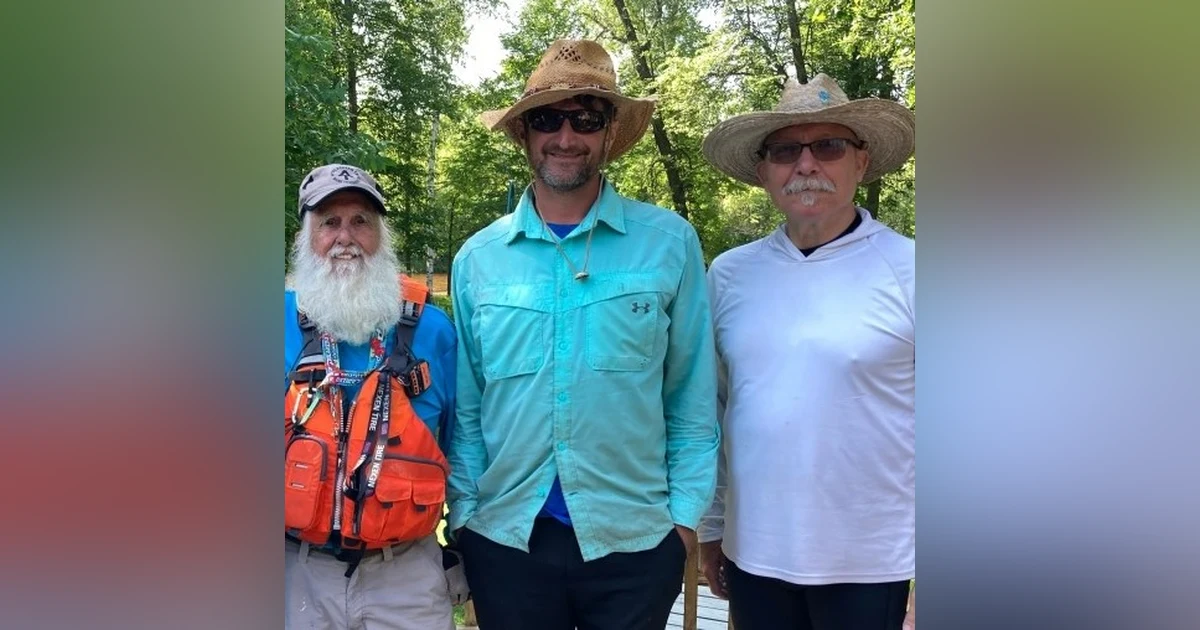
Last week, Dale "Greybeard" Sanders reclaimed his record as the oldest person to thru-hike the Appalachian Trail at age 91. For the second time. I spoke to Dale and two of his paddling companions, Dan Faust and Matt Briggs, in 2023 after Dale regained his crown, also for the second time, as the oldest to paddle the Mississippi River source to sea at age 87.
In honor of Dale’s thru-hike and his incredible perseverance, I am pleased to replay my interview with Dale, Dan, and Matt about their 87 day journey down the Mississippi River for Dale’s most recent record-setting run, at age 87. The episode covers their motivations, trip logistics, River Angels support, the challenges of low water, heat, and barge traffic, and behind-the-scenes footage captured by a film crew.
00:09 - Encore Intro
02:09 - Meet the Paddlers
04:21 - Why Return to the Mississippi
09:28 - River Allure and Differences
11:37 - Trip Logistics
13:24 - Upper and Lower River
16:11 - Daily Support Challenges
20:59 - River Angels
24:58 - Misconceptions About the River
29:50 - Hardest Parts of the Trip
31:44 - Most Rewarding Moments
35:55 - Grand Tower Breakdown
38:25 - Meadow the Mascot
40:38 - Record Finish
43:42 - Adventure Mindset
44:23 - What’s Next
46:20 - Contact and Guests
0:02 Welcome to Paddling the Blue. With each episode, we talk with guests from the Great Lakes and around the globe who are doing cool things related to sea kayaking. I'm your host, my name is John Chase, and let's get started paddling the blue. Welcome to today's episode of the Paddling the Blue podcast. Last week, Dale Greybeard Sanders reclaimed his record as the oldest person to through hike the Appalachian Trail at age 91, And that's for the second time. I spoke with Dale and two of his paddling companions, Dan Faust and Matt Briggs, in 2023, after Dale regained his crown also for the second time as the oldest to paddle the Mississippi River, sourced to sea at age 87. In honor of Dale's through hike and his incredible perseverance at both the Appalachian Trail and the Mississippi River, I'm pleased to replay my interview with Dale, Dan, and Matt about their 87-day journey down the Mississippi River for Dale's most recent record-setting run at age 87.
0:57 Before we get to today's interview, James Stevenson and Simon Osborne at OnlineSeaKyaking.com continue to produce great content to help you evolve as a paddler and as a coach. And you'll find everything from basic strokes and safety, to paddling in tides, surfing, coaching, documentaries, expedition skills and incident management, and more. If you're not already a subscriber to OnlineSeaKyaking.com, here's your opportunity to get started. Visit OnlineSeaKayaking.com, use the coupon code PTBPODCAST to check out, and you'll get 10% off just for being a member of the Paddling the Blue community. And for those of us who also enjoy paddling whitewater boats, be sure to check out OnlineWhitewater.com. They're offering the same discount to listeners using that same code PTBPODCAST to check out.
1:40 And I'd love to help you put those skills to work. I offer a wide range of programs in the Great Lakes and beyond from paddling skill development, instructor certifications, workshops, CPR and wilderness first aid, guided trips, and more. Most recently, I led a trip to Alaska, and we're working on some cool future trips. Visit PaddlingTheBlue.com, click the Courses and Trips link at the top of the page, and I hope to see you on the water. Enjoy today's Encore episode with Dale Greybeard Sanders, Dan Faust, and Matthew Briggs. Matt, Dan, Dale, thank you very much for joining Paddling the Blue today. We appreciate you coming on. Glad to be here. Pleasure's almost. So first, a big congratulations to each of you. Doing the entire Mississippi once is a huge accomplishment.
2:23 Well, doing it twice or more is just on another level. So you've each done it multiple times, and I'd love to get into learning about what brings you back to the river. But first, let's start with a little bit about your backgrounds. So, Dan, tell us a little bit about you first. I started paddling in 1969 as a tenderfoot Boy Scout. My first canoe trip was on the Spoon River. We did 100 miles that summer. It took about a week, and that got me hooked. And I've been paddling ever since then, just an ordinary, average recreational paddler. Just been doing it for a little over 50 years now, and I love it. Super. Not stopping anytime soon, so that's good.
3:05 Dale, tell us a little bit about you and your background. I started paddling in the early 50s in a professional capacity, a lifeguard and swimming instructor, canoeing instructor at the same time. And became a canoe instructor in 1954. I stayed active for several years there and then joined the Navy and had a family and didn't canoe a lot until I retired. And after I retired from the Navy Department in 2002, I'd been doing a lot of canoeing, a lot of different rivers, a lot of different lakes and went through the whitewater circuit and all that kind of stuff and still enjoy the sport. I like to canoe more than I like to kayak. Yeah. All right. All right.
3:46 So, Matt, tell us a little bit about you. I'm from Mississippi and much like Dan, I got my introduction to paddling and the scouts at a young age. First large trip was 10 days in the Boundary Waters canoe area in Minnesota with the scouts. We did 10 days. That was a great trip. It kind of lit a passion for me for paddling and canoeing. And I've just done that recreational through my life. And then the Mississippi River was just kind of always on that list of big waters and big rivers to paddle one day. So as I mentioned earlier, you've each done this multiple times. I'm curious, what keeps bringing you back to the Mississippi?
4:28 Dale, let's start with you on this one. What keeps bringing me back to the Mississippi? Well, that's a magical river, you know. And it's just really inspiring to be able to feel in my heart that I'm out there on that massive river paddling it. But there's more to it than that. My dad really feared the river so much. It was just, I mean. He was shake even going across the bridge. He was a big boatman, a big fisherman as well. But I think that had a bearing on me wanting to overcome my fears of the river because of his. And then, of course, when I paddled it the first time and I got that record as the oldest person to do it, that was kind of like, you know, it was kind of like smoking pot.
5:15 It gave me a boost to have that gave me a morale booster in other words to have that attention, I like the attention I must admit that so getting the record back was important and when I was able to get a hold of a film crew two film crews that was, agreed to do what is turning out to be a little bit more than a documentary but a full length film I jumped on the chance and I, put out the word that I was looking for paddlers. Matt jumped on it right away. And I was so happy because Matt and I have a history of working together on the trails. And then Dan came along and joined in.
5:55 And I was really, really happy that those two asked because I wanted somebody this time that was an asset. They were both assets last time. And I didn't want people to never paddle it before because I would be babysitting them the whole time. So, Dan, how about you? What keeps bringing you back? Well, I love the river, just like Matt and Dale do and lots of other people. So I was kind of hooked when I did the river the first time in 2021. And that's when I met Dale, got to sign the wall at his house. And that was a big thrill to meet Dale. And I heard about Dale doing his second record attempt this year.
6:38 And I was in. And, you know, for me, it's kind of like going along with somebody and they climb Mount Everest or cross the Grand Canyon. Or, you know, I think about being a sports fan playing in the Super Bowl or the World Series. You know, I wasn't just there watching. I was on the field playing. I mean, if you had that opportunity, who would do that? You know, to go along with a legendary figure like Dale Sanders and take part in a trip like that was an opportunity I just jumped at. I just kept bugging Dale until he finally agreed to let me go along with him. I figured it was a once-in-a-lifetime opportunity, so I just had to do it. Very cool.
7:21 And Matt, how about you? For me, like Dale briefly mentioned, we have a history on the trails together. When I met him in Memphis, when I paddled through the first time, soon after that, we undertook a pretty ambitious goal to hike a trail, basically Eastern Continental Divide Trail. It runs from Key West, Florida, up into Canada. And we'd been working on that for several years before COVID hit. We had basically hiked everything from Key West all the way to almost the Canadian border with the U.S. And the borders got shut down. So there was a couple of seasons where we weren't able to move forward on our plans to complete this trail.
8:06 So then I saw that Dale was tired of waiting around. And when he threw out that he was going to do the river, I just felt that was for both of us, the alternate next step on that goal. Because, you know, you got to go out and keep moving and keep active and maintain your physical fitness and everything to do these long distance trips of whatever type. And so that just became what I was going to do next year. I wasn't going to pass up the opportunity to continue to spend time outdoors and help Dale meet his goals and meet all the people that come along with traveling with Dale. Now, this Eastern Continental Divide Trail, do you have plans to continue that?
8:49 I would love to finish it. Matt and I could do that. And I think I can finish it, actually, to be honest with you. I think I physically can do it. I know I can do it mentally, but I'm a little bit discouraged right now because two years in a row, we had put everything together to do it, and then Canada closed the borders the first year, and the second year, they didn't reopen the borders. So it kind of discouraged me. And to be honest with you, that had a great deal of influence on me paddling the river again, because I had to come up with an alternate adventure. And paddling the river again just seemed like it fit in very nicely. Dan, this podcast is titled Paddling the Blue, but there really isn't a lot of blue on the Mississippi.
9:34 So, tell us, what's the allure of paddling a river nicknamed the Big Muddy? It's America's river, first of all. There's a huge amount of history and folklore, connected with the river. I don't know, I think I have book Dale. There's just something... Mystical, magical, mysterious, whatever, about the river. It's one of the biggest and longest rivers in the U.S. It's just unique. And I think I first heard about people paddling the river about 20 years ago. I was up in Madison, Wisconsin at Cunocopia. Byron Curtis was promoting a book he'd written about his trip down the river. And I had never even thought about battling the river before that and i found out.
10:20 Through his book and his uh talk that i got to to witness there in canoe copia that, it's it's a little bit like the appalachian trailers you know little river towns all along the river and you can resupply and meet people and it's kind of doable i would have never considered doing a long trip like that before i heard about it from through byron curtis so, yeah i mean it's it's the mississippi there's something about it i don't know what it is but as americans we identify with the mississippi sort of a magical place for me, so dale what's so different about the mississippi versus any of the other trips that you've done, you know rivers flow but the mississippi boils at the same time it flows that's one of the reasons i think it stays muddy all the time keeps turning the bottom but, the way the bottom is like it must be like a must be like a washboard because, it just boils when especially when it gets really high, and one of the big problems this year was the water was so low it was you know low water means slow water so that really slows down a lot but.
11:24 That mississippi is there's no question about it's a magical river and you don't want to make a mistake on it because if you make a mistake it'll it'll get even with you i can tell you that much so matt i understand you did a lot of the logistical planning. So what goes into planning a trip like this? I'll say as far as the logistics and running the everyday operations out there on the river, that wasn't something that I was really prepared for till we arrived at Lake Itasca. When McDale first announced he had planned to go solo down the river and have some support, and eventually changed his mind, and I jumped on board, and it was initially just he and I.
12:09 And then Dan, we picked up Dan and then the film crews and it kind of this, it kind of grew where when we got to Itasca, uh, instead of just being me and Dale going for a paddle down the river. Now we needed to have a lot more organization. And, uh, so after me and Dale had to talk, I was pleased to take over that position, but, uh, Dale had done some preparation. And so a dam, we put together a river angel list, created a sheet everybody could get to electronically, Google sheet. And we compiled all the river angels ahead of time that we knew would be available to us.
12:51 Plus, there were people that were unknown to us that were reaching out to each of us and saying, I live along the river, near the river. So we compiled that sheet ahead of time, and then Dale had his Corps of Engineers maps for the river. And those were my two greatest resources. And then just, of course, Google. And then on the lower river, use John Ruskey's rivergator.org, which is another river guide. Use those resources, and that's what most of the day-to-day planning was based off that. So Dan, Matt mentioned upper river and lower river. Can you give us a little definition of what the difference is between upper river and lower river?
13:32 Yeah, fairly officially, the river is divided into three distinct sections. The headwaters, the upper river, and the lower river, or the upper Mississippi and the lower Mississippi. The headwaters is defined as from Lake Itasca to Minneapolis, roughly. That's it. Minneapolis is where your locks and dams start. And so then the upper river will go from Minneapolis to Cairo, Illinois. The locks and dams stop roughly at St. Louis. But the Army Corps of Engineers, the way they count the mile markers or the way they designate The mile markers, it starts at zero at Cairo and goes up.
14:18 So the miles at Lake Itasca starts out, I believe, at 1341 or 1341.5, something like that. And then you count down the miles until you get to Cairo, and you get a zero. And then on the lower river, from Cairo all the way out to the Gulf of Mexico, the mile markers, again, start like 953, something like that. And they count down all the way out to the Gulf of Mexico or to mile zeroes, just a few miles shy of the Gulf of Mexico. So it's kind of a weird setup and everything, when you're out on the river.
15:01 Your location, it's all based on the Army Corps of Engineers mile markers. So when someone says I'm at 845, mile marker 845, well, you need to know if it's upper or lower because there's two mile marker 845s. So I hope that makes some kind of sense because it's kind of weird. It's kind of complicated, and it can be very confusing if someone doesn't really understand all that. Got it. Okay. So one wishing to paddle the Mississippi River will need three different sets of maps. The first one is the upper river, as Dan mentioned.
15:44 You can get those at the state of Minnesota in the Parks Department. I think it's the internal affairs department or something like that. And then the upper river maps, you get those from Army Corps of Engineers. And then the lower river maps, you can also get those from the Army Corps of Engineers. But there's several sites on the web that you can order them. Okay. So that's where those mats came in that you mentioned earlier, Matt. Yes. Okay. So, Matt, coming back to logistics, what are the biggest logistical challenges that you faced along the way? Well, we were lucky enough at the beginning to have some ground support down to St. Louis.
16:24 Marv came along with his truck and a pull-behind, teardrop-style trailer. The goal was to get reconnected with Marv every evening so Dale could sleep in the trailer if he wanted to. We were able to paddle with less gear in our boat. Lighter boat, easier, able to travel quicker and less wear and tear on your body. And so I would have to look ahead every evening on the maps, sometimes use Google and look for marinas or boat ramps or an area where we would be able to link up with Marv at the end of the day. And then that location also needed to correspond with some minimal mileage standards that we had every day in order to meet our goal to be at the Gulf in 87 days.
17:14 So there were a lot of hours laying in the tent, just bouncing back and forth and looking at what locations might work. And then at the same time, trying to keep a location in a midday, if we have to ditch, if we get into bad weather, what's kind of, what's our out, what can be our shore out remark to get to us with the support vehicle. So just working those things out in the evening. But then Marv was great. You know, sometimes I couldn't necessarily get him a completely clear picture of, say, go to XYZ Marina and we'll meet you there. We didn't know sometimes what the access was going to be like on his side from the road.
17:55 So, you know, in the mornings I would do the brief, kind of give everybody an idea of what was going to happen for the day. And sometimes I just would send Marv off with just kind of a general description of like right in this area you see on your map, there's supposed to be a ramp or it looks like there's some access by using this Google satellite imagery. Marv would then take off and a lot of times to go work out those facts for us and solve the last portion of that logistical riddle. How long did you have access to Marv? Marv stayed with us all the way till St. Louis. Okay. About to St. Louis and then we had we did Marv had to go above St. Louis and we got another guy Todd Todd came along and he's traditionally a hiker and but it heard about Dale and volunteered his time and he came and spent several weeks the last several weeks into thanks into St.
18:50 Louis with us and was great breath of fresh air and kind of funny guy and it was a nice unexpected unplanned addition to the team there to kind of get us that last little leg into St. Louis. And what did you do after St. Louis then? Below St. Louis, the river starts getting big, kind of what most people picture in their head. And at that point, you no longer have the locks and dams with their large pools to be able to hold water and control flooding. And the river starts to flood in a big way, actually just above St. Louis. So the towns are further back. they start stretching where it may be a mile or more off of the river before you get to the main levee.
19:38 And then the towns are even further back behind the levees. It's no longer possible at all in many long stretches of the river to access the river with a vehicle. So at that point, land support on a daily basis kind of becomes a mute point. And then we went to relying on And primarily river angels, people that help paddlers out and would have to use that sheet that I talked to about, the Google sheet we created, and find someone. So when we got to XYZ town every two or three days, we would have someone there who could help transport us into town or to resupply or whatever we needed to do.
20:19 So in the, let's see, what you call it, the upper river. So the part that Marv was meeting you. So as Marv would meet you and Dale would be able to get the camper and the rest of you guys got the ground, right? Yeah, it worked out, though, because, you know, kind of a trade-off is Marv could, you needed something from town or you were hankering for Powerade or particular flavor Gatorade or any kind of little town thing that you wanted to get, then you could slip Marv some cash in the morning and tell him what you wanted or what it was you needed. And, or he could bring town food to us. So it was kind of a, Dale got the bed, but we got a lot of side benefits by association. All right. All right. And Dale, Matt mentioned River Angels. So tell us a little bit about the River Angels along the way and why they do it.
21:05 Yeah, River Angels, that's kind of a trail thing as well. Trail Angels, what they call them. We're going back to that trail name. But the trail name never has caught on. But the River Angels pretty much came from the Trail Angel program. I'm one that can be credited with bringing that in. Because back in the early teens, I actually started the Mississippi River Angel Program, the first to do that. And what they do is they just help us as much as they can in situations. They bring stuff to us, as Matt mentioned, along the way. We stay at their homes.
21:45 And they help with portages as much as legal. And it's just a very valuable tool. And I'll be honest with you, if we hadn't had River Angels, it would have been much, much more difficult on us to resupply, to have a place to sleep, and to simply just get the morale boost with a good meal. There are towns you can stop and go in without River Angels support, but they are few and far between. Yeah. So why do they do it? What's in it for them? They don't get paid for it. They do it just simply out of the goodness of their heart. I'm a real grandeur myself, and I know that's exactly what it is. I've been putting up paddlers here at the house for years.
22:27 12 years now and never received a penny for doing it, so it's just just something you want to do you want to help out it's very difficult and people know that, and the river angels are aware that their help is really really extremely important a matter of fact just curiosity i i think i have the official paddlers wall of fame not the, hall of fame but the wall of fame here in my home i have Close to 300 paddlers that have signed that. All right. So tell us about that. I first started hosting paddlers around 2010. In 2011, I had several come through. One of them was a big adventurer, Dave Cornthwaite from London. He was paddling the entire lake, standing up on that board and paddling the entire lake to the Mississippi River.
23:19 And he stayed at my house. And as he was getting ready to leave, my wife, Miriam, his name is Dave Corsway. And she said, Dave, I want you to sign this wall. And we both said, oh, you know, you just painted that wall. You don't want to be painted. It happens to be in the stairwell going from the basement, the paddler's den, up to the house. And she said, yes, I want him to sign it right here. So he signed his signature right there, and he put the date on it, 9-11-11, exactly 10 years. The 10th anniversary of the 9-11 attacks in New York. So then the next paddler came through. We said, Rod Wellington. We said, Rod, sign here. The next one came through, Mark Couch.
24:01 Mark, sign here. All three of those are big deal paddlers. Mark and Rod both did the Missouri River from source to sea, almost 4,000 miles that they paddled. And since then, it just sort of caught on and people now come here just to find a wall. I've got, Several really important, well-known, named paddlers have signed a wall. And it's just full of signatures now, all the way up and down. Pretty much on both sides. I'm still saving one site for later years, but pretty much, every once in a while, a signature gets on that wall.
24:45 All right. Have you signed your own wall? Oh, yes, three times now. All right. We got to get Matt over here to finish up his signature for this last trip, too. All right. So, Dan, what's a big misconception that people have about the Mississippi? That's a good question. I know for me, the lowest part of the river from Baton Rouge on, I had a lot of misconceptions about that. My first trip in 2021, I chose to finish the trip on the Atchapalaya River. And that's how I got out to the Gulf of Mexico. And that's a great alternative and the reason i did that was to, avoid all the barge and river traffic the huge ocean going ships and things that are on the lower river farther towards the gulf that you get the more river traffic commercial big ships and barges you see on the mississippi.
25:44 So that part is true. The misconception about that, though, is that the river wasn't nearly as congested as I thought it would be. There was a lot more traffic, but there was a lot more space as well. I personally didn't feel like I was in any danger at any time as far as, you know, getting run over by a barge or anything like that. But the other misconception I had about that part of the river is that I was afraid there wouldn't be anywhere to camp. We stayed with some river angels and we had a chance to go into town. My wife was actually down there on that part of the river and supported us a little bit. So I had a little bit of an advantage on the guys. She would pick me up and take me to the hotel where she was staying.
26:29 But actually, there was pretty good camping down there. Camp spots were not as plentiful in that lower part from Baton Rouge on as they were north of there on the river, but there were still good campsites. And the fact that Matt and Dale had done the river before and done that section of the river before, which I hadn't, that was a big advantage. And of course, Matt had a huge amount of experience and expertise of finding campsites and just digging out this information just because that's what he'd been doing for the whole trip. So it worked out well. It worked out a lot better than I thought it would. So I think...
27:11 For me personally, that's the biggest misconception is that that part of the river from Baton Rouge on, you know, they call it Cancer Alley. It's very industrial. And that is true. A lot of it is very industrial. I thought it would be somewhat unpleasant and stressful part of the river. I read a lot of accounts. I did a lot of, a huge amount of research before I did my first trip. And some people did find the river to be that way. They found it very stressful and hard to deal with the river traffic and hard to find good campsites. But I didn't feel that that was true on the trip that we did this summer. But I had a big advantage in that I had Dale and Matt to help out.
27:53 And I didn't have to worry about a lot of that stuff. They took care of it all. I just had to get out and battle the river every day. So, yeah, I think that's my answer. I just think that section of the river from Baton Rouge Owens is not as bad as people have the idea that it might be. So, Matt, what's a big misconception that you hear about the river? Probably what Dan was hitting on there, that the lower river below Baton Rouge is dangerous and ugly. And to kind of put it in perspective, too, of the number of people that do the Mississippi River, a lot of people don't understand what a very small community. We heard Dale talk about the Paddler Wall of Fame.
28:35 And he said, you know, it's been 10 years and he has about 300 signatures. So that's 30 people a year. Quite a few of those folks that paddle have signed Dale's Wall weren't even going the entire way source to sea, as we say. So it's a very small community of paddlers. And I would say that's a large misconception within that group. And then that tends to, I think, get spread some that it's just not safe or beautiful or whatever down there. And another one is just that the river's a super big, dangerous place and that the barges are super dangerous, which, I mean, the river should be respected. It can be and will be a dangerous place if you don't respect it and you don't keep your bearings at all times.
29:22 But there's lots of room for the most part out there to maneuver. And most of the river traffic is moving at five miles an hour or less. You know, we're paddling at a low rate of speed. Nobody wants to run into anybody, so you have, for the most part, a lot of time to react. Most situations evolve very slowly, so long as you're attentive to your surroundings and what's going on, then it's really not very high risk. Dale, what did you find to be the most challenging part of your trips down the river? Well, first of all, I would say, let me just say something about the barges. The barges are not a problem. All you got to do is stay away from them.
30:07 And the most challenging thing for me, of course, was my hearing problem. If somebody were to ask me, well, one thing you wish for, I would say better hearing aids, because I couldn't participate in any on-river conversations at all, because I can hear through these hearing aids pretty well if I can read lips at the same time. People put masks on, I have to tell them, you want me to hear you, take your mask down. So that was my biggest problem was inability to hear. And of course, it was more difficult this time than it was. I thought it would be easier because I knew the river, but it actually turned out to be harder for me this time than last. I think there's four things there that contribute to that. One is the water was very low, and low water means slow water, which means that the current is not helping us.
30:57 And we had a lot more days of real serious hot weather this time than we did the first time. I mean, we probably had a month of days where the heat index was around 100. So when you're out on the water and it's close to 100 degrees and you've got the sun reflecting off the water, it's just terrible on the body. And then the other third thing was that we had a lot of headwind. We had a lot more headwind this time than we did the first time I paddled it. So you put those three things together with the fact that my hearing was bad and it just made it really harder to paddle. And of course, there's one other factor. I was seven years older. Only seven, though.
31:45 So what's the most rewarding part of paddling the Mississippi for you? There's so many things. Of course, and that final day with my family there was really, really extremely rewarding. I think I was really impressed with the film crew, too, and the amount of footage, the movie quality footage that they gathered and accumulated. And it was really a blessing to have two and then three paddlers with me, especially with Matt and Dan, that have paddled the rivers before. That was really an asset, having that experience with me. Instead of me having to babysit them, they were babysitting me.
32:28 As a matter of fact, if it hadn't have been for Matt doing the daily planning and keeping us on track there, I would have been in a lot more miserable situation than it was. And I was pretty relaxed and comfortable because I didn't have to worry about planning those day-to-day routines. And he was carrying the brunt of that in his heart. He was carrying the brunt of that responsibility. And then Dan helped tremendously with his internet and computer work. I don't know if you've read Dan's blogs or not, but they're still up there. People might want to read the Dan Pau's blogs because they are really worth reading. Yep. We'll make sure we have a link to Glory Days as well as your website, Dale. We'll put those in the show notes.
33:13 So, Dan, what's the most rewarding part of Paddling the Mississippi for you? Oh, like Dale said, it's a million things. But for this trip, if for sure, for me, I got to witness history being made. I got to spend time with one of my heroes, Dale. I got to know him a little bit. Like, you know, he was a hero. Now he's more like a friend, which is just super rewarding thing. You know, I did the trip solo in 2021, and that was great. It was a great trip. Can't take anything away from that. But honestly, and I'm kind of a solo paddler guy.
33:55 I like to do things solo and whatever happens to be outdoors, big trips or anything. And doing this trip with a group was unbelievably rewarding. I definitely think it's more of an accomplishment, at least in my mind. It's to have three guys that stick together for the entire trip from day one all the way to the end. It's harder than you might imagine. I read as many accounts as I could about these trips and even the backpacking trips and stuff because there's not that much out there written about the Mississippi. But probably, I would say 70 or 80% of the accounts I read, the groups broke down at some point.
34:40 And a lot of the times they split up. It was some irreconcilable differences. And we had our challenges. We had our rough days. You're out there. You get tired. You get hot. You get dehydrated. You get cranky. Things happen. People are human. But we always recovered from that, and honestly, quite quickly. The lowest day on the whole river for me personally was the day we got into Grand Tower, Illinois. We were at Devil's Backbone Campground. And I was ready to quit. And Matt called a meeting immediately as soon as we got to shore and turned that situation around in about two minutes, literally.
35:28 I went from a low to a high point of the whole trip for me. And I never questioned whether or not I was going to finish the trip with these guys after that. No question in my mind. So for me personally, this was the biggest accomplishment I've had so far. In my life doing anything like this, a bigger accomplishment than my first trip going solo. I can't even explain how rewarding that is. So Matt, tell us a little bit about that moment in Grand Tower, that meeting that you call. That day started out pretty much like any other. Paddled down the river and then there was a little miscommunication that morning on what stops we were or weren't going to make.
36:13 There were a couple of places where it might have been possible to access. And then we had really high winds that day, which made communicating even more difficult when you're out on the water. I don't know between fighting we were fighting fighting the river and the wind that day which puts everybody on edge there were a couple little back and forth on the water nothing nothing major but coupled with the current conditions on the water and then coming into devil's backbone the river comes down a straight stretch and it really the water picks up momentum, and it rams into devil's backbone ridge it's a big uh rock ridge naturally occurring that just kind of blocks the river and turns it at.
36:55 Almost over 90 degree angle. So that kind of was culminating at the peak of the end of the day, had all those factors coming together. So when the group hit the beach, there was just an incredible amount of tension in the air and amongst us and just kind of a feeling of everything coming on you all at once. And it was like, man, I just normally out there on the river, you're very relaxed for the most part, not a whole lot to worry about. So when you do get tense, it's much more heightened effect when outside factors are stressing you. And that was kind of where everybody was at, I believe, in their headspace at that moment. Brought everybody to shore and said, hey, before we run up here in this campground and start this whole other stressful situation, I just, you know, I want to apologize for my part in anything today.
37:46 And, you know, let's just bury this hatchet and go up this hill and find us a place to camp and have a good rest of the day, basically, just a kind of a little pep top and talk. And everybody just came together in that moment and recognized we were all sharing that moment and kind of blooming in our emotions at that moment. We all kind of came together and had a good group hug and reset that energy between us and boom, then walked up that hill and had an amazing experience. On the spot, River Angels went to town and bought us food and drinks and all that and turned that day around from that moment on. So, Dale, you had another guest on the trip. Tell us about Meadow.
38:31 Oh, Meadow. Tell us about Meadow. Oh, yes. Meadow was our, when we started off, she was our fourth person, you might say. But she's not really a person. She's a dog. A little Pomeranian, Matt brought his little Pommy along, and her name is Meadow. And she became the mascot. Not only the mascot, but she was, that dog could tell when somebody was depressed or was having some difficult time. She would come to them and just sit down in front of them or curl up beside them and lay down.
39:12 She was really a morale booster. I'm telling you right now, I am so delighted that Matt brought Meadow and Meadow became a member of our team. So, Matt, tell us about Meadow. She joined you for the whole trip? She did. She's about three years old, and she started accompanying me on long-distance backpacking trips when she was less than a year old. Last year, I had a pretty big year. I hiked. A little over 4,000 miles total last year on several long distance trails. And I left her behind with some friends and she had a great, great summer as did I.
39:53 When I came back home and I picked her, realized that that was the one regret I had about this epic summer was that I didn't have her with me, and just kind of promised her and me that whatever, wherever I go on my adventures in the future, she's, she's coming with us. She's a trooper. I don't have to worry about her. I can let her off leash. She doesn't go more than about 50 yards away, so you can set up camp and do your thing. We could do our thing, and she could go down the other end of the beach and visit with Dan and Dale. She's very independent, but she loved it. At first, she wasn't too sure about the canoe, but she settled right into her role.
40:38 Dale, September 8, you land on the beach as the world record holder again as the oldest person to paddle the headlong to the Mississippi River. What was that moment like? That moment, it's really, even trying to think about it to explain it, how important it was and how hyper it was and how exciting it was, it almost brings tears to my eyes because it's just very difficult to put into words. It's totally for it. in some way of expressing that. I mean, the satisfaction that you get from accomplishing, a long-distance and difficult adventure that takes several months to do is just overwhelming.
41:24 Unless you have done some type of adventure in that category before, I doubt very seriously if you could really understand the significance of the last day, of the finish line. That's all I can say. It's just overwhelming with joy. Dan, how about you? Yeah, you know, it was a dream come true and you had this goal for 87 days and you finally get there. It's a little bit surreal and it was great. A lot of times what I'd read about with other accounts, you know, people get down there and they're all alone on the beach. Maybe they have hired a fishing boat or somebody to come pick them up or a river angel of some sort or something. but it's not your family, it's not your close friends, your paddling partners or what have you.
42:17 And it's a little bit sad to read about that. Our experience was completely different than that. So we had a whole group of paddlers who had done the river. And I mean, I think there was four or five of us there who had done the river before. And one first time paddler on the Mississippi did the whole thing when he got there. And then, of course, we had friends and family who'd come out on the fishing boats who were prepared to take us back and had a little party there just for a few minutes. It was fantastic. It was a lot to take in, a lot of emotions. It was kind of overwhelming, but it was a very happy occasion.
42:59 It puts a big smile on my face right now just thinking about it. It was just unbelievable. Good. How about you, Matt? I would say overwhelming sense of satisfaction and relief, kind of like if you were doing a big project around the house or at work that you'd been working on for a long time and, you've enjoyed it and it's been rewarding in its own way. And then when you finally finish that project and you step back and it's over with this, you know, weight of responsibility kind of lifts off you. And is replaced with the overwhelming sense of satisfaction. Cool.
43:43 I like Matt's response. Yeah. Dale, let's switch away from paddling for just a moment. So you hold the record as the oldest person to do the rim-to-rim-to-rim of the Grand Canyon, the oldest person to do the Appalachian Trail, and for the second time, the oldest person to paddle the length of the Mississippi River. So what's your message? If you want to do a long-distance adventure, either in terms of mileage or in terms of number of days or years it takes to do that adventure, that's fine. That's great. But if you don't have it in your heart, if you're not willing to eat it, live it, and sleep it, don't do it.
44:23 Good message. So what's next for you, Dale? Well, next, as we're going on tour with the film, the next big thing that I'm looking forward to, I'm actually excited about, is, God willing, and the creeks don't rise, I'm very seriously considering doing the Appalachian Trail again. And especially if I can put together a support crew that Nemo Will Nomad had when he broke my record, I'll do the Appalachian Trail again at 90. All right. You heard it here. So, Dan, how about you? What's next for you? You know, I have no idea, John. I just have had that question a couple of times, and I tell people, if the river taught me anything, it's to take life one day at a time.
45:10 And so I'm just going to see what life brings to me. I might do another trip on Mississippi. I might get that two trips in in one year that I've dreamt about. I might try some more backpacking. I'm not really much of a backpacker. I'm a newbie backpacker. I've made a lot of the newbie mistakes. I hope I got that behind me. Maybe I can learn a lot. I did learn a lot already from Dale and Matt. Those guys, they know what they're doing out on the trail. You've certainly got some expert mentors there. Yeah. Couldn't ask for any better mentors than Dale and Matt. So I don't know. We'll just see, see what happens.
45:51 All right. How about you, for me i guess the next big one's going to be go out and hike the pacific coast trail in the hiking world that was called triple crown which is to hike the appalachian trail the continental divide trail and the pacific coast trail that's the last one on that list so that'll that's next up for me cool, and matt will be a triple crown holder when that happens, that's very cool very Very cool. All right. So how can listeners reach you and learn more about the Mississippi River and your adventures? And I'm going to start with Dan. Probably the best is my blog. And that's danofaust.wordpress.com.
46:35 D-A-N-N-O-F-A-U-S-T.wordpress.com. Matt, how about you? The best way to contact me is to email at matthew.briggs1 at yahoo.com. Super. All right, we'll get that in there. And then Dale, how can listeners reach you? Well, you can find some information on my website, graybeardadventurer, that's an E-R on the end, dot com. And go to my Facebook page, which would be Dale Graybeard Sanders. But the best updates would be the actual Facebook page itself. Graybeard the documentary. And that's where you can get some real good information on activities that are going on related to our panel.
47:23 Great. Well, we'll look forward to seeing that documentary come out, and we will make absolutely certain we get that out as well and share that with the listeners. The name of the documentary, and that's going to be a full-length film, 90-minute film, and it's going to be called Graybeard, The Man, The Myth, Mississippi. Wow. All right. So one final question is a question that we ask of all of our guests here on Paddling the Blue, and I'm going to start with Dan on this one again. Dan, who else would you like to hear as a future guest on Paddling the Blue? Ellen Falterman, also known as Ellen Magellan. She's a remarkable young lady, and she's done the Mississippi River, the Missouri River.
48:05 And now I think she's embarked on a multi-year trip to row around the world. So remarkable young lady. Cool. Well, we'll connect with her as well. Matt, how about you? For me, it's going to be the Bromanshankels in northern Minnesota. Sandy and her husband's name escapes me. But the Bromanshankels, they're a set of river angels that live right on the river in Minnesota. And they are a vital resource. They help with portaging around some dams. They shuttle paddlers up to the headwaters.
48:45 You know just super super active giving you know full-time job for both of them this past year with the with the boom of paddlers we've had and they just give endlessly great folks, cool thank you and dale how about you who else would you like to hear as a future guest on paddling the blue. My two sponsors i have to mention both of them because i as well as a film crew, and and of course, the paddlers as well. But my two sponsors really deserve credit. And that would be Immacore Medical out of Canada, Hans Christensen, and Lori Underwood Wells.
49:26 Between Lori and Hans, they have made this whole process possible. They're wonderful sponsors, and I think they would be good guests. Okay. All right. Well, I appreciate that. Well, thank you very much. I appreciate all of you joining us today. This has been a great, great discussion. I've really enjoyed hearing about your time in the Mississippi River multiple times. And again, congratulations to all of you. Congratulations to Dale on your record-setting accomplishments. Thanks, Chad. Thank you so much. Thank you. Thank you. If you want to be a stronger and more efficient paddler, Power to the Paddle is packed with fitness guidance and complete descriptions, along with photos of more than 50 exercises to improve your abilities and enjoy your time on the water.
50:12 The concept and exercises in this book have helped me become a better paddler, and they can make a difference for you too. The exercises in the book can help you reduce tension in your shoulders and low back, use the power of your torso to create leverage and use less energy with each stroke, Use force generated from your lower body to make your paddling strokes more efficient. Have the endurance to handle long days in the boat. Drive through the toughest waves or whitewater. Protect your body against common paddling injuries. And while you're at it, you might even lose a few pounds. And who wouldn't mind that? So visit paddlingexercises.com to get the book and companion DVD. Congratulations to Dale on his most recent record-setting through hike. He is now the oldest person to not only through hike the Appalachian Trail at age 91, but, of course, to paddle the entire length of the Mississippi River at age 87.
51:00 He's quite the inspiration, and I look forward to what comes next for Dale. If you're not already a subscriber to OnlineSeaKhiking.com or OnlineWhitewater.com, use that coupon code PTBpodcast to check out, and you'll get 10% off just for being a member of the Paddling the Blue community. And as a reminder, you can find programming and trips for me at PaddlingTheBlue.com. I hope to see you on the water. Until next time, thanks again for listening, and I look forward to bringing you the next episode of the Paddling the Blue podcast. Thank you for listening to Paddling the Blue. You can subscribe to Paddling the Blue on Apple Music, Spotify, or wherever you find your favorite podcasts. Please take the time to leave us a five-star review on Apple Music. We truly appreciate the support. And you can find the show notes for this episode and other episodes, along with replays of past episodes, contact information, and more at paddlingtheblue.com.
51:49 Until next time, I hope you get out and paddle the blue.


