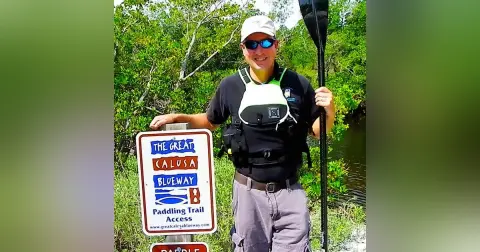
#155 - Paddling Florida's Great Calusa Blueway: Mangroves, Mounds & Manatees with Mike Hammond

 Apple Podcasts

 Spotify

 Overcast

 Castro

 PocketCasts

 RSS Feed
Mike Hammond oversees the Great Calusa Blueway, a nearly 200 mile paddling trail in Florida’s Lee County. Mike joins today’s episode to talk about the area’s fascinating indigenous history, its interesting utopian history, the beauty of the trail, and why this might be your next paddling destination.
Highlights include the region’s unique subtropical wildlife (manatees, dolphins, shorebirds), the Calusa people and shell mounds like Mound Key, the Koreshan historic site, protected mangrove tunnels, safety considerations, volunteer stewardship, and inclusive outreach programs.
- Great Calusa Blueway: https://www.leegov.com/parks/Blueway
- About the Calusa Tribe: https://www.floridamuseum.ufl.edu/earth-systems/blog/tell-me-about-the-calusa-tribe/
- Who were the Koreshans?: https://en.wikipedia.org/wiki/Koreshan_Unity
00:09 - Welcome to Paddling the Blue
01:21 - Introducing Mike Hammond
03:22 - The Great Calusa Blueway
04:09 - Project Origins
06:27 - The Trail Experience
09:00 - History of the Calusa
10:26 - Favorite Trail Spots
12:29 - Sea Turtle Walks
14:29 - Calusa Engineering
16:47 - The Calusa’s Legacy
17:52 - Managing the Trail
19:27 - Outfitters and Partnerships
21:18 - Vetting Outfitters
22:20 - Unique Wildlife
24:40 - Safety and Respect
27:16 - Unique Trail Experiences
29:32 - Trail Accessibility
32:19 - Driving Tourism
33:49 - Festival Evolution
35:11 - Event Information
36:07 - Weather Considerations
38:50 - Trail Funding
40:27 - Starting a Water Trail
44:31 - Favorite Stories
45:57 - Educational Programs
47:48 - Closing Remarks
0:01 Welcome to Paddling the Blue. With each episode, we talk with guests from the Great Lakes and around the globe who are doing cool things related to sea kayaking. I'm your host, my name is John Chase, and let's get started paddling the blue. Welcome to today's episode of the Paddling the Blue podcast. Mike Hammond oversees the Great Calusa Blueway, a nearly 200-mile paddling trail in Florida's Lee County. Mike joins today's episode to talk about the area's fascinating indigenous history, its interesting utopian history, and the beauty of the trail and why this may be your next paddling destination. Before we get to today's conversation with Mike, James Stevenson and Simon Osborne at OnlineSeaKyaking.com continue to produce great content to help you evolve as a paddler and as a coach.
0:45 You'll find everything from basic strokes and safety to paddling in tides, surfing, coaching, documentaries, expedition skills, and incident management, and their newest course, Greenland Rolling. If you're not already a subscriber to OnlineSeaKyaking.com, here's your opportunity to get started. Visit OnlineSeaKyaking.com, use the coupon code PTBPODCAST at checkout, and you'll get 10% off just for being a member of the Paddling the Blue community. And for those of us who also enjoy paddling whitewater boats, be sure to check out OnlineWhitewater.com. They're offering the same discount to listeners with the same code PTBpodcast at checkout. Enjoy today's interview with Mike Hammond. Hi, Mike. Welcome to Paddling the Blue. Hey, John. Thank you for having me.
1:28 Absolutely. Absolutely. So you oversee the Great Calusa Blueway, and that's what we're here to talk about today. So tell us a little bit about, well, first tell us about you as a paddler. Oh, okay. I guess I started paddling. Actually, I wasn't the paddler. I was the passenger in the bottom of a canoe up in Lancaster County, Pennsylvania. My dad was very involved with the Lancaster County Canoe Club. He was a whitewater paddler, ACA instructor. So since the time I was little, it was open canoes, trips to the boundary waters, Canada, Adirondacks, just going out and camping for a week with my mom, dad, and little brother.
2:09 And then after that, my dad would go whitewater paddling. We couldn't keep up with him, but he'd take us on trips. And it was, since I was little, it was open canoes, kind of went to kayaks and now it's it's kind of a lot more paddle boarding than anything all right yeah we talked about that earlier um off air and we'll talk a little bit about why that is and to some degree but so it's in your blood then yeah it's it's definitely my blood it was it's one of those things i'm not sure i didn't appreciate it as much when i was little but just those trips when you just go out you know for a week onto the lakes and just out on the water and just whatever you have is what you have it just it was just such a great great experience and just really did it formed who i am and i kind of i came back to it i came back to it in my own way, yeah paddling and my dad still paddles he's still one of my volunteers my mom's still volunteers comes out and helps some cleanups and.
3:06 It's amazing. My dad built a kayak with my little girl. It's still, it's in the family. That's very cool. Very cool. So those formative years led you to decide to make paddling, to some degree, your life's work. So tell us a little bit about the Great Colusa Blueway. Well, the short answer. I'm glad we have time I can give you the long answer. The short answer is the Great Colusa Blueway. It's a 190-mile paddling trail here in Lee County. and Lee County's in Southwest Florida. So the trail has markers out on the water, but we also have paper maps, the digital maps, website. We have an app, you know, Facebook page, events.
3:48 So it's really is, we, the paddling trail makes it easy for people to plan their trips up, north and come on down and, and just, you kind of know what you're getting into and can see all these great spots to paddle and to put in and what to expect, points of interest. It really is. It's an awesome thing that we have here. Cool. Now, how did the project start? However, so I came down about 21 years ago and I actually, I got to help with phase two, but phase one started in 2001. Somebody who worked for the parks department and now she's with our visitors convention bureau, Nancy McPhee, wonderful person.
4:29 She recognized how, what a beautiful area we had for paddling and what an attraction would be. Wanted to make it accessible for everyone so she started working on putting together the great colusa blue way paddling trail and again when i came down i got the help i wasn't really helping again i was probably just a passenger you know in the boat but they were setting up where the trail was going to go getting the markers up and once as they did we had a big festival and it was it was it was really cool but it really was created so people could get on the water and know where you can launch, where all the cool things are to see while you're paddling. So it was created by somebody within the Parks Department.
5:11 All right. And you said it was the Lee County Parks Department that created it? Yes. Okay. Yep. And it's really supported. It's by the Visitors Convention Bureau as well. They worked hand in hand, so much so that they actually recruited Nancy over there. She's still there. Okay. All right. Now, did you look at different models or did the Parks Department and the tourism body look at different models to create the trail? How did the idea come about? I think part of it, so there are other, obviously there's the main paddling trail. There are other trails that are around. I think what makes ours a little different is we incorporate more of, people can stay at some of our historic inns and some of the places along the water.
5:55 There are primitive campgrounds, but we also wanted to pull in some of our other places that could say that if you're not necessarily camping. But they did, also the Florida Paddling Trail Association, they were looking at connecting us with the rest of the trail that goes around Florida. But our big thing was keeping people away from an issue we would have that you might not have in some of your other paddling trails. We don't want people to be close to boat traffic. So we have people, our trail will tuck away back behind the mangroves and you feel like you're far away from civilization. Then you pop out and you're right next to your hotel. okay yeah so what would somebody experience along the way you mentioned mangroves so you know tell us about the trail sure so that this is where we can really get into the trail there are so many different parts and cool things about the trail that i love the mangroves i do love going through the mangrove tunnels you are just totally engulfed in nature you look to the side there's a little crabs.
6:55 You look under the water, there are the fish, the snappers. There's all kinds of, the life is all around you. The birds are right next to you. But it really is, if I can, I might say people, a lot of times they start their trip in one of our state parks, Koreshian State Park. And our park, it was actually owned by a cult at one point or a unity, the Koreshians. So a lot of paddlers start there. You start at Koreshians State Park. You camp. It's a wonderful campground. And you get on the Estero River. But the cool thing about that campground is they still have 11 historic buildings.
7:35 And the Koreshians, when they came down from Chicago, they were different. They were very different. They actually own a big chunk of Estero, a big chunk of Fort Myers Beach, and their history is so interesting. So you can kind of start in this very cool historic campground, get some weird Florida history, paddle down the creek that has live oaks going over top of it, come out into our bay. And then you have the Calusa Paddling Trail is named after the Calusa, our first indigenous water people here. And you paddle to what was their capital, Mound Key. It's 125 acres that the Calusa made themselves with shells.
8:18 So it's pretty incredible. You can go into this island and then from there, you paddle over to another spot where the Calusa had one of their mounds. You're seeing dolphins, manatees along the way. We've got other state parks where you paddle. The only way you can get to is by boat. So really, it's a cool subtropical because we are, we're way down here in Florida. You get to see cool stuff. you really don't get to see in other parts of the United States. Some stuff you don't get to see in other parts of Florida. As you're describing some of these things, which just makes it sound amazing, some of those are things that people probably don't normally think about when they think of Florida.
9:00 Yeah, I don't think people think, so just the Calusa alone, and we could talk about hours about that. So they were our first people. They had a huge, it was a kingdom. It wasn't a tribe. It was a kingdom. People, other tribes did have to pay tribute. They had a hierarchy. It was hereditary. they ruled. In fact, Ponce de Leon, they're the ones that they got an arrow in a Ponce de Leon. He died in Cuba. They were tough people, but their history is everywhere. When you paddle the trail, you can see their capital, see the island. You paddle to the mound house on Fort Myers Beach. And you see there, that's the oldest house on Fort Myers Beach. And it did the best in the hurricane because it was on the mound in Hurricane Ian a few years ago.
9:46 But actually, when they dug up the pool, you can see what's inside the Calusa mound. So it's really cool. You can paddle from history to history to history. And it's right there. And I don't think a lot of times people don't think about the history of the indigenous people in Florida, the Spanish, when they were here, the Spanish fishermen, the Calusa, I'm sorry, not the Calusa, the Corretions and just how different everything was. But to me, that's what the Calusa Blue Way is. it ties. That's how people got around on the water. The Colusa Blueway ties all this history and the wildlife and the environment together. That's what the Colusa Blueway really is. That's really cool.
10:26 That's really cool. So what's your favorite part of the trail? It's kind of like saying your favorite kids. I do have a spot and I think it's my favorite. I'll explain why. Bunch Beach. Bunch Beach is our only, it's a mainland beach. It was actually a segregated beach. So African-American families is the only beach they were allowed to go to in the 60s, which is crazy because our barrier islands like Sanibel, the other islands where people farmed out there, it was very mixed and everyone got to go to. along fine. It wasn't until later that areas got segregated. But Bunch Beach is one of the best birding beaches in Florida, in all Florida. And part of the reason is because it's a mud flat.
11:11 So on low tide, we've got birds, people from around the world come to see our birds at Bunch Beach. It just has amazing things we take for granted, like spoonbills. Which a lot of people confuse with flamingos. Some of the things that we have for migration, some of the things that regulars, they're there. They're there all the time. But also I'm a special Olympic coach. So it's a pretty protected body of water. So it's where I've been coaching stand-up paddleboarding for the special Olympics for years. So that's made it really kind of near and dear to my heart. And since my, we haven't done in the last couple of years, but my son, he wasn't quite a year old. We started doing sea turtle walks for an organization that monitors sea turtle nest.
11:56 And we did that for years so he kind of grew up walking that beach at least once a week during sea turtle nesting season so it was my it was our one-on-one time we had a lot of cool adventures and, lots of meaningful talks out there so bunch beach is one of my it's one of my favorites for sure and it also has those mangrove tunnels i love so much so you can paddle in the mangrove tunnels when it's windy and see all kinds of wildlife have a great experience you can go out more into the bay. You can paddle over to the beach. It's just a really cool spot. Tell us a little bit more about the sea turtle walks. The sea turtle walks? So from May till I believe it's November 1st, it's sea turtle nesting season in Florida.
12:40 We usually get, for the most part, it's the loggerheads. So now Bunch Beach, as excellent as it was for wildlife, it was not the best sea turtle nesting beach because it was our mainland beach. It wasn't a wide sandy beach. So sometimes the nest, if we did have one, they'd have to be relocated. Our islands of Sanibel, which Sanibel is known worldwide, Captiva, Fort Myers Beach, which is a sterile island, Benita Beach, all of our barrier islands, Cayacosta, they have lots of sea turtle nests. And it's kind of more appropriate because the turtles can get up a lot further away from the water, lay the eggs, versus Bunch Beach is more of a shallow mudflat.
13:25 So you almost feel like sometimes the sea turtles, they may have gotten lost. They may have missed Fort Myers Beach by a little bit and came in a bunch. But we'd walk. If we'd see the sea turtle tracks, we would call and it'd be flagged off. So we make sure no one was setting up their, you know, their umbrellas or anything on that part of the beach. We would tape it off. After about 60 days, the sea turtles would hatch. And then after three days after that, the nest would get dug up to make sure there weren't any little baby sea turtles remaining in there. And if there were, they would be released at night then. So that's how we'd monitor the nest. And we did it through turtle time. There's a woman named Eve Haverfield who's been running it for years.
14:06 And she has the permits and everything. We were just, we were her volunteers, but my son and I, we did do it for, it had to have been about 15, 14 years. Yeah, it was, it was really cool. It was a special time. That does sound cool. Definitely. And you mentioned the Calusa and you said they built something out of shells and I missed that. I'm going to hear a little bit more about that. So the Calusa, they would also call them the Shell Indians. So they created this large kingdom. There were thousands of Calusa. They were one of the only indigenous people that had, they were so sophisticated without farming. Everything they did, they got from the water. So they ate lots of mollusks, lots of shells.
14:51 So they'd actually build these large shell mounds. So Mound Key, it's 125 acres, about the highest points, about 30 feet tall. They actually had a water court. They had fish traps where they keep the fish alive until they're ready to eat that were large. Places they could keep their canoes, canal systems. They did all this and they did it with shells, with leftover conch shells. So it was just thousands and thousands of shells. They'd raise themselves up and they'd build structures on top of the shell mounds and i had mentioned the shell uh the mound house the mound house was built on what was a small calusa village on fort myers beach we had a hurricane a few years ago and there was it was catastrophic so much damage that house actually really did well because it's at it's on top of the calusa mound And they even have a replica of a Colusa canoe.
15:51 The canoe only moved a few inches versus, you know, the hurricane washing away. Houses and cars. But the canoe was okay because it was on top of this big mound that the Calusa built. Wow. That's pretty impressive. Yeah. I mean, it really is amazing. Just the foresight to do that. It just blows the mind when you really think what was involved. And I think a lot of people, and I did too, I assumed the older shells would be on the bottom. Sometimes they'd move. Sometimes when they carbon date the shells, they realize that some of the shells on the bottom or newer, that they actually sometimes would move the mounds around a little bit. But they really were, they were engineers. They really did some, and they really had to understand the tides, the wind.
16:38 They really had to understand the environment to do what they do and make it work. And at what time in history were the Calusa most active? So from about 2,000 years before the Spanish arrived. So they were here about 2,000 years. And Ponce de Leon tried to make contact and they weren't impressed. They didn't have bows and arrows, but they had, I think, what's called an addle-addle. It's kind of, it's almost like a lever that throws a spear, small spear, big arrow, kind of like you're using a lacrosse stick to throw a spear. Okay. And they got him and he went back to Cuba and died from an infection. But then when the Spanish, they came back and like a lot of the indigenous people, disease, other, there were tribes that came down and were used to try to hunt them to get them to slavery.
17:29 So the Spanish was the end of the Calusa. They survived about 200 years after the Spanish came. They held up pretty good, but it was inevitable. They said a few of the Calusa may have escaped down to Cuba. Okay. We're still, I'm not sure if that's been proven yet to be accurate. So what's your role with the trail? It's, I don't want to say I do everything because I have such a great team of volunteers. I don't want to make it sound like I'm a one-man show. I've got a lot of volunteers who are super helpful and I couldn't do it without them and coworkers who help me. But my job is I manage it. I do everything from going out and making sure if a sign has fallen down, get it back up on the post, social media, helping with events.
18:21 If somebody calls and said, hey, where can I launch? I talk to them and help them decide where to get a great spot to launch, help families put together places to paddle. And I do almost everything, but I have lots of help. It's a super, I work for the Lee County Parks Department. It's a super supportive department. So I've got volunteers that sometimes the volunteers love to do a lot of the fun stuff, like going out and checking the markers and making sure they're okay. Sometimes they do such a good job. I don't have an excuse to get out there. I'm like, okay, guys, how about you wait for me to check some with you? But kind of kind of do do everything and just even making sure when the maps to every time we do the maps calling everyone and making sure everything's still accurate and work closely with we have a lot of great outfitters.
19:10 So I work with the Outfitters, help promote their events. There's other organizations like Keepley County Beautiful. They had a cleanup last week. So I helped run one of the sites with one of our Outfitters. And we got out in kayaks and paddleboards and helped clean up a small bay. And then two days from now, I'm going to go out to Captiva and help again with the cleanup and help with the swim race the next day. So it's a little bit and a lot of everything. All right. Right. So I noticed that you mentioned outfitters, and I saw that you had a map and a guide that has an outfitters listed on that. So how does the relationship with the outfitters work? Well, very, very, very closely. And the outfitters that are on the map are established outfitters that have been here for years.
19:55 I had mentioned a lot of people start paddling from Koreshian State Park. It's on the Estero River. Estero River outfitters, they were established long before I got down here. It's a huge kayak shop. so they have everything it's a a paddler's dream going there it's the old traditional like we've got everything shop but actually the the sons run it now but the mother who started the shop was one of the people important starting the calusa blue way so outfitters have been here pushing before there was a calusa blue way and now it's to the point where her children i've. You know, work, they're young men now, but we work together on events or they sponsor our events.
20:36 And there's, we've got great outfitters in every part of the Colusa Blueway. So we have somebody down the Estero River, the Imperial River. Bunch Beach has a great outfitter that we work with all the time. We head over at Gulf Coast Kayaks. They're spread out all over and I get to work with all of them. It's really great. We do have a lot of, there are outfitters out there that I don't quite know they're mobile. Sometimes they'll come in for the season, but if they're on the map and are on our website, we've got a pretty good relationship with them. And it's people I trust when journalists come down or families come down. I feel comfortable sending, saying, yeah, go out with this group there. They give great tours and you'll come back.
21:18 So what's the vetting process look like for an outfitter to get added to the list? A big part of it's being, so with the maps, It's kind of, it works itself out with the maps. We redo the maps every few years. So getting on the paper maps, by that point, we know someone has been here. They're invested. They've got a good track record. People are safe. They're established. It's just people we know. We definitely don't want to send somebody out because there were a lot of people that came down. And it takes a little while to kind of get used to our environment. We are different. Southwest Florida is different from California. You know, other parts of the United States and Canada. And so that we've got different things that when people come down, just that they're experienced, I'll go out with them.
22:05 We talk to them, go out with them. You know, we'll see if they're strapping the PFDs to the paddle boards and telling people they don't have to wear them, then that's probably not someone getting on our maps, you know. You mentioned the area is unique. What's different? What's what's so different about southwest florida well we're down far enough that we are we're in the subtropics so even even if you go up to tampa's only two hours north if you go up to tampa you do not see as many coconut trees you do not see also quite as many of the exotics that we have but because we we could be so warm down here we do have some of the wildlife and we're on the fly zone.
22:52 We do have, we have wildlife that some people, first thing I usually get from people who aren't from Florida is are there alligators on the Caloosal Blueway? And if, if it's fresh water and you're in Florida, yes, there, there could be alligators there. And I, I'll say all of our creeks and rivers, there will be alligators there, but we also, we have the manatees, the dolphins, we have, we have wildlife that needs to be respected, even our shorebirds. So if we have, if I have an outfitter and they're howling on top of the manatees. To try to show their guests the manatees, that's not someone I want to send people out with. I want people who respect the wildlife, not just because it's an alligator, and of course you should respect alligators, but the plovers, the small shorebirds, the things that are pretty you want a picture of, the things you want to pet but you shouldn't, I want to make sure people are going out with outfitters who respect all of our wildlife.
23:51 Because it's unique, it's beautiful, but it does need to be respected. And also our weather needs to be respected down here too it can it can change so sending out somebody who knows to check for weather someone i've we've got great outfitters if it's windy, and they've got an open space they they know where to send the paddlers or they won't send them out at all and they'll get yelled at and they'll get told you know i'm experienced paddler but they'll they're very good i've had people not let me go out because they didn't realize who i was and they at first and they said well it's pretty windy we don't want to let people out there. They might've detected my Pennsylvania accent and didn't think I knew what I was getting into, but we've got really good outfitters. Good.
24:34 Awesome. I mean, that's an absolutely important piece to make sure that you keep everybody safe. You want to bring them all back. So that's it. We want them to have a good experience too. That's the whole point. We want them to come back and then say, Hey, I want to do that again and tell their friends and say, you've got to go down there and see this, you know, cause the manatees do pop up right next to you. And I, it's, it's funny cause I tell people like, don't approach the manatees, give them lots of space. The manatees make it hard. They don't cooperate with me because a lot of times they'll pop up right next to the kayaks and practically beg to be dead or they'll roll over and expose their bellies. And it's like, you're making this hard for me to tell people to stay back and leave you alone.
25:18 It really is a cool experience. And so my son, when he was little, I mean, they've always growing up with me, had animals around, love wildlife. But I think his big connection with manatees was when we were at Lover's Key. It's a great spot to see manatees. I was taking out and he was in his little kayak, another one my dad had made. He's in his little kayak. He goes, daddy? And I look over and there's a manatee. It had his lips because they have prehensile lips. It's almost like a rhino's lips or an elephant trunk. Like it's prehensile. So it had these lips and it was kind of like massaging his kayak right next to him. It's heads out of the water. It kind of fuel in his kayak. And he was like, well, just keep your paddle up, buddy. And he has his paddle up.
26:01 And the manatee just kept going, kind of like shushing him, making that sound as they breathed. They breathed, but that really helped him make that connection and that experience, see how amazing manatees are and the water is down here. It's the best part. Our water's the best part down here. That's fantastic. So, manatees have come close to you, but there's no alligator petting season. No, no, no. It's funny. I get opposites a lot of times. you get people who are scared and want to paddle the opposite direction right away. Well, you know, the alligator's just basking and could care less. And then I've got people, and sometimes it would be kids, believe it or not, summer camp kids who want to paddle and get close, or people want to get pictures, so they want to get too close.
26:49 And just give it all space, you know, because even, if it's just going to go under the water, it's sunning itself, it's digesting food, it's energizing you know we we don't want to disturb the wildlife as some of the cute wildlife like otters because i know you otters are all over otters don't want you getting too close and to be honest pound for pound i'm more worried about the otters than the alligators. What uh you were talking about how you you and your team of volunteers do everything for the trail what would you say the most unique thing is that you've ever had to do for the trail wow there's so many there's so many cool things that we do, I think one, well, it's funny. There might be a few things, but just putting up the signs.
27:37 So the signs are, they're not large. I think they're only 18 by 18 inches. It's informational sign. It's a typical paddling sign, the metal square sign of the paddles that show you you're on the trail. It's kind of unique going out there on my paddle board and with my drill. And, you know, when the tide's flowing in some of the spots and trying to drill. And you're trying to stand on the paddleboard, get this sign up, holding it on the bolts, the drill, everything at once, not fall off. And, and then, you know, and then meet the dolphins will be going by and kind of checking out what you're doing. It's, it's just amazing. But I have dropped the drill in the water.
28:20 I have dropped pieces and you've got to get it. But it's just, it's almost, it's just a weird thing. And people say, well, why don't you just use a boat? And it's like, well, it defeats the purpose, kind of, because I want to experience it as a pallor. But also, we have it set up in shallow areas where the boats can't get to a lot of times. So, it makes it tricky. But, I mean, also, after the, we have had, I don't know, Southwest Florida did have some hurricanes. So, a part of the cleanups, too, going in, we could get into areas where some of the heavy equipment could not get. So we were just finding crazy things in the mangroves and pulling stuff out. But we've had the unfortunate part of sometimes if you find wildlife that's passed away, getting it to our Florida Fish and Wildlife, if it's a manatee, paddle a manatee so they can do the necropsy or things like that.
29:12 It's always different because we can get into spots that other people can't. So we can get in to do animal rescues or things like that. So it really is a weird thing. Fun experience. It sounds it for sure. Does the, does the trail not travel any open water or is it mostly protected areas? It's mostly protected areas. There are a few spots where you have to kind of, and if you look, you look at a match, you can see we're back. Some, some, the spots are a little open. We have spots on the map too. It, it differentiates. You can see a dotted trail and the dotted trails were, there aren't markers.
29:56 We're not saying, you know, people, like most of your listeners would be fine to see kayakers can paddle through these passes. We don't want somebody that's a typical recreational paddler to say, I'm going to try to go from island to island while the tide's going out. Because it's like trying to ferry across a river that's, you know, at high water. We don't want people trying to get pulled out. So, but for the most of the trail, we really do keep people back. And protected, but you do have the opportunity to paddle out and get in, you know, into the gulf if you want to, it's right there. In fact, a lot of, a lot of people do, they might, they'll paddle the backwater and they'll paddle around and they'll stay maybe at a beach hotel.
30:39 Cause that's where the family wants to stay, you know, while mom or dad wanted, wanted to do some more heavy duty paddling. But we, we, we did a really good job of keeping people out of the really truly open water. Now you say that in some, some of the water, it is protected behind barrier islands, but on a windy day, again, some of the recreational paddlers, they'll call and they'll say, Hey, is it, is it hard to get out to this Island? I see it's only four miles. A lot of times, if you're calling and you're asking me that it's, it's kind of a, it's a red flag because, you know, experienced paddlers would know four miles can be easy or don't even think about it, or it can be tough. If the wind's blowing really hard or you're not sure where you're going.
31:21 Sure. Lots of factors. Yeah. It's just, and in your experience, sea kayakers, it's all, it's stuff like you had John, John Connelly on the show. It'd be a breeze for him. He wouldn't think twice and he'd, he'd do some of these things, even if the wind is blowing. But there, there are, there's some sections where we, I've had journalists come down. I say, well, maybe try to talk them into staying back in the more protected waters. But I, I actually think it's fun. The Kayacosta, it's one of the state campground, uh, parks and it's a barrier Island. And so the storms did shut it down. It should be back open in November, by the end of the year. So that you've got the back bay side, but you could go across the island and then you're in a golf and then you've got to surf.
32:02 So it's really cool. I had a family come and they were, the family's having a great time surfing on the one side and then they go across the little kind of inlet and paddle around and look for shells. It was wonderful that you can get the best of both worlds. That sounds pretty cool. Yeah. How does the trail drive tourism? So we do get out to, we try to let everybody know that it's here. The festival, when the trail first started, really reached people from Canada were coming down, people from all over the United States were coming to check us out. It sort of is just a wonderful place to come down.
32:44 Paddlers come. It's a great place where I guess you can do these day trips too. It's not i think a lot of people you've got to make a huge commitment to see some of the wildlife that i mentioned lover's key lover's key you can put in and you're right there in a wildlife and see the manatees so i think that's really appealing to a lot of people especially in the winter when they're cold when you're in where i'm from pennsylvania and you're really cold and you're seeing like what's this calusa blue way and you're seeing pictures of the manatees the dolphins all these the calusa interesting places to paddle we get we get thousands it's hard to run the numbers because we have so many launches and spots where people launch their own kayaks but we have thousands of paddlers you know every month that are launching on the calusa blue way and coming out and enjoying it and the more people are sharing their photos these awesome photos on their social media the more i think that's the best way the organic world word of mouth.
33:40 Everyone's, you meet people from all over the world coming to Powell, the Colusa Blue Way. You mentioned festival. Do you have a festival focused around the Blue Way? So we did have a festival and the issue with having these outdoor events, they kind of put all our eggs in a basket and then you get one weekend of it being really windy or possibly rainy. So we spread the festival out. So we don't have the traditional Colusa Blue Way Festival. It started off as a week long, and then it became over the weekend. When I took over, we spread it out so we had the battle in the blue way. So we had a big race, a big paddle race. We actually had an OC6 race.
34:20 Primarily it was paddle boarding at the time, but we had sea kayakers, surf skis, and we also would have the speaker series. I spread out all the different parts, the fishing tournament. We spread them out through the year. so if we do have a bad weather one weekend we didn't lose everything we we just lost maybe one part of it or one part of it had to be delayed so the a lot of people do miss the festival so because it really was one just paddling weekend where he really it was awesome it was amazing i'm glad i got to be a part of it but now we've we spread everything out and a lot of it the outfitters have really stepped up and taken over pieces of it.
35:02 So it's really cool, but it is spread out. I still have my old Colusa Blueway Festival shirts, so I'm trying not to get them too dirty. Now, I'm assuming that information about all the different events and activities that surround the Blueway are available on your website? Yes. Our website, Lee County Convention Bureau, our site is on their site. It's great because we're hooked up to everything. If you don't want to go paddling, if you've got family members that might want to go do anything else, so you'll hear music, do something else. There's tons of events and things are listed there. But if they do go to ColusaBlueWay.com, that'll take them to the site.
35:44 The Facebook page, we post events. I post other events too that aren't necessarily ours, like the cleanups. If there's an ACA training, something the outfitters are doing. We try to make it the hub for all the paddlers in Southwest Florida so they know what's going on. Because there's so much going on. We've got just the other weekend, I had three things on my calendar that I wanted to do. And I couldn't do all three. So it's just this time of year, we've got so many cool things going on. You mentioned temperatures so what are the temperatures like year-round they get pretty warm in the summer this summer we they it would say it's 94 degrees and for a floridian i'm like oh that's not bad but the heat index it was up there so i do i do my work early and we weather really does dictate typically in the summer you get out you paddle early before it gets too hot and if it doesn't get too hot it storms so that's what a lot of it is we get out you paddle you do your do what you want outside early you get back it storms and then you can go back out and and do what you need to do but in the winter it's it's like heaven that's and that's why in the winter.
36:57 That's our busy season i know a lot of people like we're up in pennsylvania everyone went to the beach they went to the beach in the summer because it was way too cold to go in the winter down here week and everybody comes here in the winter. So go out to the beach and it's, it's very pleasant, but actually I'll, sometimes I was a park ranger for several years before I had this job and people from Michigan and Minnesota, they laugh because I'd be all bundled up walking on the beach and they'd be, you know, out there trying to get a tan, but it, in the winter, it fall, winter, and spring, it, it's perfect. It gets warm in the summer, but I love it. I just get out early because that's the best time. That's when the birds are coming out. That's, you know, before other people are on the water, sun's coming up.
37:39 It's just sea turtles are popping up. It's just beautiful. It's, I actually do love the summer, but I just get out early. How do you track usage? That is something we have, I have a difficult time with because we have so many launches. I can check in with my outfitters and see how many people that they have going out. Because the Colusa Blueway, the 190 miles, parts of it, and I am Lee County Parks and Rec. But most of it, it's the launches are private, you know, they're marinas, they're open to the public, but private. They're not Parks and Rec. The outfitters, they're, it could be anything from an ADA ramp.
38:21 That's really nice to a little spot where it's a tiny little beach between the mangroves where people can launch. So as far as usage, it really is difficult. When I do my grants, a lot of times it has to be based on social media hits and things like that. But there's so many people using it so many different ways in remote areas. I can't. It's one of the most, it's difficult for me to actually track. And you mentioned grants. So how was the trail funded? We actually have several different ways, and sometimes it depends year to year. The Visitors Convention Bureau will support a lot of attractions down here. And just, if I could imagine, I feel like the Edison homes are down here. That's a big one.
39:05 Thomas Edison had his labs for his winter laboratory down here. So big attractions like that or Ding Darling, these huge wildlife areas. Our Visitor Convention Bureau actually has grant money so we can market and just let more people around the United States and Canada, Europe know that we're here. There's also grants where people, when they're getting their boating license, when they're paying their taxes, it helps support navigation. I'm part of the Colusa Blueway because our trail helps keep the kayakers off the motorboat areas as safety. We can get sometimes get grant money to help us inform the paddlers to keep their vessels away so they're different they're different avenues a lot of it too is we in florida we have heads and beds we've got when people stay at a hotel they pay a small tax to stay there and then that money is to help support things that that attract visitors to come down here and also we've got two uh baseball teams that red socks and the minnesota twins have spring training down here so that's another big thing too with tourism, trying to support tourism and just let more people know what we have down here.
40:19 What advice would you have for a community that's thinking of starting a water trail that has the amenities and has the water to do it? I've had a lot of people ask me that in Florida. And I think the big thing, first of all, is to start working with your local government. Start working with the parks department. And you really have to listen to their concerns. And some of the obstacles, there are a lot of concerns. When you work for a local government, you have a lot of considerations, a lot of liability, a lot of different things. But really work with them. Get the community involved. But you have to work together. I think if you're fighting, it makes it incredibly difficult, but showing the value, working together.
41:05 If your local municipality says what their concerns are, work with them to try to come up with a solution, but getting everyone involved. That's how it happened with us. we again it was nancy mcphee but she had the support of the outfitters somebody else we're very fortunate someone named jim lavender who works in the park he actually was in the parks department was with lee county was also very supportive and just having everyone work together that that's how it happened but everyone saw the value so working with somebody to see the value i think but unfortunately i think when people fight they don't if they don't see the value or they're not listening to each other's concerns it kind of it doesn't go anywhere certainly, what's your favorite story from the blue way.
41:59 I can, I can, I'll tell, I'll tell one, maybe this is one I shouldn't tell, but I'll tell it because I do get people and one of their concerns, they say, aren't you, aren't you afraid of alligators? And most of the trail that it's on the saltwater and you, you do, you rarely see them out. You rarely see them on the saltwater. But the person who had this position before I did, you know, I was a paddler. I had set up the safety plan and everything for paddling in Lee County. And she had asked to be taken from one launch to another. And it's freshwater on the Klusatchi River up this little creek called Hickey's Creek. And I said, sure. And we took our environmental educator.
42:40 And we were paddling up the small creek and we heard rustling. We heard rustling in the bushes. And I thought, oh, what's that? And Betsy was in the front and I was in the back. And we heard something started running through the woods. And I thought, oh, it's a big dog or maybe a hog, you know, wild hogs down in Southwest Florida. And then Betsy said, oh, my gosh, it's an alligator. Here, because she was in the front, she had frightened an alligator. and almost always, almost always the alligators, if they see somebody, they slide in the water, they disappear, they hide. This one decided to run back into the woods away from Betsy, ran kind of a big loop and came back and jumped off the bank.
43:25 So right about the time she said, oh my gosh, it's an alligator. I looked up and saw an alligator jumping off the bank and I thought it was going to land. And it wasn't. And in my head, it was a big alligator. It was jumping off this big bank. In reality, it was a small, frightened one that was trying to get away from a paddler. But just that second, and people say, aren't you worried about the alligators? I can't. I don't want to lie and say, well, no, I'm not worried about them. But that second, I was. I was worried that one was going to. But it hit the water, and it disappeared like they always do, and everything was fine. But that was my moment of, oh, my gosh.
44:05 And it's something I'll never forget. And again, I probably shouldn't have told that. I probably should have told all the, I don't know. I've got wonderful stories where a dolphin, you know, just popping up. And I can send you, since I have your email, pictures of just a dolphin popping up and swimming around my daughter and interacting with us while we were on our paddle boards. We just sat there and it just hung out with us at sunset. I mean, that was probably the opposite, you know. That was a very calm, beautiful moment, you know, or when the manatee popped up and started tasting my son's kayak. like these are all. You know, beautiful moments. But that little alligator, that is something that I'll never forget for sure. Yeah.
44:48 But in reality, it sounds like the alligators are more afraid of you than we are of them. Oh, absolutely. Yeah, I see them. I see them all the time on the freshwater. But again, I'm going up pretty far into the small creeks and the thing people say, aren't you worried? The couple rules, I always highly, highly stress don't paddle with your little dogs. Don't throw your little dogs in your kayak and on your paddleboard and go up into little creeks where there are alligators. And that's one of the things I talk about. I do reptile programs for the kids. I say, if you walk by me at summer camp, you're fine all day. If you start walking by with a bunch of cupcakes that your mom had, your mom made for you, I might try to take one of your cupcakes.
45:30 It's kind of the same thing. If you're walking, you're paddling by an alligator with food on your, your paddleboard. It's not, we're not food. They're afraid of us. They, they, they want to get away. So I'd say don't paddle by with snacks and, and don't bother the babies because all moms are, all moms are protective. So. Yeah, absolutely. You mentioned environmental educator and then some of the programs that you do. So you do do a lot of programs with the Blueway as well? We do. We have, so I had John, one of your guests before came in. We have the Colusa Blue Way Speaker Series. So I'll have experts in there field talk about their adventures, authors who've written books about paddling, but also have experts on sharks or birds in our area come in and do programs.
46:18 Sometimes I'll lead tours when we go out, lead journalists. And I was trained as a Florida master naturalist. I do a lot of reptile programs for the kids in Lee County. It's something I just love doing. I got to do it as a park ranger and I haven't had to give it up. It doesn't quite fit in as much with the Colusa Blueway gig, but I have a lot of fun doing it. So I still do it. But we also do programs where something near and dear to my heart, we're trying to get just people out on the water who might not have the opportunity to normally. So again, being a special Olympic coach, Surfers for Autism, they came over to Otter Coast.
46:58 That's a program we have in Florida. It's not the Colusa Blueway. It was started over on the East Coast, but Surfers for Autism, typically they're surfing and it's children with autism that they take out surfing. They have, it's an awesome, awesome event, awesome day. But on our coast, a lot of times it's more paddling with the paddle boards or at least using the paddle boards so they can catch the small ways. So that's another type of program, helping other people do their events over here. But we're trying to, also there's a club, group of adults with special needs and we're volunteers, my coworkers, we're getting them out on as many parts of the blue way as we can safely. So just trying to it's another thing i really like to do is to try to get people out on the water who just don't get to get out as often too well thank you for the work that you do.
47:48 Oh, thank you. I love it. It's easy. It's not actually a job. There's 99% of this I would do for free. So hopefully my boss isn't listening. Excellent. Well, you mentioned some great history. It was great hearing about the corrections just briefly, and then we'll include more information in the show notes there, as well as definitely the Calusa and the fascinating engineering that they've done. Wildlife in the area all sounds absolutely amazing. And like I said, we'll make sure we put links in the show notes so people can learn more about all those things. How can listeners connect with you? If I can, I can give my email. It's pretty simple.
48:29 M as in Mike Hammond, mhammond at leegov.com. But if you call the Lee County Parks Department in Florida, everyone knows. I want to talk to the kayaking guy. I want to talk to the Calusa Blueway guy. The calusablueway.com is our webpage. So you can go on there and you can get all of our maps. You can get our maps digitally. You can find out where you get the app. You can get all this information. But I really do enjoy talking to people. It's one of the best parts is helping people. We have families coming down and everyone's different on what they want to see and where they're staying. And at this point, we've kind of got it down. We can never make guarantees with wildlife, but we can get pretty close on where the manatees will be, when, and when the dolphins are going to be putting on a show and things like that.
49:22 Once you get the feel for the tides and what's happening, we can get people, give them a pretty great experience. That's very cool. So for all of our listeners who are thinking of going down to Southwest Florida and going to the Blue Way, make sure you stop in. Tell Mike that you heard about it on Paddling the Blue. Yeah, that'd be great. So Mike, one final question for you. Who else would you like to hear as a future guest on Paddling the Blue? I would like to, and I barely mentioned David Chen. He is the president of the Florida Paddling Trail Association. So that the circumnavigational trail it's 1200 miles so while i talked about i'm the director for this area i've talked about a very small portion of it david could give you some insight to paddling all around florida and really some of your seacock they really spread their wings and do some miles and check out some the best parts of florida.
50:19 So is the Blueway part of that 1200 mile trail? Yes. Yes, it is. I'm the director for this area and actually have a co-director that has further south in the Collier County, the county south of us. And what we do is somebody's paddling around. If they ask for help, we can do anything from help, you know, running, get groceries for them or get something out to one of their campsites or just give them information. You know, act as a trail angel. but that's uh we we get people all the way around florida paddling the florida paddling trail association so it's it's really cool but we're the calusa blue way is just a small part of it but it's really awesome sounds great does sound like a beautiful place and congratulations on putting that together and stewarding that trail and making that available for everybody mike it's been a pleasure to have a chance to talk to you and to learn about your work and learn about the trail Thank you.
51:12 Yeah. Thank you very much. This was fun. If you want to be a stronger and more efficient paddler, Power to the Paddle is packed with fitness guidance and complete descriptions along with photos of more than 50 exercises to improve your abilities and enjoy your time on the water. The concept and exercises in this book have helped me become a better paddler and they can make a difference for you too. The exercises in the book can help you reduce tension in your shoulders and low back, use the power of your torso to create leverage and use less energy with each stroke, use force generated from your lower body to make your paddling strokes more efficient, Have the endurance to handle long days in the boat, drive through the toughest waves or whitewater, protect your body against common paddling injuries, and while you're at it, you might even lose a few pounds.
51:55 And who wouldn't mind that? So visit paddlingexercises.com to get the book and companion DVD. Thanks to Mike for sharing the great Calusa Blueway with us. I found the history of the Calusa people and, of course, the trail very interesting. You'll find more information about the Calusa people, the Koreshian cult, and, of course, the blue way by visiting the show notes for this episode at paddlingtheblue.com slash 155. And if you're not already a subscriber to onlineseacocking.com or onlinewhitewater.com, what are you waiting for? Use the coupon code PTBPODCAST to check out and you'll get 10% off just for being a member of the Paddling the Blue community. Thanks, as always, for listening, and I look forward to bringing you the next episode of Paddling the Blue.
52:39 Thank you for listening to paddling the blue you can subscribe to paddling the blue on apple music google podcasts spotify or wherever you find your favorite podcasts please take the time to leave us a five-star review on apple music we truly appreciate the support and you can find the show notes for this episode and other episodes along with replays of past episodes contact information and more at paddlingtheblue.com until next time i hope you get out and paddle the blue.