#121 - Coaching Insights and Tierra del Fuego with the Kayak Waveologist Greg Paquin

 Apple Podcasts

 Spotify

 Overcast

 Castro

 PocketCasts

 RSS Feed
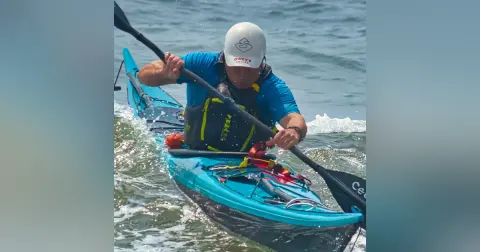
In this episode of Paddling the Blue, host John Chase speaks with Greg Paquin about his extensive involvement in British canoeing and his passion for paddle sports coaching. Greg shares his inspiring journey from civil engineering to becoming a full-time sea kayaking coach.
Greg also recounts his thrilling expedition to the remote and stunning landscapes of Tierra del Fuego, describing the breathtaking scenery and unique challenges faced along the way. Additionally, he discusses the inception and growth of the Autumn Gales event, which provides a platform for paddlers to experience advanced tidal race environments under expert guidance.
Listeners will gain valuable insights into the world of performance coaching in sea kayaking and learn how Greg's diverse experiences have shaped his coaching philosophy. Discover more about Greg's adventures and his contributions to the paddling community in this engaging episode.
0:01 Welcome to Paddling the Blue. With each episode, we talk with guests from the Great Lakes and around the globe who are doing cool things related to sea kayaking. I'm your host. My name is John Chase, and let's get started paddling the blue. Welcome to today's episode of Paddling the Blue. Greg Paquin is today's guest. And in today's episode, we'll talk about Greg's involvement with British canoeing, what keeps him going in paddle sports coaching, Tierra del Fuego, and the Autumn Gales. Before we hear from Greg, James and Simon at OnlineSeaKyking.com continue to produce great content to help you evolve as a paddler and as a coach. You'll find everything from basic strokes and safety to paddling in tides, surfing, coaching, documentaries, expedition skills, incident management, and more.
0:45 It is all in one place. So if you're not already a subscriber to OnlineSeaKyking.com, here's your opportunity to get started. Started visit online sea kayaking.com use the coupon code ptb podcast to check out and you'll get 10 off just for being a member of the paddling the blue community enjoy today's episode with greg paquin hi greg welcome to paddling the blue hello john how are you i'm doing very well it's a beautiful day i got out in the water today and did a little surfing so i can't complain ah good good so tell us uh you've got a quite a paddling history so tell us how you got How you guys started paddling? Well, I started sea paddling after I graduated engineering school, civil engineering school, back in the late 80s. That's when I graduated.
1:33 And, you know, during that, being in college and before college and stuff, I was always really into mountaineering. Engineering, and any break I had, I was always running off to the mountains and things like that. But once I started an engineering profession job, I really quickly found out I could not do that often. But I do live in the Northeast of the U.S., Connecticut, close to Long Island Sound and Rhode Island and the Atlantic Ocean. And I also was into enduro motorcycle racing at that time.
2:17 And again, I could not participate like I used to. So I sold my Husqvarna and bought myself an NDK sea kayak. Never look back. I do still think about riding. I bought an old Greenlander, original Greenlander, not the Greenlander Pro, but the Greenlander. And that was a tippy critter. But, you know, that's kind of how I started at that time, only because I just couldn't run off to the mountains anymore. But what attracted me to the ocean was that there's a lot of similarities to mountaineering.
2:57 You know, you have your navigation and understanding the weather and being skillful at what you're doing. And so that just really spoke to me. And, you know, maybe it was an old sea kayaker magazine. That's kind of how I made the transition from a mountaineering, mountain climbing background to sea paddling. I just didn't have time to get away, and I had this great resource right at my fingertips here. Put the path forward anyways in that regards. So by proximity, that sort of helped. Sure does, yeah. All right. Do you get out and do any mountaineering at all? Maybe in the wintertime, but that's where the telemark skiing comes in.
3:40 But, you know, I miss that too, but I've had plenty of sea kayaking adventures to take me all over the world to keep me busy. Is pedaling your full-time occupation? It had not been. And for a while, maybe 10 years ago, it was. You know, I needed the break from that engineering world that became so stressful. And you become a vice president and a manager and all this kind of jazz. And I just needed the break. and I had started my company already, Kayak Ravology. And I always thought that I could, well, it'll be a side business and, you know, I can coach people and go places.
4:23 But, you know, for a few years, I did rely on it completely. So how did you make that leap from the engineering world to a full-time occupation in paddling? I think I was forced. I think it was the economy, you know. I was, you know, I was the highest paid non-family member, so to speak. And I went down the road. And when that happened, that was like ready. I was ready. My bags were actually packed to go to the Anglesey Sea Kayaking Symposium in May. And I got the word and I still went. I just decided, well, I'm just going to put all my eggs in one basket and just go for it. And really up my game with my coaching qualifications at the time and just give it a good go.
5:07 Well, do what you love and it'll never feel like work. Yeah, it'll catch up to you. I mean, meaning like all the work that you put into it, you're going to get payback eventually. So coaching. So you stepped into that coaching world and you've got an awful lot of initials after your name in terms of coaching qualifications. So tell us about the coaching qualifications that you've earned. I would say that kind of goes with as you're progressing as a paddler. This is before that I worked full-time in the industry, but where I started it. When I first started paddling in the early 90s, I learned of the BCU, British Canoe Union.
5:52 And there was actually in Rhode Island, And there was a BCU coach that came over from Wales. He was working for a company in Rhode Island. And, you know, I kind of heard about that. And I said, well, that seems really interesting. And so a friend of mine asked, hey, do you want to go do this three-star training? I'm like, sure. Sure. And that's kind of where I got hooked into it. It was hard. It took me three times to pass that old BCU three-star. And I did it in an old Greenlander, not a boat where they had to have a lot of rocker. And that was a hard thing to pass. But I liked that challenge, you know, the pass fail.
6:34 Because if you failed, you knew what you needed to fix and you worked hard to correct those performance gaps to make things better. And that was kind of the start of it. And that was in the early 90s. Since then it was the VCU Four Star after that. So I did that in Sea Kayak, Georgia, one of the early symposiums down there. And that's when I met Nigel Dennis. And I was the only one in the past at that time with the group of people that were doing it. So then once I felt like I had enough knowledge about sea kayaking, then I felt like I could be an instructor and I could teach people the great things that I've learned.
7:20 And at that time, what was most accessible was the ACA's coastal level four to level five awards. Awards so as i continued down the bcu star awards i also was starting my instructor pathway. Not a coach yet but i was instructing in 2004 a group of us were had been training and we went to angle c in october to do a five-star training and that was a good eye-opener and then we went back in 2006 to assess the, you know, the, the, you know, the buds that I had trained with to, to achieve this level.
8:08 We went back and we did pass in 2006. So once I had that, then I felt like, well, then maybe I could do the ACA advanced sea kayak instructor. So I did that. Yeah. So I, I did attain those awards, and that's kind of when I started kayak waveology as well, back in 2008 is when I started. You know, one of my mottos was like, you know, for my company motto is kayak. Those who are looking to do more, to do more with their performance paddling, to do more with their sea kayaking. You know, I was pitching. I wanted to work with the higher level clientele because that's what I had time for because I was still an engineer.
8:54 So I used both systems. Both were valuable. Both are valuable. You know, I did then start in the British Canoeing coaching pathway. And I started with Coach 2, soon did the Coach 3 training. But I was really applying a lot of what I knew how to do as an instructor to fit it into the coaching realm. What I see happening, and it has happened in British canoeing, is that a lot of the coaching science has come down from the universities, Olympic-level coaches, into the recreational coach level, which most of us coach at and teach at is in the recreational realm.
9:39 But the push to go to this performance coach award was coaching science information that I had not been exposed to at all, being an ACA level five instructor. And it was new and it was like, oh, wow, this is something I'm learning again. And so that's what really – what I like mostly about the British canoeing system is that I'm continuously learning. They keep raising the bar in you. If you're a game, they keep following and learning. It just makes you better. So out of curiosity, the performance coaching pieces of that, in what ways do you apply that to recreational paddlers?
10:25 I would say that the obvious thing, the biggest thing is being –. Making it individualized to that learner. And you could have five, six people in a course and to be delivering a, it could be a surfing course, sea kayak surfing course or something, which I like to do. And each one of those folks are, they're performing similarly, but each one of them is their own person. They learn a particular way better, different than somebody else. And to be able to pick up on how they learn and how you can deliver something to help them so the light bulb goes on for them.
11:10 Individually, for five people, while you're running an overall course, it becomes quite a challenge to do. But there's lots of methods to try to attain that, those learning moments for these performers. But that starts to fall into a craft of coaching rather than instructing somebody off a syllabus. And you're customizing the program and meeting people where they are. Exactly. And it's getting better at doing that, which does good for any business, brings more clientele in, and people return. Turn and, and, and you, you just, it's exciting to see the growth of paddlers once you've changed to that individualized coaching practice and using different coaching tools to do that.
12:04 It's exciting to see, you know, their growth and where they end up going after. It's exciting to see what you've created and how far they go. And I think that's what keeps me going with coaching. As British canoeing has changed, everybody remembered the Star Wars awards, three star and a five star. That's what people in America remembered. So that's not that linear pathway anymore, which makes it confusing. But the way it's aligned now is because not everybody maybe doesn't want to go down the leadership award pathway.
12:45 So now you have the personal performance awards, you know, two-star to five-star, if you will, in each discipline of paddle sports. I only really deal with sea kayaking discipline. So someone can travel down the personal performance awards, which are a lot like the four-star and the five-star when I did it back in early 2000s. It's a lot like that. And then you can do those parallel to a leadership pathway if you choose to. You get to the coastal personal performance award. And that's the same skill set for the sea kayak leader.
13:31 So a lot of people like to go down the personal performance award pathway to make sure they have the right skill set to even make that jump to another pathway for the leadership awards. You don't have to, but it just gives people another option. Sure. Yeah. I mean, making sure that your personal skills are sharp before you're moving into a leadership role is important. Right. So, when you're in the leadership award qualification programs, you're still being tested on your personal battling skills. Of course. It's not like that goes away. But you're not learning it for the first time when you show up at a sea kayak leader training either.
14:11 Which had always been a problem that people were coming to the trainings to actually get the skills that they need. I mean, that's one way to do it. Yeah. So there's other ways to get the skills now. But not everybody wants the responsibility of being a leader. So that's why they created that personal performance pathway. And then your third track is the coaching track. Coaching track as well. So that really starts, the coaching pathway starts when you have your first leadership award, right? So it's called moderate water. That's where the Sea Kayak Leader remit of sea state conditions are. It's called moderate water.
14:57 You know, at least three foot breaking waves on surf. Sea state four could be as high as the door in your room. You're out there in the swell. You have tidal tide that you need to start dealing with now. Tidal planning, because there's current involved, but no tidal races. That's kind of the moderate water environment. And then advanced environment is with tidal races, flows over two knots, winds higher than force four. So in the current system and those three tracks, where do you fall? Like my personal skills wise, I had the old five-star.
15:40 I had the performance coach award, and I have an endorsement off of that advanced water endorsement, which I needed all that in place to be an assessor for the advanced sea kayak leadership award. So there's a coaching pathway, and then there's also an assessor's pathway. Another level. you know go down the leadership track you top that out you really enjoy what you're doing and you want to give back and then you can drop into the coaching pathway, you know being a sea kayak coach moderate water sea kayak coach it's good and then there's advanced, so once you have those coaching awards under your belt then then you have the green light to train to become a provider of the British Canoeing Awards.
16:34 So where I'm at, so I'm a provider for all the personal performance awards, all the leadership awards, and then the moderate water sea kayak coach award. All right. You mentioned telemark earlier. And I understand you're a telemark instructor as well. Is that correct? Coach? Yeah, I am. All right. Right. So that's your, when, when the water gets too crunchy to paddle, you're, uh, you're on snow. I'm on snow. Right. So how does that telemark experience affect your paddling and vice versa? You know, so I, back early on in the conversation, I mentioned, you know, the mountaineering piece and part of that mountaineering piece was a ski mountaineering component.
17:17 And in the late 80s, that's when I started telemark skiing, started cross-country skiing. And then I started bushwhacking around in the woods and I was going to really get hurt on cross-country stuff. So I eventually found heavier and heavier equipment and that came to be the telemark world. And so I just kept evolving with the equipment really. Yeah. Now the equipment is quite robust, plastic boots, still have bellows, and the bindings are a lot stronger. So, you know, I developed with the equipment as a telemark skier.
17:59 But again, when I had more time on my hands, I said, well, I'm already coaching sea kayaking. Wouldn't it be good to coach another sport that I really love to do in the off season? And so, you know, I found a ski mountain in Southern Vermont that has a telemark school and I asked if I could come and instruct and teach and they said, yes. I'm like, I just, I went with it. You know, I did start, I did take some instructor courses before the PSIA, Professional Ski Instructors of America. And that was done with an organization called NATO, North American Telemark Association.
18:44 The other NATO. The other NATO. I mean, it was fun, engaging, and I was pretty good. And so I asked if I would help them at one of their symposiums up at Mad River Glen in Vermont. And I did it, and I really had a good time with it. And so I stayed involved with them and, but when I started teaching skiing at a ski mountain, they didn't, they didn't recognize those, those, uh, that, uh, NATO organization as a, any kind of governing body, uh, for teaching skiing. So it was fun and everything, but so yeah.
19:27 As I started teaching telemark skiing at a mountain, it seemed pretty obvious that I needed some other qualifications with the PSIA. I started down that pathway, becoming a telemark skier instructor for the PSIA. It was pretty good, and I worked hard at it. It didn't take long to get to a level three. There was only three levels. Um but you know so now i'm already coaching sea kayaking and now i'm teaching telemark skiing but when i did that whole performance coach learning about different more different coaching science stuff i'm realizing that the same it's not specific to paddle sports on how you could um teach in an adventure sport, it's very much the same as in other disciplines altogether with adventure sports.
20:26 So I would take telemark skiing, I view that as an adventure sport, like ice climbing, that kind of stuff, as I see it as the same as sea kayaking. That's an adventure sport. So the way you coach somebody in sea kayaking, is, you know, you could use those same tools, coaching them and telemark skiing. And it's, it's crossed over quite well. And so, so I've advanced a little bit further in the skiing world to become an examiner where you train other, other instructors. So, so they're starting to build off each other coaching wise, but.
21:10 A good crossover between the two. Yeah, from a coaching perspective, you know, physically, you know, the upper body gets super strong in the summer from paddling. And you go to winter and you come off of skiing in the spring. And now, you know, your thighs don't fit under your thigh braces. So it's good to mix it up. Yeah. Cross-training, if you will. Yeah, a little cross-training. All right. Right. So you've had some great experiences as well, coaching in different places around the world, outside of your home New England waters. And one of those that we talked about just briefly earlier, off air, was Tierra del Fuego.
21:51 So tell us a little bit about your Tierra del Fuego expedition and what that was like. Okay. I do want to back up to one of the philosophies that I have for coaching in my company, Kayak Waveology. Is that we're training people. We have great training waters here. We've got surf, we've got rocks, cliffs, and we have tide and tidal races. Training people in this environment, we're training people in this environment to be able to take them on expeditions or allow them to go on expeditions themselves to other parts of the world.
22:31 So they have a they have a good database of ocean environments that they could draw on to feel confident to be able to go to another part of the world and paddle some dream location, so that's a lot of what we do okay do with the coaching and that's brought me to different places in the world. So the Tierra Fuego was a trip that we were not bringing clients on. I do bring, I do client-led trips and they're usually more to Ireland, to Wales, to Scotland, and one trip in Iceland already.
23:13 But the Tierra Fuego one was a personal trip, turned into a little coaching. A good friend of mine that I had helped on along his pathway, you know, becoming an advanced psychotic leader and working with him and coaching and stuff. He's from Chile and he was, he came to America looking to advance in the ACA and nobody could really help him or want to help him. You know, from South America, there's a lot of machismo there. There's a lot of, there's a lot of powerful male stuff going on and and i i was i listened to him and i invited him out paddling one day up here and because that's where i met him i'm like wow this guy really knows his way around a boat he's a really good paddler turns out he was a icf olympic coach for the chilean slalom team but he's older now and so anyways but that was my connection to Chile was my friend Juan Paulo I had taken him to Wales to expose him to that whole world and he kept saying you need to come visit me in Chile, so eventually I went down to Chile alright so that was the connection so I established a connection.
24:46 With a person, Juan Palo, and then he invited me down. And he goes, I got a great adventure that we're going to go on. I'm like, okay, what's this? What do you want to do? And he goes, oh, we're going to go meet some of my clients in Tierra del Fuego, and we're going to do an expedition with them. And you're going to coach them along the way. But they're also part of their – because he's a coach in Chile, Part of his coaching to these guys was more guiding, be able to lead expeditions. And so myself and my other half, Paula, and I, we went down to Chile together. We met Juan Paulo in Santiago, and we flew further down to Puttarenas and started the truck journey further south.
25:36 So that's eventually how we got there. But some of the details are they didn't have great sea kayaks down there. They have sea kayaks, but a lot of them are plastics and didn't really fit well. So I'm like, well, we're going to bring three-piece explorers, NDK explorers down. So I'm a dealer for NDK. So I do bring in a lot of the boats. So I ordered a three-piece Explorer, same with Paula. And so we packaged up our three-piece boats as checked baggage and put them in the airline hull, and we flew down to Santiago.
26:22 Got a little more complicated when we got to Santiago with the boats and all our gear. Like, the next flight to go further south was a much smaller plane. So we figured out that, okay, we're going to have to air freight our boats for this next leg. Flag, a day ahead of us flying down to Punta Reynos. So that's what we did. It was a little bit odd just to load your three-piece, strap it to a pallet, and watch a forklift take it away. Gone, man, I hope it gets there. Put a hole through it. Yeah. Did this arrangement kind of happen on the fly? So you get to Punta Reynos and you're like, oh, okay, now we have to do something different than we expected?
27:07 Or did you know that ahead of time well so having our connection Juan Paulo from Chile who is who knows how to do this down there he knows how to operate in this in this country and it was his idea ahead of time to do that but we didn't know that but he was doing a lot of planning on his own he figured out that piece and it worked out just fine so we arrive and put to ran us we collect our boats everything Everything was fine. The young lads took the ferry across the Magellan Straits with their truck to pick us up off-road. Toyota Hilux, roof rack, the whole deal.
27:50 Baja lights on it. Desert racing-looking kind of truck. And we're like, oh, this is going to be interesting. Where are we going? So we drove back across. We drove to the ferry to take the truck. Across the Magellan Straits. And that's quite an interesting, tight, greasy piece of water and a lot of wind. So we eventually get to a little town. It's like the last town in Tierra del Fuego on the Chilean side, not the Argentinian side. It's like the last town. It's the town of poor veneer. So we get some provisions. We provision more for the trip there.
28:33 And again, people speak in Spanish, and we're not really Spanish speakers, so we have to try to translate wherever we could. But our friend, Juan Paulo, he could translate really good. He could speak English very well, and obviously, different dialects of Spanish. So we have one night there and but not really a full night's sleep so we have to wake up at 10 o'clock at night we're already quite tired for all the traveling so we have to wake up at 10 at night and do a night drive further south down these dirt roads to close to the bottom of, teotofrego on the chilean side and you know they chose to drive at night because it's safer because with the big off-road lights you could drive faster and less vehicles on the roads and you could also see the animals better with the lights hitting their eyes and things so it was quite it was safer to drive at night and you could make a big better time, and you had to bring your extra fuel because you needed the fuel and your trucks to get back.
29:43 So that was about another six hours of driving, And we get to an area, an old logging camp area And it's at the end of a fjord So now we're in the beginning of the Perry Icefields And it's the sub-Antarctic region, range in in chile so we're still a little bit north of cape horn and ashwaya but if you look at the bottom of like where ashwaya is and that's the whole mountain range uh that's that kind of it's an east-west mountain range and we were going on the far far western side.
30:24 Yeah so we have two young lads that were from tierra de fuego and they're all excited and and And so we did a day of training on a local lake before we head off just to kind of see what they were doing, paddling. So a little bit of coaching to see how they're moving about in boats and things. Because we don't know these, they don't know them at all. But they have scouted out some areas that potentially we could be staying for camping and stuff. How long was the trip? So the trip was two and a half weeks. Okay. Not a lot of time, really. To go this far remote. Yeah. I mean, you've already invested a pretty good amount of time just to be able to get to the location and then be able to spend the time in the location. Right.
31:14 So we did a day of training with them, and we're coming back from that training from a local lake, mountain lake. And this is logging roads, and these roads were cut in specifically for the military to get access to the southern part of Tierra del Fuego. That's why these roads exist. Okay. So they're not worn-in roads that people are using. It's rough terrain. It's like logging roads in the wilderness. But there's no logging happening. Okay. But really, the roads were built so the military can travel to get further south.
31:57 And that's why they were there and these roads are there. So there are a few hunting camps down there and there are a few farmers down there. And so these guys were so excited and they wanted this really special Chilean treat for us, British canoeing coaches to come out to, we can't, you know, they were so excited about this. They wanted to get us a present and for the expedition. And so they were in two trucks now, so they pulled off and said, you guys need to wait here in this truck, and we need to go visit somebody. So we're left on the side of the road in a truck, which we had the keys, thank God, just in case.
32:42 And they took off in the other truck. They said, just wait here. We'll be back in like 15 minutes, 20 minutes. They came back in 45 minutes. We had no idea what they were doing. Yeah. We follow. We can go back to the logging camp, hunting camp, where we were starting the journey from. And then they showed us the surprise. So they basically got a young lamb. And so they had to barter and they had to pay the farmer or convince the farmer that they can have a lamb. So it was, you know, fresh and killed, all cleaned. So that was our job that next night. That was the food for the expedition.
33:26 That was the main food for the entire trip. So you're carrying a lamb with you, basically. Carrying a lamb with us. Okay. So we did grill a good piece of it already that evening. It has some nice wine and traditional Chilean lamb on the fire, the whole thing. And it turned out that was going to be our main food. Almost every meal you stopped to eat was going to be lamb. Okay. Then we had other, we had other supplements, but so that was an interesting experience. I've never, didn't think I'm like, okay, well, it is cold down here. It is their summer. There is still ice floating. There ain't your glaciers still calving into the fjords.
34:12 So the water is very cold. So, well, it's going to be a nice refrigerator. They keep that meat cold. So in the, in the hull of your boat. So I think we're okay. So, what's the paddling like? So, the paddling, so we were starting at the head of a fjord, which had, you know, this logging road access to it. And there's a river that comes out from that mountain lake. But the scene is big grassy fields, essentially, and then 10,000-foot peaks, mountain peaks all around you. And you're looking down this fjord that goes on and on and on.
34:57 So it's a mountaineer's dream. Sure. And it's also a sea kayaker's dream. Yeah, completely remote. Very remote. And so we, you know, we spent three days paddling into the wind. So we, you know, a day up before we turned left and to another fjord. And this is the Perry Ice Fields that we're headed to. And another two days paddling up this fjord, getting close, you know, starting to see, you know, ice bits floating by, little icebergs floating by. Water is not a problem. them it's it's put a water bottle up to any little waterfall you see dripping down off the rocks, it's there's no there's no civilization there and there's no animals really so it's pretty the water is really clean you're looking down as you're paddling you're looking down in the water and you can see king crab but they're so deep down there but the water's so so crystal clear and so ice cold you can you can't get it that would be a great meal too.
36:10 So we're paddling paddling up and now we're getting to into the tidewater glaciers where you know you can probably get up to about a half a mile quarter mile from these glaciers and just looking at this massive wall and it's you know it's calving into the sea so there's tidewater glaciers and then there's hanging glaciers that don't touch the seawater all around you so we did we did find a great camp spot there on on a ledge on a rocky outcrop far enough from the glaciers from being having a problem with glaciers but yeah but ice is constantly floating by you you hear the cracking and the popping sounds like you're in a massive thunderstorm the storm all the time because it's the ice just popping sounds spectacular stunning so we use that as a base cap for another three nights and so the you know the terra firma there is either rock or.
37:14 Like thigh deep moss in very very wet and and there's hardly no trees so it's just like it's the beginning of life, vegetation life, after the glaciers receded. So it's like that first. Vegetation that starts growing after the places recede that's what you're that's what you're standing on interesting so it's so new so fresh so pure and it's pretty amazing but don't try to walk around in it because you'd be soaked you get off the rock and you get into the side deeper so for a two and a half week trip um how much of it was paddling paddling was about six days so that we we used that as a base camp area because then we could travel a little bit lighter because there's there's now three main glaciers that drop into this fjord so we were camped out by the first one we spent you know day you know day trips paddling up to explore some of the other areas.
38:20 And we didn't see much in the way of wildlife we did when we started from that logging camp because we had a fresh lamb and cooking outside the the foxes were quite curious and they wanted some they wanted some of that lamb too they weren't aggressive but they were right there, and as you're loading your boat if you don't if you don't if you look away you look back there's a fox you know 10 feet from you like you look away you know he's going to be, right there trying to take something out of your boat so but they weren't aggressive but they were just very curious and but hungry so what was your favorite paddling memory from that trip well i would say so when we were doing the day trips from the base camp And got further up and we started, we saw leopard seals hauled out on these icebergs and leopard seals, I don't know if you've ever seen leopard seals, but they just look so prehistoric.
39:24 Their mouth, their face, their teeth, it's just an amazing animal. And, you know, they weren't threatening and we didn't feel threatened. And so they just smiled and showed their teeth. And we got some awesome photos. I'll bet. So that was pretty spectacular. And we showed the photos to some local people after we got back. And they're like, leopard seals, nothing is around when leopard seals are around. They kill everything. And the marine life knows it. And when they're those, that's why we weren't seeing any other animals or sea life because once the leopard seals are in town, everybody's scrams. All right.
40:13 So, yeah, it took a few days paddling to get up there. It took a day to get back. Are a pretty cool experience and glad you had the opportunity to do that you also have the opportunity to create some experiences for other paddlers and you do that through the autumn gale so tell us a little bit about the autumn gales and how that got started so the autumn gales got started on the heels of an old symposium called the rough water symposium that we were a part of, and that was put on by main island kayak tom berg that was his brainchild and that That event happened in our home waters here, eastern Connecticut, Rhode Island, for the rock hopping, the surfing, and the tidal race surfing.
40:59 So that event was pitched more as an intermediate paddler's event, and there was a whole nucleus of paddlers and community of paddlers that were more advanced, that wanted more. War so that rough water symposium only ran for three years and then i felt like i wanted to continue an event on after that so it came up with the name autumn gales had to be careful of the using the word gales because it was a great symposium called the gales of november, in the Great Lakes, as you might know. That was by Stan Klattek. Yeah.
41:39 But at that time, that symposium had gone dormant. So we just basically used the word autumn gales instead of November gales or gales of November. So that's where the name came from, so to speak. But it's the same idea as really get out there, in an advanced environment or given that a pathway out there for people to experience some advanced environments in tidal races and maybe big swell surf that wraps into this area. And there's strong winds at that time here.
42:20 So the event was pitched originally as more an advanced event. But we had to make more changes. is we had to not just bring people to show them this environment. It was more, now we need to now coach people better in this environment. And so I'm drawing on the experiences and the people that I know, the coaches that I know from Wales that were willing to come over to help me safely put on this event. So most of the international coaches that come to the Gales now are the ones that have very specific experiences and coaching experiences in advanced tidal race environments.
43:09 And then all of our local guides have to be the minimum five-star advanced psychotic leader. You know, we match up the guides with the coaches, you know, a local guide with an international coach to move around the environment. The local guides are going to know where to go and when. And the coach is going to be looking at the ability of the paddlers and start coaching them in a progressive way. May not be in the biggest stuff at all. But it's really given that, you know, a lot of people won't go out in windy, advanced conditions where they don't feel safe going out.
43:50 But now we're giving them a window to be able to safely do that. We try to keep it safe as possible to do that. To give them that experience, to give them that data point that they can now work with where they once before didn't have that data point to even consider. So that's why people like to come to be push their boundaries a little bit and there's you know it's a great community of paddlers that do it and there's a great community of coaches and they all mesh well and it's this is the 16th year of running and now when does it run we always try to do it around halloween so looking at the end of october sometimes the beginning of november and And each group is paired with a local guide and a coach.
44:38 Yeah, and there's different levels of groups too. So we need people to come. So the advanced paddlers are actually quite a small group, but there's a lot of intermediate paddlers that make up the base of the autumn gales. And it's a great environment and a safe way to be able to experience that environment and learn and grow within that. Where can people learn about the autumn gales? They can find it through a website called autumngales.com. And they could also find it through my website, kayakwaveology. Yeah. Tell me a little bit about kayakwaveology.
45:20 So kayakwaveology is my website that I run and a list of courses that I offer. You know, there's a blog there that has dip past expedition travels and stuff. So there's a lot of resources here. And it's a way for me to, I do have an online sale shop for specialty paddling gear, sea kayaking gear. And I'm an NDK boat dealer, so I need to be able to show what I have in stock. So it's just, you know, it's, it's, it handles a few revenue streams for me as a, as a coach, right? You know, it's the coaching revenue stream. There's the boat sales, there's the gear sales, there's boat repairs, there's expeditions.
46:02 So it's just it's a my website is really you know takes you through all that whatever kind of service you're looking for with the advanced paddling or the need to be advanced paddling great you know we do take people that are just starting out we always love to do that and build them and watch them grow fun so if people are interested in learning about your coaching services they'll find that at kayak waveology as well as the other services so So it's been fun learning from you, learning about the BC system, learning about the autumn gales, kayak waveology, your experience in Tierra del Fuego. And it's been fun. I appreciate it. I do have one final question for you, and that is, who else would you like to hear as a future guest on Paddling the Blue?
46:45 Well, you know, I would say some of my mentors that I have had help me on my journey. It'd be great to hear from them. So one of them, particularly, his name is Kieran Tasker, and he resides on the Isle of Man in the UK. Excellent. Yep. So a fantastic coach. He has a business there on the Isle of Man, but he's also quite an expedition paddler as well. All right. So he's going to help me on my performance coach pathway quite a bit. And so.
47:25 Good dude. Super. Well, more than 120 guests, and I don't think I've talked to somebody from the Isle of Man yet. The Isle of Man is a wild place, and not only for the motorcycle race, but the sea paddling there is amazing. Excellent. A lot of tidal races, and a good old Manx saying would be, if you look at their flag, the Isle of Man flag, Celtic flag, it's like there's a foot But they always hit the ground running. Boom, boom. Okay. Well, we'll get the flag. You'll see it. All right. Well, we'll definitely reach out to Karen and get him on the show. So I appreciate the lead.
48:06 And we will make sure we put links in the show notes to the Autumn Gales website, as well as Kayak Waveology, where listeners can connect with you on both of those areas. Super. All right. Greg, thank you again for the opportunity to talk. I appreciate your time. Thank you. Thank you for having me. Thank you. If you want to be a stronger and more efficient paddler, Power to the Paddle is packed with fitness guidance and complete descriptions, along with photos of more than 50 exercises to improve your abilities and enjoy your time on the water. The concept and exercises in this book have helped me become a better paddler, and they can make a difference for you too. The exercises in the book can help you reduce tension in your shoulders and low back, use the power of your torso to create leverage and use less energy with each stroke, use Use force generated from your lower body to make your paddling strokes more efficient.
48:54 Have the endurance to handle long days in the boat. Drive through the toughest waves or white water. Protect your body against common paddling injuries. And while you're at it, you might even lose a few pounds. And who wouldn't mind that? So visit paddlingexercises.com to get the book and companion DVD. Fuego sounds like an amazing place to paddle. Thanks to Greg for sharing his experience in South America as well as his thoughts on coaching. You can learn more about Greg, the Autumn Gales, and Kayak Waveology by visiting the show notes for this episode number 121 at www.paddlingtheblue.com slash 121. Thanks to all who've clicked the Buy Me a Coffee link on our webpage at www.paddlingtheblue.com and thrown a few dollars our way to help offset the cost of producing Paddling the Blue.
49:39 It is a true labor of love, and I enjoy bringing these stories to you, and your help to cover the cost of hosting and production are greatly appreciated. Thanks, as always, to our partners at OnlineSeaKiking.com for extending that special offer to you. Visit OnlineSeaKiking.com, enter the code PTBPODCAST to check out, and you'll get 10% off just for being a member of the Paddling the Blue community. Until next time, thanks, as always, for listening, and I look forward to bringing you the next episode of Paddling the Blue. Thank you for listening to Paddling the Blue. You can subscribe to Paddling the Blue on Apple Music, Google Podcasts, Spotify, or wherever you find your favorite podcasts. Please take the time to leave us a five-star review on Apple Music.
50:20 We truly appreciate the support. And you can find the show notes for this episode and other episodes, along with replays of past episodes, contact information, and more at paddlingtheblue.com. Until next time, I hope you get out. Music.