#138 - Finding flow through exploration in the Outer Hebrides and more with Tom Thorpe


 Apple Podcasts

 Spotify

 Overcast

 Castro

 PocketCasts

 RSS Feed
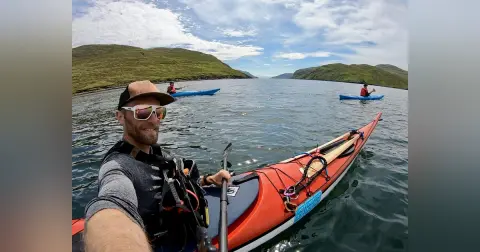
In this episode of Paddling the Blue, Tom Thorpe discusses his experiences in coasteering, climbing, and sea kayaking, and how each sport and a thirst for new experiences has influenced his personal and professional growth. He also delves into the intricacies of navigating the challenging waters surrounding the Outer Hebrides and shares insights into his solo circumnavigation of Ireland.
Learn
Connect:
- Instagram: tom.l.thorpe
00:09 - Introduction to Paddling the Blue
01:34 - Meet Tom Thorpe
03:46 - Transitioning to Sea Kayaking
08:21 - Climbing and Paddling Skills
10:33 - Exploring Coasteering
13:05 - The Art of Coasteering
24:32 - Life in the Outer Hebrides
26:30 - The Scaladel Centre
32:23 - Weather Challenges in Paddling
33:22 - History of the Outer Hebrides
40:11 - Tom’s Expedition Around Ireland
48:38 - Reflections on the Journey
55:21 - Upcoming Adventures
59:33 - Closing Thoughts and Future Guests
0:01 Welcome to Paddling the Blue. With each episode, we talk with guests from the Great Lakes and around the globe who are doing cool things related to sea kayaking. I'm your host, my name is John Chase, and let's get started paddling the blue. Welcome to today's episode of Paddling the Blue. If you're a long-time listener, welcome back, and if this is your first time, thank you very much for joining us. Today's guest is Tom Thorpe, and Tom's a familiar name and face in the UK paddling scene. Depending on the day, you can find him in one of many types of craft, or coasteering along the shore, or working a new bouldering problem, or helping paddlers find something special on the water. And today, we'll talk about his formative years, personal and professional growth, and his new home in the Outer Hebrides.
0:42 Before we get to today's conversation with Tom, James Stevenson and Simon Osborne at OnlineSeaKyaking.com continue to produce great content to help you evolve as a paddler and as a coach. You'll find everything from basic strokes and safety to paddling in tides, surfing, coaching, documentaries, expedition skills, and incident management, and more. And if you're not already a subscriber to OnlineSeaKyaking.com, here is your opportunity to get started. Visit OnlineSeaKyaking.com, use the coupon code PTBPODCAST to check out, and you'll get 10% off just for being a member of the Paddling the Blue community. And for those who also enjoy paddling in small boats, their newest offering is Online Whitewater, and they're giving the same discount to you as a listener.
1:26 Check out Online Whitewater at, you guessed it, onlinewhitewater.com. Use the coupon code PTBpodcast to check out and explore. Enjoy today's episode with Tom Thorpe. Hi, Tom. Welcome to Paddling the Blue. Hi, John. Thanks for having me on. It's amazing to get this sorted. I know we've been trying for a couple of years now, maybe even more. It's been a good time, but I'm really happy that we have the opportunity and you're in a great place to be able to do this. So you've really been around, and now you're in the Outer Hebrides, and certainly we'll talk about that place in a little bit. But first, let's talk a little bit about the path that you've taken to get here. How did you get your start as a paddler? Well, kayaking was a really big thing in schools and cadets.
2:10 And I tried to stay away from cadets and scouts and all these things, but I had friends that were involved with those things. And I just ended up in a swimming pool during lunchtimes, I think, at school. And you had a lot of freedom. I'm 38 now, and back then people were just like, yeah, get the kayaks out, own playing around and they were just old dancers and you know we'd be in there just trying to roll and stuff like that and it was it was just good fun and then another friend was like oh i'm going with my dad to the harbour do you want to come and i was like yeah okay so i'd just be paddling around and again we try and roll and mess around and then it just went from there i i got into climbing and mountain biking in a big way and actually open canoeing and I did a little bit of white water kayaking but then I moved to the Isle of Skye and started using sea kayaks and suddenly it dawned on me that a sea kayak was a perfect craft for windy conditions you know you could still surf them and do cool stuff and rock hop but I could load them up with kit and actually what I used to do with the sea kayaks was put loads of climbing gear in them and paddle out to islands and abseil down rock faces looking for new routes.
3:36 But then I just, yeah, I kind of moved away from whitewater kayaks and open canoes. I still paddle those things, but I just got really into sea kayaking. And that was kind of, that was 2009 when I was on the isle of sky definitely is a vehicle to be able to to get you somewhere and i love the uh the idea that you've used to paddle or used sea kayaks to be able to get to better climbing destinations we've had a couple of other guests you've done the same yeah well you know obviously you can load them up with kit and i don't think i ever really did much climbing but i just took the kit in case I found really cool stuff.
4:19 And I, you know, I did some, but then it became about the sea kayaking, I guess, and learning everything or putting all my skills into that craft and being able to get out to those amazing islands. And yeah, it's just kind of like became my, my main thing, I guess, you know? Yeah. Yeah. Now I know it's a little bit of a departure from, from the sea kayaking piece, but how about your history as a climber? I was really into downhill mountain biking and just street riding, BMXs and skateboards. I went to college in Cornwall and a really good friend of mine called Ash was really into bouldering.
5:00 And he was like, you need to come climbing. And I just remember being so bad and I'd just be falling off and just not able to do it. I didn't understand all the coordination and the balance and the strength. I was only 17. And then slowly it just started getting better and better and mixing with the people and involved with that scene. And don't get me wrong, John, I never got really amazing at climbing. You know i'm climbing okay but it was just a great scene and you know hanging out in those wild places and being with good friends putting up new trad lines and trying to find new boulders it's just it was a big it is still that's what i do here as well but it's just a big adventure as well that's great that's great now out of curiosity how do you think the your your climbing has translated over to paddling and vice versa well actually that's a good question and the reason why is because sea kayaking almost or the people mountaineers and the people looking for that same kind of adventure and experience and some of the early expeditions some of you know some of those guys the big you know big expeditions some of those guys and girls were heavily involved in mountaineering and it was well known it's kind of mountaineering on the sea and i believe that.
6:28 Climbers as well it's changed actually recently and it's become a little bit more park and play and a little bit more convenient but trad climbers and mountaineers you know they kind of like a bit of a struggle fest they're kind of a little bit masochistic they like training they like kind of putting themselves in committed situations and kind of pushing the limits and sea kayaking, is is very much sea kayaking is just so applicable and works so well for me, is because i surfboards i climb rocks right but you can only surf boards when the waves are working you can only climb rocks when it's dry now a sea kayak you can launch that sky kayak anywhere as there's water.
7:16 And I'm almost guaranteed to have a good paddle. And the satisfaction and the accomplishment I can achieve from a sea kayak is almost guaranteed. And that's why I like it. But you still get all those elements and those things which you're looking for in those other sports. And I just think that really just sat well with me. You know, as far as I got at sea kayaking, I was able to do more and more. I could paddle to islands further offshore. I could cross areas with more tidal flow I could paddle out through and land in bigger surf so but it doesn't need to be like that it just it could even be flat and I'd still have a really good paddle so I my weekend was coming and I know it was guaranteed that I was going to have a really good weekend and finish that weekend and go back to work on Monday morning just feeling like just like I've had the best time ever. Do you know what I mean? Yeah.
8:17 I think there's a lot of transferable stuff, but from all sports. And I think that a lot of those things can be achieved in every sport, but it's just more guaranteed with sea kayaking in my personal experience. Now, do you think that there's skill transfer? So has being a climber made you a better paddler and vice versa yeah so i do an awful lot of training i train all the time i've got my own gym here and i train specifically for climbing but i've made my workouts more generic so it's more so i can go surfing and i'll be and i'll be pretty good because it's more focused towards that stuff so that lifestyle of training just it's just something you do and it has a really positive impact on your sports and that's very much climbing if you go to a climbing gym the good climbers in there or even mediocre climbers they'll be training as a lifestyle choice it's just something they do the fitness and nutrition element is is just a standard thing and having grown up through that and again you know i was never and and i'm not like a seriously good climber but i'm okay but that it's just training is just something you do and i think that that really yeah that that just helps everything but also you know the more mountaineering stuff part or the more mountaineering side of climbing with
9:50 the navigation you know i was kind of. Mountain leader and able to find my way around and that's all come from that as well reading guidebooks and trying to find little rock faces you know in a vast area or something you know it's just it is transferable for sure, I'd say the one thing which is more applicable than anything possibly is that I do is co-steer, guiding, co-steering. Because, and I was working with a good friend of mine down in Cornwall to run co-steering. Because a lot of what I do, even the other day when I was at the Flannan Isles, you know, I'd use my tow line as a swim line.
10:33 And I'd swim into the rocks and I'd climb up on the rocks. I'd pull the boat in. It's all co-steering. And I think that if you're a sea kayaker and you really want to get into something which is going to have a seriously good impact on your paddling and safety is co-steering and the ability to move around on wet rocks, the ability to use ropes. However, I would say that sea kayakers are just a bit too obsessed with tow lines. But yeah, that's, yeah. So co-steering is an interesting add here. So that's not something that is as common here in the U.S. So for those who are unfamiliar with coasteering, explain a little bit about that. It's a cool idea.
11:14 Yeah, so you guys there, you have something which is really big, which is canyoneering. Yep. Or canyoning. And that's very similar, you know. However, coasteering, you wouldn't usually put up Tyrolians and that sort of stuff. But the way of moving, abseiling, potentially, however, even that, you probably wouldn't do co-steering. But the basic idea of co-steering, and I take people out co-steering a lot as well, you've got a route or you've got A to B along the coast, or sometimes can be a circular or a circuit. But you just you swim you jump and climb and you might use the ropes and kind of like pull yourself along or you might throw a line a swimmer and pull them in to speed things up and it's just moving efficiently through the the coastline the transition zone between the sea and land and you can play in the waves you can it's just a fun thing and usually you like usually people would need a guide for that because they might not be super familiar with the ocean or you know that environment and you can make it so fun it's one of my it's one of my most enjoyable things to do as a guide is to take people out coasteering because i can almost guarantee that people are going to have such a good time however people do
12:45 struggle with swimming in seaweed and coming into contact with jellyfish sometimes i've had a couple of people get a bit shaken up by that but you know again you know this is interesting it's uh it's important experiences for people to kind of expand their comfort zones and yeah as long as you don't push them too much you're in uh. It is something that definitely gets you outside your comfort zone, but also gives you that healthy respect for the sea and the power of it. But that also gives you an opportunity to figure out how do I use the sea to the advantage to do that co-steering activity? 100 and with all my sports surfing coasteering kayaking whatever it is in the ocean or on the ocean surf ski i've realized that the more comfortable and familiar and relaxed a person is the more enjoyable enjoyable it'll be but the safer it is and the more you can use it and understand it and it will help you as soon as you're like rigid tense scared you're actually becomes more dangerous because you're just not moving you're not operating your mind's not clear you're making short sharp split decision which just there aren't it's not calculated so and again co-steering or anything like that surfing just even just swimming in waves just being familiar with that environment it will have a seriously like it'll have a big positive impact on your paddling for sure definitely so you
14:17 seem to have reinvented yourself i guess i'll say several times as a paddler from you know you mentioned the dancer days and that that really takes you back i used to have a dancer myself and that was a fun little boat but then you know you go from the dancer to sea kayaking to a fast sea kayak to surf ski to operating a livery and to now a center director so tell us a little bit about that progression over the years. So, yeah, it's been a fun journey. And I like to put myself back in those places to kind of take my mind back to where I was in life or even the industry and even the sea kayak world as a whole.
14:58 So, you know, like outdoor centers and schools, everyone used or they all had fleets of clothes, cockpit, ciphers or dancers or whatever. That was just what was available. And I think you know throughout those periods you just use what's available and then as you progress in time and kind of you become more exposed or exposed to different things and different craft. Obviously I'll use them and I think when I went to college in Cornwall we were using white water you know shorter boats so I'd be in them and learning how to do that and we'd be on rivers and then obviously moving to Sky and using the center sea kayaks.
15:46 I couldn't afford my own boat for quite a while. And then I managed to buy my first sea kayak, which was PNH Capella 163 carbon Kevlar, lovely bit of kit. But as soon as I had that and I started paddling with other people and they were in different craft and I try them I quickly became aware of why there was different shapes and sizes and you kind of start understanding all that so then I'd be like I want that boat so I'd then save or I'd trade up for that boat and then I'd end up with that and then I guess I just my level of paddling got to a point that I actually needed certain gear like I was I was paddling but my kit was holding me back.
16:37 And I'm quite proud of the fact, and I used to be quite self-conscious about it, I've never had much money. I've always been an outdoor instructor or worked in schools doing big aspirations in all my sports. And I was looking out at these islands and I was doing, you know, I was paddling, but it was taking a bit long or, you know, I was kind of trying to, I was coming up with plans, but I was a bit, I was held back by the kit. So then I, you know, contacted, in fact, no. So my friend had a FSK and that was a Tarrant. And I was like, oh, can I borrow your Tarrant? And he was like, absolutely, Tom, crack on, you know. And I remember I used that and I went out to the Eddystone, which is Lighthouse off of Plymouth.
17:25 And it's sort of eight miles, eight nautical miles off of Reimhead. I went out to the Eddystone and I come back and I was like, okay, I can see what this is about. And now I was like, I can see the benefits of using this craft. And then I paddled around the whole of Cornwall in three days and covered some big distance. On that first day, in fact, all three days, I covered, you know, big distance. And I was like, and I was offshore in kind of open water situations because you kind of go from, you headland hops, you kind of go from headland to headland to speed things up. I just couldn't believe how much that kind of opened up what I was able to do but then I was like okay this has changed my perspective my life's changed suddenly because I can now do more, so then I kind of got chatting to some companies because I needed one of these boats but there's no way I could even afford one even secondhand at that point they were you know still quite a lot of money second and they still are now and then I got into being sponsored I was still I was already sponsored by ve paddles and i was working with the original owner of ve paddles and we were product testing and it was so much fun you know using kit and using abuse it and he changed things and whatnot i got in touch with a company and they lent me or they sponsored me an fsk and that was amazing and that's what i used for paddling around scotland and ireland
18:55 great bit of kit and i was giving them a little bit of feedback for that which was cool but then someone said to me you need to try a surf ski and I was like. Don't know about that like i'm a you know you know i know what's gonna happen if i get it on that craft and i like it i'm gonna want one and i just can't afford one and i's gonna change so i put that off for about two years and then i got on a surf ski and i was just like oh my goodness all those things that i've wanted in a sea kayak already exist i was like this these craft this you know these surf skis are just made to do the job they are performance craft they go downwind so well the seat in position is really comfortable and like it's it's just a really dynamic position.
19:53 And then suddenly i just got involved with coaches and people which had been through a proper kind a coaching pathway and they've been coached themselves and they were coaching me in technique and suddenly my paddling just started going in just going through the roof like I just started progressing I think I had plateaued I taught myself a lot and I was looking for information and trying to be trying to contact people that I thought might be able to help me progress in technique and style and then suddenly surf ski world was different they were you know and I was involved with some amazing paddlers like sean rice and a good friend of mine called ralph baker and they you know accomplished paddlers really good paddlers and they were coaching and giving me some top tips and i just went i was like this is this is it and i just focused on surf ski for i don't know i still do it now a lot but like you know three or four years or whatever and i, I just really enjoyed that, the downwind experience and the training.
21:00 And I kind of, as I said to you earlier, I love training and I love the fitness element. And sometimes that felt a little bit out of place in standard sea kayaking, apart from the FSK performance world, potentially. But as soon as I got involved with surf ski, I was like, this is made for me. It's a performance sea kayak, which fits so well and it's comfortable. And the more I train, it's almost like the more you push a surf ski, like it doesn't matter. Like you could be the best surf ski paddler in the world. You can always be better. And I was just like, I was like, no matter how much I train, I was like, let's go. Like, and it was, it was great.
21:40 And island circuits were quicker, but it did humble me because I wasn't very good to start with. And I was like, thought I was this amazing sea kuyahoga. And then I get on a surf ski and I wasn't very good. I was like, well, the boat must be wrong or the paddle. It was just that I needed to take things back to basics. I need to rebuild my skills and relearn and unlearn all that stuff, which was potentially not quite right. So it was an amazing journey. And I'm still doing that now. And up here on the Outer Hebrides, we've got some of the best downwinders I've ever done. And you know you've got these fjords or really long sea locks locks they're not called fjords here but it's very similar and the wind funnels and we've the downwind here john is just unbelievable like so and it's right here on my doorstep and one thing that's guaranteed here in the outer heavenlies is wind so so it's good fun but i i'm back in there in the sea kayaks now I've moved away from the FSK stuff and that's partly because again I just haven't been able to buy one of those boats but I do really like using a sea kayak for what it's good for and more classic style boats and then having my my surf ski which is kind of like for that performance training fitness downwind stuff so I've got my Nord Cap which I love because it's just
23:12 it's good fun and it's great for expeditions it's satisfying to paddle maybe slightly slower pace really nice for offshore and crossings and then I've got my surf ski which I just take out for a couple of hours here and there you know. Yeah, there's definite truth to, you know, like you said, if you want to do a big trip and you need to gobble up some miles and do it with confidence and do it with kit, then your sea kayak is great for that. But if you're really looking for just that quick athletic pursuit and just that thrill, surf ski would be your route. Yeah, and I mean, you know, these two worlds are emerging. We've just had when was it a couple of years ago amazing paddler you know absolutely smashed the record for going around the uk um on a surf ski and and that was just yeah really impressive that was a supported trip slightly different style of expedition or or you know circumnavigation but i I mean, no one can argue that those craft, the surf skis are just amazing at lots of different things.
24:21 And that one had hatches, so you can still take a small amount of kit. And then again, someone's just crossed the channel, the English channel, super quick time on the same craft. And yeah, so it's starting to merge. But for me, like I like to be from my waist down, especially I like to be dry. So I do like, on expeditions, I do like to have a spray deck and I do like to be kind of dry and have my kit with me. There's something nice about a self-supported or self-sufficient trip where you're just out there and you don't rely on anyone else. But it's just different, you know, it's a different style.
25:03 Certainly. Then you transitioned for a while there to a livery operator, is that right? Well, I mean, I've had a couple of businesses and I... I had a surf ski company and sea kayak company, and I used to sell surf skis and do guided trips kind of off my own back. And down in South Devon, which was great, and I used to hire out Kit as well. And yeah, that was a good process. And it got to the point where it was like, let's ramp it up or let's do something different. To make money, proper money from that stuff, you know, you've got to go about it in a certain way. Right.
25:44 But I had an opportunity to make a bit of a change and come to the Outer Hebrides and step back into kind of the outdoor instructor world. And I managed the center and I've my ethos is do what's on your doorstep. So I always make sure I can do stuff. And that's why Sea Kayak and Surf Ski is so good, too, because you can, you know, launch on any water and have a great paddle, like I said earlier. But right here, my doorstep is now like, I would say, the best paddling environment, one of the best paddling environments in the world. So I made the change and I shut down the company and I stepped away from a different company and I kind of moved up here.
26:30 And yeah, things are good. All right. So tell us about the Outer Hebrides, the Isle of Lewis and the Scaladel Center. Yeah, so the Scaladel Centre is a purpose-built outdoor centre, and it's on the Isle of Harris. Isle of Harris and Lewis, technically joined but they are separated by locks and rivers or burns but this this center is is built underneath the highest mountain on the outer hebrides which is called the klesham. 799 meters high and we're in glenscaladell but we've got amazing access to all sorts of different environments it's a multi-activity center kayaking is just one of those things but all of our locations are tip top our coasteering sites our climbing crag the gorge scrambling the kayak place you know take people around scalpe just on in the lock here c4 violence just opposite the center i can get people out to the shantz you know i paddled out to the flannans the other day and that's just up the road where you'd launch for that we've got absolutely amazing seascapes and kind of coastal areas here the beaches are just unbelievable and it's just a fantastic environment you know you've got whitetail eagles flying over the center golden eagles as well red deer are roaming freely and
28:01 there's a lot of them otters we see quite often on the sea kayak trips there's common seals here there's gray seals on the west side and yeah you can see whales dolphins it's just it's a super wild environment and. Scotland west coast orkney shetland as well like it's very very much like that the coastal areas around scotland are very wild and very beautiful but for me the outer hebrides is almost like a completely different kettle of fish it's it's it's a seriously beautiful place and as a guide it's it it really you've got to be on it so you know the weather here can change quite quickly and that's something that people say like down in the south of the uk and whatnot that does happen but usually you're you're quite aware of the pressure systems you're quite aware of what's going to happen but up here because the mountains and the atlantic is where it kind of all meets we're almost the outer hebrides is almost the breakwater for the rest of the north of scotland so we get everything and it can you know you know force well 100 mile an hour gusts here you know and obviously you wouldn't take people out in that but that is quite common here and you could be paddling in kind of force three and it would go up to four,
29:33 six, maybe even slightly more. Quite quickly so as a guide you've got to be you've got to be on it and that and the outer heavities does have this reputation and commercially you get a lot of commercial operators coming up here trying to run expeditions and stuff and they do struggle because you know you could the forecast changes every six to 12 hours so you know you could only go really three days forecast before a trip or whatever and then that'll probably change as well so when you plan a trip super far in advance it is a big risk to whether or not you'll be able to run it but it's for me so yeah for me professionally it's fantastic and safety is number one and we luckily because we've got so many activities I can just pick the best activity for the day or I can change the plan if i need to and then if someone you know if i get people coming up to go and do sea kayak trips i can pick different locations you know we've got the west coast which is swelly usually windier we've got the east side the east coast which you've got almost loads of little sheltered like natural harbors and sea locks and inlets and rocky coastlines so there's always an option apart from obviously when it's just really windy and stormy but then the center's a lovely place to hang out so if you can't get on the water then we can just drink coffee and you know eat cake you.
31:06 Know yeah in terms of being the uh the break wall like you said for uh for for scotland i mean. If you get a good wind out of the northwest and you know your last windbreak is iceland or Greenland, you're 1,500 to 3,000 K away. Exactly and you know it's not just about the air and the wind you know the the atlantic there the surfers that live up here you know the board surfers that live up here on the islands usually they're they're pretty on it and the reason why is because a lot of the waves are a little bit heavier than what you might find in in devon and cornwall and you get quite deep water and then it meets these islands and then just kind of pushes up so you get some big swells hitting these islands and that fetch is is a long it's a long fetch you know and like you just say there's nothing between us and all those places and that makes it fun too and i will say that again you know the the things that people say you know talk about freak waves and stuff it does happen more here you do end up with bigger sets here or there's just an abnormally big set within, you know, the swell and it can just pitch up.
32:23 So you just got to be on your toes. And I just love that. And for me, I've done this stuff for a long time and it just allows me to progress personally with my skills, but also I do need to look after people and I do need to make decisions. And a lot of my kind of, again, you know, one of my things is avoidance. It's better than cure. So selection of locations and environments is paramount. And one of the reasons why I wanted to live here is because I really wanted to know this place and I really wanted to understand how...
33:04 The wind, the weather interacts and the character of all these different locations. And it's really fascinating because I do think that on these islands, there's several microclimates. And I'd only really know that if I were to spend a lot of time here. And just being here on the Outer Hebrides, it's not even just about, it's not even about doing sports all the time. Just being here and watching the synoptic charts and how that translates into actual weather on the ground you know being on the beaches and watching the sea you know learning these environments I just find it fascinating and I knew I wouldn't be able to do that properly unless I lived here and I do think I've only been here for just coming up to a year and the amount I've learned in this year is just unbelievable and i just love that you know so when people say i want to come kayaking i'm like that's fine and i can take them to places and i can avoid like worst case scenario situations because i understand how the sea interacts and how the wind and the weather and different wind directions funnel and all this sort of stuff i just find that quite satisfying for me personally and professionally you know yeah it's great personal and professional growth so uh yeah so tell us about some of your favorite paddles in the area you mentioned flannan is earlier.
34:29 Yeah so i mean there's an ultra classic here which is well known and actually it's well known because as a offshore ish trip it's it's quite accessible and that's the the shantz or the shiants and that's out there in the minch and it's a great trip out to the shance or the shance and there's puffins everywhere in the summer there's caves jellyfish you get some good tide flowing through there so it's you know there's as much the the tide through the minch is is stronger than on the west side so you've got to be on it with your tidal planning but it's quite short and once you're out there it just feels lovely and it's a great trip so i can on the surf ski i can get out there and back in you know a morning or whatever and it's lovely or i could take the i can take the sea kayak and spend a night out there yeah i really like the champs but i've been exploring the islands on the west side and that's possibly the Yeah, I just love it. And the reason why is because you've just got to be on your toes a bit more because of all those things I suggested.
35:46 But every island here has a different energy and it has a different feel. And it's hard to explain. But I just like going to these places and exploring, seeing the wildlife. You get a lot of different kind of birds and, you know, lots of gray seals out on those kind of West islands. But it's just really lovely to be out there and there's human history here which goes back so on the outer hebrides i think since the last ice age people have been here for 9 000 years but there's a lot of history which is almost pre-clearances which is fascinating and and people were cleared from the islands a lot of those islands on the west side and small communities hung on but you know sort of before the 1850s there was really functional communities out on these places and you know the farm the farmsteads and kind of the farming techniques like the fianican and some old buildings and and sheilings where they used to go potentially the summer residents to kind of look after the sheep or they might be there harvesting seagulls and feathers and eggs so there's a lot of human history out in these places and i've really started to get into that i just i just love it and there's also much further back you know there's this history from 5 000 years ago uh 3 000 years ago and you know i'm reading up on a lot of that in the moment and
37:19 you know even like all the old there was some old burial cairns and kists which were repurposed to build more modern structures. But yeah, there's like a whole timeline of events out in these islands. They've been important for centuries. And there was Viking Norse influence here. They arrived here in sort of. 800 AD and then they kind of were around for 400 years but they actually never left they just kind of merged with the Gaelic population but a lot of the names here are Norse and I just love that so you know I became quite fascinated with the Vikings after watching the series and did loads of research and up here it was kind of a sea kingdom and yeah it was part of Norway so yeah it's just i'm still learning you know even some of those facts which i was things i've said might not be super accurate but i'm still learning and and going you know going with the flow but it's just fascinating reading up on all this stuff and being out there and actually seeing it in real life i just like that that's cool i had somebody else mentioned the chance i think it was i think it was allison finch if i'm not mistaken and i just said that was one of her favorite places in the world to go yeah so like the chance or the chance is like a bite size offshore trip you know it's a lovely thing to do it's a it's a real sense of remoteness and wilderness out
38:53 there and it's a nice place to camp it's it's something it's a it's a big big trip here in the uk you hear a lot of sea kayakers either want to get out there or talk very fondly about when they were out there. Are the islands inhabited? No so there there's a local crofter that has sheep out there and there's an old there's an old cottage out there which is you can stay in it but it's not an open bothy a lovely family in that and it's where a guy was based and i can't remember the year but he wrote a novel he's he was in there and it's the novel's called the sea room and he spent some time out there just in isolation writing and the novel's well known but you've also had like bbc series that have been kind of based out there and yeah like it's it's a it's a cool place to be there's a really beautiful almost like natural harbour bay and you get lots of yachts anchoring in there in the summer and it's cool And literally, there's puffins everywhere. Like, you're surrounded by them.
40:05 And razor bills as well. But yeah, it's really worthwhile checking that out for sure. All right. That's very, very cool. Very cool. Yeah. So over the years, you've done some pretty amazing expeditions. And I've talked to quite a few paddlers who've paddled around Ireland. And each story is different. And so yours was a speed trip. So I'm going to kind of shift gears here. Tell me a little bit about your Ireland. circumnavigation? Yeah, so I had a plan, and my plan was I wanted to paddle around the north of Scotland, I wanted to paddle around Ireland, and I wanted to paddle around the UK.
40:45 COVID came, so I never got to the UK circumnavigation, and that's still on my list. But the island trip was significant I guess because it was solo it was anti-clockwise and I launched and ended in Scotland so I did the crossings as well as part as part of it and that's why that one was possibly abnormal in regard to everybody else's circumnavigation or the ones that you'll hear about I did attempt or I I'm. I looked at the weather and I knew the weather systems before that.
41:28 So I knew the wind directions leading up to that for about a month because I'd been watching. And then I looked at the forecast and then the long-term forecast. And it wasn't until I got to Port Patrick that I decided the direction and how it would come about. I had like some plans in my mind, but it wasn't until I was there that, and I was camping in my van the night before that I really made some solid decisions and it wasn't going to be a speed record attempt, but I knew that I do cover quite a lot of ground and I can, you know, I could have a good go at that if I wanted to and things went well, but I wasn't going to put pressure on myself.
42:14 So I was in a nice boat and I had all my kit and I went super light. I took hardly any kit and just went super minimalist, kind of alpine style. And I was watching the weather and we had some Easterlies and I was like, I'm going to go counterclockwise. I'm going to go anticlockwise. I'm just going to make this happen. And I loaded up the boat and I set off and it was super foggy, couldn't see anything. And i just started heading across the channel but also north because i was like i need to make as much ground as i can so i may as well just even if this is a longer crossing i'm just going to start heading to island way up north as well and you know like the way i paddle i just kind of just make stuff happen you know and i just i know i'll get there like and i'll just keep paddling even if it takes longer and I had a really good cross in, My GPS broke, you know, on mid-channel.
43:19 And it was literally white out, couldn't see anything. So I was like, oh, it's fine. I've got my bearing. I know where I'm going to hit land eventually. Like, I know what the tides are doing. And I'm just following my bearing. So I just stayed on that. And I did. I made it across to Ireland. And I was there. And I'd never been to Ireland. And I was really happy to be there. And then I was like, let's go. And I just started putting in some big distances and camping in beautiful places. But I wanted to go and see some of those smaller offshore islands as well. So I didn't just hug the coast. I kind of did end up going around quite a lot of the islands as part of it.
43:59 And I started making good time. And it was good fun. But it was hard. The start of an expedition, your body's, although I did a lot of training, and I used to paddle to the Eddystone Lighthouse at night and went to the Sillies and back a few times and I would tow a buoy like for resistance training which I probably wouldn't do now after all the surf ski training and coaching so I know how to actually train more effectively but at that time I was I was training a lot so I was on it you know I was but I was settling into expedition life, settling into the big distances. And I was a full-on vegan, devout vegan at the time.
44:40 And I was desperate to, I was, well, not desperate, I was determined to prove that vegans could do everything that anyone else can and kind of fully involved with this thing. And, you know, I had quite basic food provision and, you know, so I did push myself going around Ireland but it was just an amazing trip I saw some amazing places and you know met some amazing people on the beaches just randomly and camped in beautiful places and yeah I had a couple of there was a particular time people like the action kind of near miss stories but there was a time kind of near Achille Island, I think it is.
45:23 And there was a big weather front coming and there was some big wind and rain and I woke up super early and I wanted to get ahead of this to get to somewhere else to camp and get some provisions. And I was paddling and the weather hit and the wind picked up and it was crazy. And I just remember this wall of rain, water coming off kind of over these hills and towards me. I was paddling through kind of a channel and I was just like, in this crazy condition, so windy and rain, I couldn't see anything.
46:04 And I was like, okay, I need to get my bow into the wind and I'm just going to hold ground. And one of my things, I do big kind of cross deck kind of bow rudders or sweeps, bring the nose around. And I did this big kind of cross deck stroke and to bring the nose around and my back just went. I just remember, but I remember feeling it and hearing it and I was like, no. I, I got the bow into the wind and I held ground, had my head down and I was just holding ground for about to through the school kind of passed and I paddled to the bank and I just led down the bank. I was like, oh man, that's not good.
46:45 Like, I think I've probably done something like pretty bad and it, and it hurt, but I was like right get back in your boat and let's paddle to the the nearest village and set up a camp and go and get some provisions and I did and set up the camp and that was all fine and I gave myself I really didn't want to take any days off but I I had to take a day off to let my back just recover a little bit and actually I'm glad I did and it it it did recover luckily and it was a bit stiff for two or three days after that but i just powered through it and then it and then it was fine but i just remember that noise and that feeling of my back just the talk through my spine just be like you know these big plum bow kind of like you know big kind of bows on these boats are so great you know for downwind and for waves but with the beam winds some sometimes that can cause a lot of resistance and that's just what the case was basically i just kind of I've had a lot of wind on that bow and I, yeah, cross, cross deck stroke might not have been wise in that, in that particular time.
47:54 Quite an experience though. That's for sure. Yeah. Well, the whole of the Island thing, you know, I didn't get the record. I think I, you know, the record's 23 days. I think, uh, you know, I, I kind of managed 26, but I was so proud of that. And especially with the crossing and, you know, I was covering some big distances and it was just such a cool. Thing to do and uh yeah when i arrived back in port patrick i was just like i was like a machine like i could have just kept going around the uk like i would have just kept going when you get used to paddling like that and those distances and. I don't know your body just changes and you just become like literally a machine but.
48:38 I did have to stop i was meeting my then kind of fiance for a small holiday but i was just like i just want to keep going but i was just so kind of happy with that achievement and i'll be honest the reason why i didn't get the ferry across and do it in a tactical way like a lot of people do the circumnavigation that are going for a speed kind of yeah a speed circuit is is because i just couldn't afford the ferries okay so so i was like i just get a paddle from from wales or scotland and port patrick to northern ireland that's that's the closest kind of passage and i was just like that's that's gonna happen i'm just gonna let's just go so but i like that i like the fact that you just do it make it happen that's kind of what i do you know yeah that's resourceful so you that that paddling light and fast you know i i understand and respect that ethic yeah so i think the thing is with my personal paddling and the way that i paddle i can always suss out a natural harbor i can always suss out a place to land and i'm always quite confident that i've got another five or ten miles in the tank no matter how tired you think you are you can always keep going so I'll always make a plan to get to a certain point if.
50:04 I can't get there for any particular reason I know that I'll be all right like the again the co-steering skills I'm pretty good at moving across rocks if I do have to bail I I'm I'm pretty sure I'll be okay even if it's like barnacles and rocks for my feet but i'm very confident i can make it to those harbors or behind those headlands or i can land through surf which is sandy anyway you know so like sandy beaches the fella that climbed all the 8 000 meter peaks in a certain amount of time and broke the record he said that when you feel absolutely done you're actually only like 60 done or something like that and when And he was something like that.
50:50 And when I watched that, I was like, yeah, I completely agree. Because I've always got, especially in an almost extreme situation, there's no choice. You find that energy. You find that ability. You snap out of that negative mindset and you switch into a positive go-get-em attitude. And I like almost putting myself in those situations. But I've kind of got that ability to do that. So our bodies will go much farther than our brains think they can. Yeah, seriously. And, you know, the ocean is big and the distances are vast. And one thing I've learned is that planning is really important.
51:32 And on my trips, when I am covering distance, I like to know how long that's going to take. So for example, there's a headland, I can see it, I'm going to paddle to it, but it's 10 miles away. I know how long that's going to take, I check my watch and that's so good for psychology and if I'm looking in short I can see features and I almost like tick them off as I go and I know the distances and where I'm at and I found that not just paddling kind of aimlessly or just you know kind of like just going for it and not really knowing how long it's going to take or just having a kind of unplanned approach I've learned that that's not wise you know you can set your pace you know where you are and i find that that's just that really helps so yeah like there's there's some logic to it all fast paddling is not just about you know going for it and nutrition is really important and just making sure you can eat as you go and you can recognize when you are getting low on calories you can recognize when you are getting dehydrated and, and making sure that doesn't happen because that's, you're going to take a huge crash, which is, is not helpful, especially when you're offshore on your own. True.
52:53 But, but yeah, like, and other stuff I just, I just cut out, you know, like I gave myself a limit on how much water I'd carry because water weighs a kilo a liter, you know, which is a lot. So you know i kind of like would only carry four liters sometimes i've had i'd be short on water if i'd camp on a headland or an island to make sure i can keep my line for example for the day after and i don't go too far in shore because it just adds distance and time so sometimes i'd be short so i'd be cooking with seawater sometimes and even reflecting on that the amount of salt you know some people will say well you're taking on loads of salt so you're gonna have to rehydrate more or or hydrate more and now i'd be like yeah that's right but when you're in that situation, you just make it happen like you just you just do what you gotta do and uh it was it was full on and it was definitely i learned a lot even then and if i was to go around the uk now i think i would again i take some of those things and i'd i'd do things slightly differently probably All right.
54:01 So good learning experiences. Congratulations on that trip. You mentioned other trips. What's next? So there's a big reason why I'm here on the Outer Hebrides, and that's because I can see St. Kilda. And St. Kilda is possibly one of the most full-on open crossings you can do in the UK. And it's a long way offshore, and it's over 40 miles offshore, which is big. So if you paddle to the Scilly and back without getting out of your boat, that's kind of where you need to be at for that. And I just really want to be out there. I want to be doing that.
54:47 And North Rona, you've got some other, that's one of the other islands off the tip, off the top, just north. And yeah, I just really got a big fascination with these places. So that's what I'm looking at at the moment. I really want to paddle around the Outer Hebrides, you know, on an expedition. And I would love to paddle around the UK and I'd love to paddle around South Island, New Zealand as well. But the thing is, John, you know, work, I'm an outdoor instructor. I used to work in schools and I'd take those summer holidays and I'd do exhibitions. I work in an outdoor center and it's very busy. So that's a big, you know, most of the summer.
55:33 But that's why I was looking at the Southern Hemisphere and looking at, you know, New Zealand or wherever, because that could happen. Because obviously I can do that in our winter. Beautiful. i i certainly understand the uh you know the the situation that you're in i work in the recreation world as well and we work when people recreate so yeah no that's exactly all right so it's just a different thing you know i can take the winters off now whereas before working in schools you can take the summers off which just is back to front but yeah so that's kind of but, you know like my my kind of outlook's changed and one of the reasons why i love surf ski is because the the trips i do on those boats are just so much fun and i've learned that you can get a lot out of a shorter trip now and again the human history and the natural history behind areas i just find it so fascinating so would i if i went around the uk would i do it quickly well i'm not sure actually i think the people that have done that quickly and set those times and records you know john willesey joe leach and the chap that did it on the surf ski that's so cool so part of me thinks that it's almost like well congratulations guys like why put myself through a masochistic kind of.
57:03 Just push myself to the limit to try and do that who am i doing it for what am i doing it for and that's a question which i've i've been thinking about in the last year or two is who am i doing these things for why am i doing these things and what's the purpose and i think that i i just love the history of our sport i love the history of our communities i love even the natural history and how our landforms and shapes and islands and mountains have come to be. And I love the nature. And I think that maybe that would be a bit of a focus, but I would still be covering big distances and I would still be paddling in a committed kind of like, I don't know, kind of fast and light way probably.
57:54 But I think it would be, I want to meet people and I'd want to watch the birds and I'd want to find the whales, and i think that's yeah i think i'd kind of go for a middle ground if you see what i mean yeah i can say almost exclusively when i've talked to paddlers that have, paddled something big gone around something big whether it's uk or ireland or or whatever else, when we talk about that particular aspect almost every one of them says i would do it a little bit different and then that difference would be i'd take in the atmosphere i'd slow it down just a little bit. Yeah, I think, you know, there's certain areas which I probably wouldn't hang around in, which would probably be the East Coast of the UK or whatever, the open crossings, you know, you can smash them out.
58:41 But there are certain areas where I think spending more time would be... Probably just more enjoyable and actually i might even want to do it with someone but i do struggle to find people that paddle in a similar way but i think having a team or you know doing it with someone else you just would have such a good time and create a really a really good bond so but who knows man you know like i i'm focusing on different things i've got my climbing my surfing my surf ski, my sea kayak and running. So there's lots of stuff going on. And if I get some spare time or a spare month, then I definitely want to go on a long expedition, but we'll see where that is, you know?
59:30 Good. Well, we'll look forward to seeing where that takes you. And again, you know, congratulations and great work on all these different disciplines and weaving them all together and learning how each of those makes you better in the other discipline. and it just makes paddling more enjoyable. So I appreciate the opportunity to talk to you and appreciate the opportunity to see it through your eyes. So how can listeners connect with you, Tom? So the center here at Scaladel is focused towards the young people of the islands and youth groups. I do work with tourists and people coming for adventure or looking to come up to the Outer Hebrides to get out to certain places and guiding trips.
1:00:11 But the best way is my Instagram Tom L Thorpe and just yeah if you want to ask any questions or if you want to know any advice about the Arabides or whatever or yeah just send me a message but yeah the islands fill up as you know, It's crazy busy in the summer, and everyone should come here and check it out. It's absolutely beautiful. So hopefully I'll meet some of your listeners. But yeah, I just really appreciate the opportunity, John, and it's been lovely to chat to you. Sure. Thank you. So to everybody who's listening, you've just got the invite there. Come out to the Scaladel Center and to Isle of Lewis and see Tom.
1:00:54 So with that, Tom, I've got one last question for you. Who else would you like to hear as a future guest on Paddling the Blue? So i'm aware that you've chatted to a lot of people but there's one paddler which is it sticks out in my mind and he he is an amazing guy and he's been involved with sea kayaking for a lot of years in lots of different ways and that's a guy called howard jeffs who's a top level coach and has been involved with building sea kayaks and designing his own kit yeah super humble guy a really really lovely guy i think would be worthwhile chatting to him for sure fantastic well i've had a recent conversation with robin riddick and on episode 133 and we talked about a number of things and he had also mentioned howard jeff so we got a couple of references to howard jeff's here so we'll definitely look forward to getting howard in the show and learning from his experience as well.
1:01:54 So thank you very much for the referral and thanks again for the opportunity to chat. I appreciate it. Nice one, John. And yeah, like you should come over to the Out of Hebrides as well. We'll go for a paddle. That sounds great. I'd love to. Nice one. Thanks a lot. Thank you. Have a great day. If you want to be a stronger and more efficient paddler, Power to the Paddle is packed with fitness guidance and complete descriptions, along with photos of more than 50 exercises to improve your abilities and enjoy your time on the water. The concept and exercises in this book have helped me become a better paddler, and they can make a difference for you too. The exercises in the book can help you reduce tension in your shoulders and low back, use the power of your torso to create leverage and use less energy with each stroke, use force generated from your lower body to make your paddling strokes more efficient, have the endurance to handle long days in the boat, drive through the toughest waves or white water, protect your body against common paddling injuries, and while you're at it, you might even lose a few pounds.
1:02:50 And who wouldn't mind that? So visit PaddlingExercises.com to get the book and companion DVD. Thank you to Tom for joining us to share his experiences. He may be the first anti-clockwise Ireland circumnavigation paddler that I've had the chance to talk with so far. I especially loved his comments towards the end there, where he gave us thoughts on considering the why we do things and who we do them for, and making sure we're keeping those right reasons in mind when planning a trip. In today's social media-fueled world, it can be easy to do things for glory rather than joy. And Tom brings a great joy for exploration, for learning, and new experiences. And his experience shows that you never know what's behind the next door. If you'd like to learn more about Tom and the Outer Hebrides, I'll add links in the show notes.
1:03:34 And thanks again to our partners at OnlineSeaKyaking.com and now Online Whitewater for extending that special offer to you. Visit OnlineSeaKyaking.com or OnlineWhitewater.com, enter the code PTBpodcast at checkout, and get 10% off just for being a member of the Paddle and Blue community. Until next time, thanks again for listening, and I look forward to bringing you the next episode of Paddling the Blue. Thank you for listening to Paddling the Blue. You can subscribe to Paddling the Blue on Apple Music, Google Podcasts, Spotify, or wherever you find your favorite podcasts. Please take the time to leave us a five-star review on Apple Music. We truly appreciate the support. And you can find the show notes for this episode and other episodes, along with replays of past episodes, contact information, and more at paddlingtheblue.com.
1:04:20 Until next time, I hope you get out and paddle the blue.