#139 - From Marathons to the Mississippi: Paul Mellor's Epic Adventures

 Apple Podcasts

 Spotify

 Overcast

 Castro

 PocketCasts

 RSS Feed
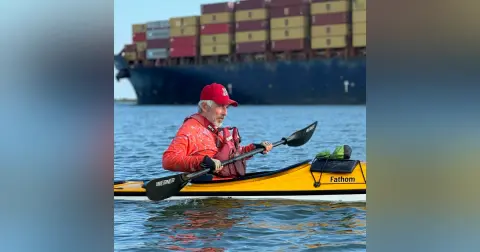
In this episode of Paddling the Blue, John talks with Paul Mellor, an adventurer who has conquered marathons in all 50 U.S. states, cycled across the USA, and most recently, paddled the full length of the Mississippi River. Paul shares his stories of unwavering determination, the challenges of river life, and the remarkable kindness of the people he met along the way.
Connect:
Learn:
- Strokes of Kindness: paddling America's most iconic river reveals the humanity of its people
- Summer in the saddle: A Bike Ride Across America
- You're almost there: Sights, Sounds, and Exhilaration of Running and Marathon in All 50 States
- Memory: How to Remember Anything (Kindle Edition)
- Finding the Keys: for remembering anything
- Pathway to the Podium: Life as a Professional Speaker
00:09 - Welcome to Paddling the Blue
01:33 - Meet Paul Mellor
03:56 - Adventures on the Mississippi River
06:31 - Writing ”Strokes of Kindness”
12:09 - The Humanity of River Angels
16:15 - Navigating the Mississippi
23:10 - Preparing for the Journey
27:45 - Goals for the Paddle
31:55 - Reflections on Kindness
36:14 - Challenges and Perseverance
39:57 - Celebrating the Journey’s End
51:21 - Contemplating Future Adventures
51:42 - The Memory Skills Connection
57:32 - Closing Thoughts and Future Guests
0:01 Welcome to Paddling the Blue. With each episode, we talk with guests from the Great Lakes and around the globe who are doing cool things related to sea kayaking. I'm your host, my name is John Chase, and let's get started paddling the blue. Welcome to today's episode of Paddling the Blue. Today's guest is Paul Mellor. I first met Paul at Canoe Copia, and I was instantly interested in his story. He had a collection of books chronicling his adventures running marathons in every U.S. State, cycling across the USA, and most recently, paddling the length of the Mississippi River. And today we talk about those adventures, his resolve to set and achieve goals, his experiences along the river, and his equally interesting work outside adventuring.
0:42 Before we get to today's conversation with Paul, James Stevenson and Simon Osborne at OnlineSeaKeyaking.com continue to produce great content to help you evolve as a paddler and as a coach. And you'll find everything from basic strokes and safety to paddling in tides. Surfing, coaching, documentaries, expedition skills and incident management, and more. If you're not already a subscriber to OnlineSeaKyaking.com, here is your opportunity to get started. Visit OnlineSeaKyaking.com, use the coupon code PTBPODCAST at checkout, and you'll get 10% off just for being a member of the Paddling the Blue community. And for those who also enjoy paddling small boats, their newest offering is online whitewater, and they're also offering the same discount to listeners.
1:24 So check out Online Whitewater at, you guessed it, OnlineWhitewater.com. Use the same code PTBpodcast to check out and explore. Enjoy today's episode with Paul Miller. Hi, Paul. Welcome to Paddling the Blue. John, nice to be here. Thanks for having me today. Yeah, thank you. So we had an opportunity to meet at Canucopia this year. It was the first time we've had a chance to meet. Yes, yes. It was a fun time. Big crowds, as always, and it's great to meet you. I've heard of you, and I've seen your videos on exercising and on packing a kayak, so it was really a pleasure when you came to my booth. Yeah, so yeah, you had a booth in the Great Hall area, and I walked by and I noticed you had a number of books there, and a few of them really caught my attention, and you've got quite a list of unique exploits, so give our listeners a little glimpse into who you are.
2:18 Well, my name is Paul Mellor. I grew up in Cranston, Rhode Island from a family of six. And my parents loved traveling. Traveling was so important. I can remember there was a map on a kitchen wall growing up. And every morning while eating my cornflakes, I would look at that map and study the states and study geography. My parents traveled across the country in a station wagon. So I really got to love the United States. And then I went to college at Western Carolina University, graduating in 1982, and still had that traveling bug and always liked to travel. Because of that, I got into marathon running.
3:02 It's been said that a marathon is like a mini Mount Everest that comes to a town near you. So I ran the Richmond, Virginia Marathon. And from there, I ran one in Pittsburgh. And by golly, 17 years later, I had run a marathon in all 50 states. And then later in life, I biked across the country from Yorktown, Virginia, to Vancouver, British Columbia. Now, I had done the running. I'd done the pedaling. And then looking at that map, I thought the Mississippi River, gosh, wouldn't it be great? To paddle down the Mississippi River, and that's what I did, and it was really a great experience. All right.
3:43 So a marathon in all 50 states, then east to west, cycling across the U.S., and then you thought, well, why not go north to south and paddle to Mississippi? Exactly. I mean, why not, right? All right. So what was the inspiration for these adventures? Well, I've been asked that by many folks. Why am I doing this? I think it's just the love of the country and just to see things. In my paddling, I hadn't paddled much. My parents had a summer place in Bridgeton, Maine on Highland Lake, and I got into the canoe a couple of times. And then many years ago, I was on a trip at Lake Tahoe, and I rented a kayak.
4:27 And there's something about being on the water, which I really had not experienced. I can remember riding my bicycle in Richmond, Virginia and going by traffic and the cars and the trucks. And then I veered off to a lake. And instantly my world changed. Instead of hearing the cars, I heard birds. And boy, what an experience. And I really started to think, you know, going down the Mississippi River and I had done some preparation on it. I got on the Mississippi River Paddler's Facebook page and read accounts from those who had done it. Now, it is more difficult to paddle the Mississippi River because when you run marathons, you can go to your closet, get out the running shoes, lace them up, and run out the back door.
5:14 With the bicycle, you can go to the garage, get on it, and head down the street. Kayaking was a little bit difficult. I had a. A 2006 Toyota Corolla, and it doubled its value when I put the kayak on top of it. So the logistics of kayaking was more difficult. But I got excited. I got excited when I decided that I would be preparing myself to paddle the Mississippi River. Yeah. I mean, there's definitely something different about, I'll call them slower sports, right? So, I mean, you could have gotten in the car and driven across the US, or you could have got in a car and driven the length of the Mississippi River and seen the sights from the shore.
5:57 But to be able to experience it at the pace of either running, cycling, or paddling, you really soak so much more of it in. And that's the beauty of paddling, as you know. No one's cutting you off. It's peaceful. You hear the birds. You see wildlife. It's so quiet. And I feel badly for the folks who don't experience that because all they know is just the pavement. But there's something about being on the water, which I experienced for 100 plus days when I paddled the Mississippi River. Yeah. Yeah. So tell us, you wrote a book on the Mississippi River paddle titled Strokes of Kindness, Paddling America's Most Iconic River Reveals the Humanity of Its People.
6:41 So first, why did you choose the Mississippi of all places? Well, it's the most iconic river. When you think about rivers, gosh, Mississippi is on the top of the list. And it's just the lifeblood of this nation. And, you know, the Huck Fins, the Tom Sawyers, you know, Hannibal, Missouri. I got excited when I, you know, when you're lying in bed, you think, I'm going to paddle the Mississippi River. You think, gosh, how am I going to do that? but just taking it day by day. My cousin, Rob, he transported me from New England 1,600 miles across the country to this remote location in northern Minnesota, Lake Itasca.
7:27 Then when he dropped me off, He headed out later that day. So, you know, you're in for an adventure. I read through the paddlers, the small group who have actually paddled from source to sea, that the first 100 days are the most difficult. And it was for me. The first day going into vegetation and the beaver dams, the log jams, having to pour into a 17-foot kayak at my age in my mid-60s, my hip was out of whack. The first day, I capsized twice.
8:07 I lost my camping plate. I lost my hat, jugs of water, a sponge, parts of my kayak cart, lost my left shoe, and started to lose my confidence. That was day one? That was day two, actually. The vegetation, yes, that was day two. Day one was Vecans Dam, which is a dam you have to get out of your vessel and portage around. It was the first of several portages in the headwaters. On day two started off well, and then the Mississippi River, it really got angry.
8:54 I left in a year when the water was very high, and the debris, if anyone has been to San Francisco on Lombard Street, the crookedest street in America, that's what the headwaters was like. You go, you know, for the, I will say this, for the first 300 miles of the Mississippi River, it resembles a giant question mark. And then it questions itself for the next 2,000 miles, whether it should go this way or that way, which it does until it enters out into the Gulf. The river is very narrow at the headwaters and you're constantly turning. With my 17-foot vessel, I got turned around and I got caught in a streamer where I got pinned up to a log and the water is rushing, even though it's probably about five feet.
9:41 Always had my pfd on always had my life jacket on and i get tipped and and i hung on to my kayak like a sidecar as the water pushed me about 25 yards down the river and i finally caught up to my paddle which i had which had escaped me but i caught up to my paddle i capsized later in that day two. My feet were badly infected. I took the next day off. So on the fourth day, I started out again, and I capsized one more time. I got to Coffee Pot Landing, and most paddlers make it to Coffee Pot.
10:22 That's 16 miles from the start, and it took me four days to get there. While I was at coffee pot, I met a young couple. He was a tattoo artist. He looked at my feet. He said, you need to come off the river. Your feet are badly infected. He said, what I'll do, I'll take you to Bemidji, a town 30 minutes away. You can seek medical attention. And then from there, you can continue your trip. And I said to this young man, I said, Devin, I can't do that because i want to paddle the whole darn thing i want to push pull or paddle my kayak the length of the river but then he talked to me some more he said what i'll do i'll take you to bemidji and then i'll bring you back to the same spot and that's and that's what he did he and his son carried my kayak out of there he put his the kayak on top of his truck we went to bemidji I stayed in Bemidji for a week.
11:18 I stayed at a hotel for one week. I sought medical attention. And then he came back for me and I went back to Coffee Pot. So in my mind, I was going to write this book called 16 Miles to Coffee Pot. I thought that was a great title, 16 Miles to Coffee Pot. As the trip progressed, just meeting wonderful river angels along the way, people who helped me out and fed me, who gave me a place to stay. I said, you know what? I have a new title. It's really Strokes of Kindness. And each day, just the kind folks who I met along the way. And that's what I think about.
12:00 Not so much the river, it's just the people who live right by that waterway. Yeah. I mean, nearly all the trips that we talk about on Paddling the Blue come back to the people making the difference. So with that being the title and kind of one of the things that you really learned on the trip. Tell us about the humanity of its people. Well, this young kid, Devin, probably in his late 20s, covered with tattoos, just a terrific kid and his girlfriend. I came off that river and I didn't have my shoes were off because, well, the left shoe was somewhere in the riverbed. And then he gave me an insect repellent device.
12:41 Then he gave me ibuprofen. Then he went out and got me food. His girlfriend gave me jugs of water and and then i had paper maps now when you ride a bicycle or drive a car you can get away with paper maps maps because you know where third and elm street is and the headwaters of the river he told me which i i i knew that the the river veers off in different directions and you could be paddling for two miles and come to a dead end he said your. Paper maps will do you no good and initially before i started my trip i said i can deal with paper maps i can surely figure out this with a with the dnr the minnesota department of natural resources maps that they send out for free he said you need the avenza app you need an app to put on your phone and while i was at that picnic table resting looking at my infected foot he took my phone and he put the Avenza app on it.
13:40 Now, here's a guy who spent, he was just so caring. And then he drove me to Bemidji. And then a week later, picked me up and took me back where I started. Now, it really touched me. A few days later, I was in Bemidji and I came to town and And I met River Angels, Ron and Judy. They also had met Zach Rivers, who's well-known in the Padman community. He documented Dale Sanders' trip. And he was heading down the Mississippi River with his cello. He had made arrangements with Ron and Judy to stay at his house.
14:21 And Ron and Judy invited me as well. I'm a professional speaker on memory skills. so I had a couple of conferences to attend to the summer that I left. I knew I'd have to come off the river. I didn't know where I would store my kayak, but I figured that I would figure it out. Ron and Judy just so happened that their daughter was flying into Minneapolis, so he drove me four hours to the airport. I stayed at my cousin's house in St. Paul, where I changed it to my dress clothes and went out to a conference and came back. But I stayed with Ron and Judy for three days and, And then Ann Ogg, who's well-known in the paddling community, she has paddled the Mississippi River, and we're about the same age.
15:07 She's in her 60s. She and her husband, Dan, met me in Grand Rapids, and we paddled together. And just so many stories like that where people came out to see me and came to help this solo paddler down the Mississippi River. So these river angels, you know, I love what they do. Why do they do it? You know, I asked them, why do you do it? And they just, you know, when someone shows up at your back door, you think, who is this person? But when someone shows up with your back door, if you have a river behind your house with a kayak, you say, I got to help this guy. You know, all our belongings are in our canoes or our kayaks and just the adventure.
15:57 And a couple of people have said, I've always wondered what it's like to kayak the river. And I admire you because you got out of bed and you happened to get in your kayak and paddle. So few people would ever want to do that. And because of that, I certainly want to help you. They say they've seen paddlers each summer and they just want to give them a meal or a place to stay most of my nights were actually spent in a tent i didn't reach out to river angels for the most part i actually slept in my tent but the folks that i met at restaurants very inquisitive of what i was up to i was the only one who walked in town with with wet shoes and wet pants and mud all over me and it's it's it's just a different experience when they when they see people like me come come to town in a boat so you mentioned you didn't necessarily seek them out so is there a network that you know you can go to and say all right in this town there are rivered angels here and there and wherever else.
17:03 There are river angels, and the two years that I prepared for this trip, I did make notes that at such and such a mile, you'll see so-and-so and reach out to this person. And then when you get to this town, you'll reach out to this person. But it is tough when you're in a boat, as you know, John, that unlike a car, you can't say, I'm going to be there Tuesday at 3.35 in the afternoon because the river is the boss. So it was very tough for me to say, I'm going to be there on a particular day. One of the most credible experiences I had, I was somewhere by Tennessee, Arkansas, Missouri, right, right, in the lower Mississippi.
17:48 I hadn't seen a person in probably three days. And I knew that I would have to come off the river. I had a conference to attend. So I knew I had to come off the river. I was about three days from Memphis, Tennessee. And I'm all alone, and I see this speedboat with four shirtless guys speed up to me. I thought they were pirates out for my bounty, and all I had was a couple of protein bars. Well, nice guys. I said, we don't see people like you out here. And the river was so high, a lot of debris out there. There weren't many boats out on the river in the year that I paddled the river.
18:30 And i and i asked this guy i said i need to come off the river in memphis do you know anyone by any chance where i could keep my kayak and he said yeah i think i i know a businessman let me get back to you and the next day i got a text he said contact drew he's waiting for you so i contact drew i said drew i need to come off the river i need my come off the river for three weeks i have confidence to go to. And Drew met me in Memphis with his boat and his trailer. He picked me up, he put the trailer on, and we went to his downtown sheet metal company in Memphis.
19:11 He drove me to the hotel, and then three weeks later, picked me up and brought me back to where I left off in Memphis. And by the way, one of those shirtless guys texted me the following day. And he said, by the way, my wife attended one of your memory skill programs in 2018. So it was just incredible that this stranger and his wife attended my conference on memory skills. That's a small world for sure. It was a small world for sure. Yeah. Now, what year was it that you did the trip? I did the trip in the year 2024. Okay. So quite recent then. I left in May and I finished in September.
19:59 During that time, I had speeches in Michigan, Tennessee, North Carolina, North Dakota, and New Mexico. We had to come off the river, get into my dress clothes at my cousin's house in St. Paul. I would shave, comb my hair, get to the speech, come back to St. Paul, get back into my kayaking clothes, fly to Memphis, for instance, and continue on my way. It turned out well, the first three weeks, I knew I had to come off the river in the second week of my trip.
20:40 And people say, well, why didn't you wait for another year to do this? And you know what, John, there is no perfect time to do anything in life. You just have to go for it. You just have to figure it out. So it just so happened that I paddled. It was going to be in St. Paul, Minnesota, when I had to come off the river. And I actually portaged my kayak six miles from Minneapolis to St. Paul because Lock and Dam was closed. so they had to portage. Cousin's friend said, I can transport you in my car. I said, no, I'm going to push your paddle this thing every step of the way.
21:22 For six miles, I portaged that thing. And then when I came back to the river after the conference, I portaged again for a couple of miles. And then when I got to Invergrove Marina in Minnesota, I put the kayak on top of the kayak cart. I pulled it and my kayak car broke. The wheels just crushed. My kayak car was broken. It just so happened as a gentleman was walking up, he was on his way to eat lunch at the nearby marina restaurant. He said, meet me here tomorrow at nine o'clock. I'll take you to Ace Hardware and I'll fix it. And that's what he did.
22:05 And if Dan Sheehan did not show up, I don't know what I would have done. He got out his tools and he fixed my kayak cart and he was there at the perfect time. And there were so many times like that where people just came into my life at the perfect time. That's great. I mean, people like that make all the difference in the world. How did you prepare for this paddle? Well, I grew up in Rhode Island, but for the past 30 plus years, I've lived in Richmond, in virginia long divorced raising two boys twin boys i lived by next door to the the mighty james river and when i first started there was i took my kayak to swift creek reservoir it's a reservoir near richmond and as i was paddling i was envisioning myself paddling the mighty mississippi, and again I'm very this was the first time I had been in a sea kayak so I read.
23:10 I read about paddling, and I went out to paddle, and my technique probably wasn't as great, but I got out on Swift Creek Reservoir, and I would paddle for hours. I also spent a couple of nights on Swift Creek Reservoir because I had to learn how to put my kayak up. I had a hammock and a tent. I remember one time my son dropped me off on a Friday, And I said, see you on Sunday. And I didn't know where I was going to sleep, but I'd had to figure it out. And I found a place right by a beaver dam at Swift Creek Reservoir. I put my hammock up and got in and spent a great night there and then continued on my journey.
23:58 Then about a year later, after going on the reservoir, I took it up a notch to the mighty James River. Now, the James River kind of mimicked the Mississippi. It had some rapids. It had dams. It had eddies and boats, motorboats. So I took it to the James River. During one year, I spent five nights on the James River. And it's all about, you know, cattling was really secondary. How am I going to live on the river? So I found places on the riverbank to set up my tent and my hammock. And then I reconnected with a girl I've known since kindergarten, and I spent a lot of time in Rhode Island. So I took it up to bigger waters in Narragansett Bay.
24:46 Now, Narragansett Bay, the bay, which means it's right near the ocean. So now I paddled by one boat in Narragansett Bay, and on it, it read the word Panama. And I never saw boats with Panama in Swift Creek Reservoir, the James River. Now, this was big water. This was really big water. and I paddled several times in the Narragansett Bay. So that was the extent of my paddling. I met a guy, Andrew Wickstrom. He's well known in the paddling community. He lives in Hannibal, Missouri. I met him at a paddling show in Alton, Illinois. He was a river angel.
25:30 Dale Sanders, gray beard, the oldest person to paddle the Mississippi River, was doing the presentation. I came to the St. Louis suburb to attend it. I spoke with Dale, just a terrific guy. And during his presentation, he pointed to me in the first row. He said, now Paul's going to paddle next year. And after he said that, I got a tap on the shoulder by Andrew sitting in the back row. He handed me his business card and said, when you come to Hannibal, reach out to me. I'll put you up. So I met Andrew. Later in the summer, Andrew said he always wanted to see what the end of the road is like on the Mississippi River.
26:10 So he made plans to come to Venice, Louisiana, and we paddled the last day into the Gulf. After my paddle, I said to Andrew, Andrew, you've met a lot of paddlers. How would you rank my paddling skills? And without hesitation, he said, you're one of the worst. And it really was a compliment because it showed i had the will and the want to finish the darn thing he talked about a couple of paddlers who had stayed with him one was an expert paddler he he was strong he wanted to paddle the river and in 60 plus days and another paddler had very little experience and i found out that the paddler with experience actually quit.
26:57 And the other one went on. And I said to Andrew, boy, that was odd. I'm surprised that he quit. And the other paddler went on. He said, well, the other paddler has a background of hiking. He hiked the Appalachian Trail. And folks who do the Appalachian Trail, they push the wind and the bugs and the mosquitoes aside. They just have one mindset that they're going to continue. And I think that's the experience I had of running a marathon in all 50 states. In all, I finished 66th marathon. My slowest was nine hours and 50 minutes at Pikes Peak. But I always went on. And then cycling across the country, I always advanced my bike each day. And I think that's the mentality that I had.
27:45 I had five goals when I was paddling the Mississippi River. One was to stay upright. Now, after I capsized three times in the first week, I did meet that goal. I stayed upright. All right. Another goal was to keep my phone dry. And amazingly, what I did capsize those three times, my phone was dry. I was very careful, very careful to keep my phone dry into dry bags. The third was to advance the boat. Every day I wanted to make an advancement. I wanted to go further down. It might have been 48 miles or 50 miles, and then some days it might have been seven. The next goal I had was to find a safe place to stay.
28:33 And fortunately, I did. Throughout the whole time, I found a safe place to stay. I found some beautiful sandbars along the Mississippi River. And I will say this, when Andrew picked me up in Venice, Louisiana, and then we paddled the Gulf, and we were able to get someone to pick us up with his speedboat, Andrew took me back to Hannibal, Missouri. We drove almost all night. We spent the night. It was midnight. Now, I'm in this van. I can remember sitting in the front of the van. About 10 o'clock at night, I heard a car door shut and saw the illumination from the flashlight going around me.
29:22 And I knew that my heartbeat was racing, but other than that, I remained motionless. And then a short time later, the light turned off and the car drove away. And I'm thinking police, perhaps. And in front of me was a Dollar General. Behind me was an Exxon. And in this church parking lot near the Louisiana-Mississippi line was a Target. And that's the van that I was now in. There was never a tap on the glass or a knock on the door. But after that car left, I started to think. I said, it's funny. I had just finished paddling the Mississippi River.
30:03 And during my month's stay on the Mississippi River, there was never an intrusion. There was never an intruder. There was never a loud bang. Only the trains and the rains kept me awake. and I thought isn't that something you're out in the wilderness and I felt safe when I zipped my tent up around me I really felt safe so that was a goal I had was to find a safe place to stay and the last goal I had was to be in the moment from Louisiana or from Minnesota to Louisiana I never had earplugs in I never listened to music I just listened to the birds and felt the paddle hitting the water, looking at trumpeter swans, red-winged blackbirds, eagles flying overhead.
30:53 I mean, that's an experience most people would pay for, and I did it all free of charge. What would you say is your biggest takeaway from the trip? Well, the biggest takeaway is really probably the people. You know, people say, where do the nice people live? And I say they live everywhere. Now, again, when you show up to someone's house, I'm not there to rob their television. I'm there in a yellow kayak. But I have stayed in homes where they were very liberal, very liberal. And then I stayed in other homes where they're very conservative. Didn't talk politics.
31:38 But it's funny, the individual is beautiful. People will help you. I had people from all ages just saying, how can I help you? A place to stay. What can I do? I'll give you a couple of bucks. I didn't need a couple of bucks, but they offered. And I seldom shaved. I was constantly wet. I was in mud a lot, but just people offering a helping hand as they saw me float down the river. And the individual is good. I believe most people think that, you know, when you think you're going to paddle through the big cities of Minneapolis, St.
32:20 Paul, or through Memphis and New Orleans, boy, those are tough areas. But you know what? We'll paddle on the river, and people are just tremendous. So that's the big takeaway I have to people. And just to say that I've experienced the Mississippi River from the headwaters all the way to the Gulf. Out of the endeavors that I've done, the bike riding, the running, I was most proud of, and I qualified to run the Boston Marathon, but I was most proud of the paddling. And as you know, John, when you're on the water, all it takes is one second and your world is upside down. No pun intended when I say that, but it could be very dangerous to, I paddled past some alligators, and I had leeches and ticks and mosquitoes and wind and rain and beaver dams and log jams and 27 locks and dams to get by.
33:16 And just taking it day by day. And I'm very proud that I finished the darn thing. Yeah, you should be. Congratulations. Did you anticipate that challenge of the first 300 miles? No, not at all. Not at all. I've heard and I asked the question on the Mississippi River's paddler's page. I said, do you use a paddler's leash? And some people, some paddlers would take a secondary paddle. I wanted to travel as light as possible. I didn't need another paddle. And why would I need a paddle leash? And a paddle leash is just like a leash. You hook it around your paddle and you connect it to your vessel, which means if you happen to let go of your paddle then your paddle will remain with you now i'm thinking at the start of the river at the little lake itasca where the river just begins why do i need to put the paddle leash on it's only 20 feet the width of the river is about 20 feet i really don't need to apply the paddle leash so i did not have the paddle leash connected to the paddle.
34:26 I always had my life jacket on, always, always. Now, what surprised me was the force of that river because only five feet of water, if that, very narrow. And when I headed off on Lake Itasca, the water was probably at the highest in the summer that I left. When I was starting to tip, I had to, my kayak was turned around. I had to, I had to point it downstream. And I was very surprised on the difficulty that I had to do that. I used my paddle as leverage because I was tipping the equivalent. If it were a car, I would have been on two wheels.
35:08 So I actually used the paddle to put in the water to right myself up, and the force of the water just took my paddle out of my hands, and I saw my paddle float downstream. Now, it's day two. I'm in northern Minnesota by myself, and I see my paddle floating down the river. So then I didn't know what the river wanted to do to me. I capsized and then hung on to my kayak and was chasing down my paddle. Fortunately, the river was pushing me towards my paddle, but it was also doing the same thing to my paddle. It was pushing the paddle further away from me.
35:52 I eventually caught my paddle, so surprised at the strength of the river. The next day, I took a day off. The third day, I capsized again, still without a paddle leash. After that, the second week, I always kept my paddle leash on and always held on to the paddle. Yeah. And always stayed upright. All right. Were there any times when you thought, I'm going to quit this thing? There was never, never a time. There was never a time. You can prepare for this trip. I really didn't know what the river was going to entail. but that did not enter my mind. I knew I was going to paddle. I did know that I had to come off the river a few times to attend conferences, and my foot was badly infected. There was no thought of coming home.
36:43 I just found myself, I just got to a hotel to say I will figure it out, but I did not want to go back to the river again. It's the same thing with the marathons, running the Pikes Peak Marathon. It took me six hours to get to the halfway point, and I vomited a couple of times, but I knew that I would just advance myself up the mountain and back down. So there was no question that I would do it, but I didn't know when. It took me in all 120 days from May 23 to September 19th. I had an experience outside of Baton Rouge. It was the day before Hurricane Francine came into town.
37:28 And the water was choppy, and I had barges around me, and it was raining, and my mindset changed. In the headwaters, I was thinking, oh, no, I can't tip. Oh, look at that debris up there. How can I get through there? And then when I was in Baton Rouge, I didn't say, you know, I got to stay upright. I grabbed my paddle and I said, power, strength, strong, fight. I kept giving myself powerful affirmations and thought positively because I didn't want to say, oh, I can't tip. What's going to happen if I tip? I just said, power, strength, fight.
38:11 And I made my way to Baton Rouge and spent a couple of nights in a hotel and let the hurricane pass and then get back on the river funny when i got to baton rouge two barge folks from the barges helped hoist my kayak out of the water and to a safe place and then sheriff gotro from baton rouge came i thought he came to see me he said no we had a guy who who jumped off the bridge we found out he killed his wife and he jumped off the bridge. So I was, not only was I paddling over alligators, I was paddling over someone who killed his wife, but they picked him up two days after I passed by.
38:57 So a lot of interesting things. And only Lord knows what I paddled over during that summer. Well, you mentioned just taking it day by day. And we've talked about that many times with guests on the show where you can't eat an elephant in one one bite so just treat it treat the whole trip 120 days as a series of one day trips and yes each day there will be an end to it you'll find a safe place and then then the next day the sun will rise again and it'll be a brand new trip, That's right. That's exactly right. Every day, just kind of go further down the river. And eventually, I never thought the river would run out, but it did.
39:39 If I had set my goal to paddle the width of the river, I could have finished that in 20 minutes and then would have been done with it. But no, that's 2340 miles, give or take a mile or so. What was that experience like getting to the end? Well it it was very i couldn't believe when i left the river got into the gulf it was like i was no longer playing in the kiddie pool because a big wave came and i was in in the gulf and it was it was quite a moment it was probably one of the proudest moments of my life.
40:20 Andrew Wickstrom who finished paddling with me the next day brought me back to Hannibal and then where my kayak stayed I picked it up a week later but he brought me back to the St. Louis airport and as he dropped me off I started to cry because it's over now it's it's September middle of September I've been at this since May and I just started to cry and I'll be I've always appreciated things i don't need fancy things but i remember riding to lunch with my friend lawrence he we were in his car and he was complaining about the traffic and i said you have no idea you know and i've never served in the military but i have great admiration for those who have and they have certainly suffered more than i have i was in the united states i wasn't shot at but folks in the military can't imagine what they go through but just when my buddy was complaining about the red light or someone passing in front of of him i thought you know i've been sleeping in the rain patting the rain dealing with alligators dealing with alligators i mean they were around me and i think every i think we need to get scared every now and then i think that's what life's all about you need to push yourself and just other than the mundane i was fortunate because i had a job which was i had a very flexible schedule so i was able to do it didn't spend a lot of money in.
41:56 The upper mississippi river i did stop at restaurants if i could see a restaurant or town and i did stop and ate one good meal i did have dehydrated food. And John, we met at Canucopia. A year before I left, I went to Canucopia and I attended a session on how to dehydrate food. And that was my plan. I was going to dehydrate all my food. But after realizing how long it takes to dehydrate eggs, I thought, forget it. I'm going to buy the package myself. I bought a little stove and heated food, very bland macaroni and cheese, some things I didn't even know what I was eating.
42:38 But I just put something inside me if I couldn't see a restaurant. When I left on the trip, the upper Mississippi was flooded. I passed through a lot of towns in Minnesota, Wisconsin, Iowa, Illinois. In the lower Mississippi, my world changed. We had a little drought. The river was low and also low on people. Didn't see many people, didn't see many towns at all. Interesting how that changes. Did you see many other paddlers? Yes. About a dozen source-to-see paddlers came in and out of my life. The first day, I saw these two guys named Bennett and Zach.
43:22 They had hiked the Appalachian Trail together, and they were finishing a loop to do the Mississippi River. They had started a year, that same year in Iowa. They went to the Gulf. Then they flew to the headwaters. I saw them on my first day at the headwaters. Then Zach Rivers came into my life. I knew of him. We communicated. He was going to leave a week after I pushed off because of my foot infection. My trip was delayed a week. When I came to Coffee Pot Landing, Zach Rivers was there.
44:03 So I saw him on three days. Then Brendan O'Brien, a terrific young man, I saw him, and I'm referring to my book now, even though I speak on memory, but I'm referring to my book. I saw Brendan on June 15th, June 16th, July 16th, August 28th. And you may ask, how did that happen, the gap? Because I had to come off the river to go to a conference. And then I came back to the river and I reconnected with Brendan. So it was just incredible.
44:43 I saw Ryan Phillips on June 15th, June 22nd, June 24th, July 17th. So that was amazing. he was he was paddling in a in a canoe and kayaks are much faster than canoes except that it all depends on who's manning the ship so he was much faster than me but he would pass me then because of the high water in the upper mississippi he had to come off the river i came off the river and by golly we we saw each other you know four times another couple there's terry and and mike.
45:25 They were brothers they are brothers-in-law they were finishing a loop they had started in st louis one year now they were finishing their loop they were paddling canoes i saw caleb francis august 28th september 2nd i saw terry wendy and aaron on august 28th and august 30th. Didn't see him on August 29th. I saw Chris on September 2nd and September 9th. It's amazing how these people came in and out of my life. Ann Og, who paddled the river a few years before me, she paddled the river and she didn't see anyone. But I saw 12 source to see paddlers.
46:07 And because of that, I did have to come off the river for a couple of weeks or a few weeks to attend conferences. Then when I came back, I reconnected with these folks. All great people. It's just amazing. You mentioned one name in there, Zach Rivers. You said earlier he was paddling with his cello. Yeah, he was paddling with his cello. He's a musician. He's a photographer. He documented Dale Sanders' trip when he kayaked the Mississippi River. Zach was in a canoe. We paddled from Coffee Pot Landing through the headwaters.
46:49 I watched him up ahead capsize. And we were aboutâwe capsized. We each capsized three times, so he was catching up to me. I paddled up to him and helped right his ship. In the Bemidji News, because he, a reporter, he did a little pop-up concert in Bemidji. He had mentioned that I saved his cello, saved his boat, and saved his life. I don't know about that, but I did help right his ship. He had his cello well-packed, well-preserved, so his cello stayed dry. And he would play on his cello.
47:31 Brendan O'Brien, he had a guitar. When I met him, he had since sent it back home. Another person I met, he had his dog with him. I didn't have any of that. I did have the ashes of my late wife. We had long since divorced and she traveled a lot. So I had three medicine bottles with me with her ashes. One was labeled Headwaters, that I would pour her ashes at the Headwaters. The second medicine bottle was labeled St. Louis, where in front of the Gateway Arch, I put her ashes into the Mississippi River.
48:14 And the third bottle was the Gulf. so in that respect i felt i had a responsibility to her and to my sons that i would make it to the end so i dispersed her ashes at at the gulf i didn't i didn't carry much i had clothes and quick drying clothes i i carry as little as possible because i all knew that you know you want to get down there as with little as possible sure so what's next well people have asked me that you've. Run a marathon in all 50 states. You've cycled across America and you've paddled the Mississippi River.
49:00 I don't know what's next. My hip is out of whack. I have nothing planned now. And I don't know. I do miss, as I'm looking out at the yard here, I do miss putting a tent out there and I'm looking at trees and I do miss putting a hammock out there. I sleep great in a hammock. I sleep grade in the tent. I get on the paddler's page and I look at folks who are paddling the Missouri River. Boy, wouldn't that be something. And I have a friend actually who I met paddling, well, not paddling. I have a friend who I met while we were riding our bikes across the country. And then he contacted me in the summer. He said, I'm going to ride the northern tier of the country from maine to washington state in the summer he contacted me and he said just curious where you are because he knew i was padding the river it just so happened we're in dubuque iowa so we so we met for lunch and i remember talking to isaac in a coffee shop and i i tied up my yak down at dubuque down by the dock and i walked with him and his bike into downtown Dubuque.
50:09 When we bid our farewell, I remember going. Standing by his bicycle, I remember feeling his tires. I remember looking at his panniers, his bags that he had connected to his bike. I looked up and I saw that the traffic that he had to go through and the cars he had to pass. And then the hill he had to negotiate and around all this traffic. And I thought, you know what? That's a world I don't miss. I watched him pedal off from Dubuque. And I walked back to the boat. I walked down the steps, got into my boat and paddled under the bridge.
50:49 And instead of the traffic, I had birds passing over me. And it was what a contrast of his world on the bicycle and my world in the kayak on the water. There's nothing like it, as you know, John, as many of your listeners know, there's nothing like being on the water. It's a world that a lot of people are not aware of. And I just paddled between those states down the Mississippi River, very quiet, peaceful, and just advancing my boat towards the Gulf. Well, whatever that next adventure is, I'm certain that it will be grand. So how can listeners connect with you? Well, they can connect with me. My website is mellormemory.com.
51:35 That's M-E-L-L-O-R-M-E-M-O-R-Y.com. You mentioned earlier that memory is your business. So tell us quickly about that. Well, I was in the Toastmasters Club many years ago. Toastmasters is an organization helping adults with their communication skills. I graduated from college. I sold insurance. And then I joined the Toastmasters Club. Now, Toastmasters, and there are Toastmaster meetings in all 50 states around the world. Every member has to come up with a speech. So every few weeks, I would go to the local library, just scanning the books on the shelves, asking myself, what am I going to speak on at the next Toastmasters meeting?
52:22 And I can remember going to the library, pulling a book out on memory, the memory book by Harry Lorraine and Jerry Lucas. I just pulled the book out because I was looking for a speech topic. I read the book, and then two weeks later, gave a talk at the Toastmasters Club, the seventh 10-minute talk on memory without using notes. I developed such a passion for the topic. It turned out to be a full-time job. I've competed in National Memory Championships. I was one of the finalists in the USA Memory Championship. A lot of people don't even know that there is one, but in the Memory Championship held each year in New York City, they give you pictures of 100 people, first names, last names. You have 15 minutes to study the pictures.
53:11 Then they take the pictures back. Then they give you another sheet. The photos of the same people are on it, but they're rearranged. You have to put the first and the last name together. They give you a shuffle deck of playing cards. You have five minutes to see if you can memorize the deck of playing cards. I was able to memorize a dozen. Shuffle the playing cards in under three and a half minutes. They give you a long string of numbers. You have five minutes to remember as many numbers as you can. I was able to do over 100 numbers. I've seen guys and gals remember over 300 numbers in less than five minutes. They give you an unpublished poem. You have 15 minutes to memorize the poem, and then you have to memorize it word for word. Now you think, who wants to do something like this?
53:58 I've seen guys and gals memorize a shuffle deck of playing cards in under 20 seconds. Now, my philosophy is all that is great, but what's the practicality of this? So I've been doing this for 20 years. I do a lot of work with law enforcement. I've spoken to the Michigan FBI, the California Hostage Negotiators Association. I've spoken to about 80 law enforcement departments and academies on how to remember crime scenes, how to remember notes, how to speak without notes, rather, when you're in court. I've done several bar associations around the country to lawyers.
54:39 I've done health care. I've done a wide range of presentations to a wide range of groups. I've been fortunate to have given these programs in all 50 states. A couple of years back, I was contacted by Princeton University in Columbia to have my brain tested. They put me, I had an MRI scan. They had me remember information to see how the brain works when you're remembering information, how they said my brain kind of lights up. The researchers at Princeton and Columbia were able to get a half a million dollar grant from studying my brain. In return, I got a $25 gift card from Starbucks. But I have a passion for this topic because it's all about its systems, not supplements that improve memory.
55:30 So I've been doing it for 20 plus years. I really get excited talking about memory because it's something that everyone can work on. And I did use my mind a lot paddling the river because I did not listen to the radio. I had to think positive thoughts and knowing that the impossible, paddling the Mississippi River, is something that one can do. You just have to take it day by day. And it is amazing that, you know, you just one stroke after another, you'll eventually go from Minnesota all the way down to Louisiana. Yeah, that's fascinating. It truly is. And we'll definitely direct people to your website. and they can learn more about memory.
56:11 And pardon me, I know you've got a book on this particular trip, which we've talked about, as well as your other trips. So people can check those out as well. So Paul, one final question for you, and that is who else would you like to hear as a future guest on Paddling the Blue? I would like to hear from Zach Rivers. He's a guy who knows what it's like to go from top to bottom because he documented Dale Sanders' trip. He knows Dale Sanders, and I was fortunate to stay at Dale Sanders' house in Memphis, and I signed his paddler's wall. I know you've had Dale Sanders on in the past, Dan Faust, and just a great guy.
56:54 But, yeah, I would say Zach Rivers. All right. Fantastic. Well, Brendan O'Brien is another guy. Brendan O'Brien, he took his canoe down the river. He had a single blade paddle, and he said he didn't have any gold to finish. Now, he finished a week after I did, and he was going to interview people along the way. And he said, I don't know when I'll finish, but I'm just going to kind of live on the Mississippi River. So Brendan O'Brien is a terrific young man, well-spoken, just a great guy. Super. Well, we'll connect offline about those two. So, Paul, thank you very much. This has been great learning about your trip and your experiences on the river, and hopefully others can learn from them as well and take their own one-day-at-a-time adventure.
57:43 Thank you. John, thanks for all you've done for the paddling community. It's great meeting you, albeit online here. Albeit, I think that's Albeit. John, thanks so much for all you do. and so many people appreciate the work that you do putting on these podcasts and you have brought the river to so many living rooms and continue your success and thanks so much. Thank you. If you want to be a stronger and more efficient paddler, Power to the Paddle is packed with fitness guidance and complete descriptions, along with photos of more than 50 exercises to improve your abilities and enjoy your time on the water.
58:25 The concept and exercises in this book have helped me become a better paddler, and they can make a difference for you too. The exercises in the book can help you reduce tension in your shoulders and low back, use the power of your torso to create leverage and use less energy with each stroke, use force generated from your lower body to make your paddling strokes more efficient, have the endurance to handle long days in the boat, drive through the toughest waves or white water, protect your body against common paddling injuries, and while you're at it, you might even lose a few pounds. And who wouldn't mind that? So visit paddlingexercises.com to get the book and companion DVD. Thank you to Paul for joining us and for sharing your story. One of the things that really attracted me to Paul when we first met was the title of his Mississippi River book. From that title, he truly understood that the people you experience along the way make the difference.
59:12 And I love that of his unique adventures. He is most proud of the paddle trip and what he learned along the way. He admits he didn't have the best technique, he didn't have the latest gear, but he learned, he met amazing people, never thought about quitting, and had a memorable experience. No pun intended, I guess. If you'd like to learn more about Paul and his adventures, as well as his memory skills programs, I'll add links in the show notes. Thanks again to our partners at Online Sea Kayaking and now Online Whitewater for extending that special offer to you. Visit OnlineSeaKayaking.com or OnlineWhitewater.com and to the code PTBpodcast to check out and get 10% off just for being a member of the Paddling the Blue community. Until next time, thanks as always for listening and I look forward to bringing you the next episode of Paddling the Blue.
59:56 Thank you for listening to Paddling the Blue. You can subscribe to Paddling the Blue on Apple Music, Google Podcasts, Spotify, or wherever you find your favorite podcasts. Please take the time to leave us a five-star review on Apple Music. We truly appreciate the support. And you can find the show notes for this episode and other episodes, along with replays of past episodes, contact information, and more at paddlingtheblue.com. Until next time, I hope you get out and paddle the blue.