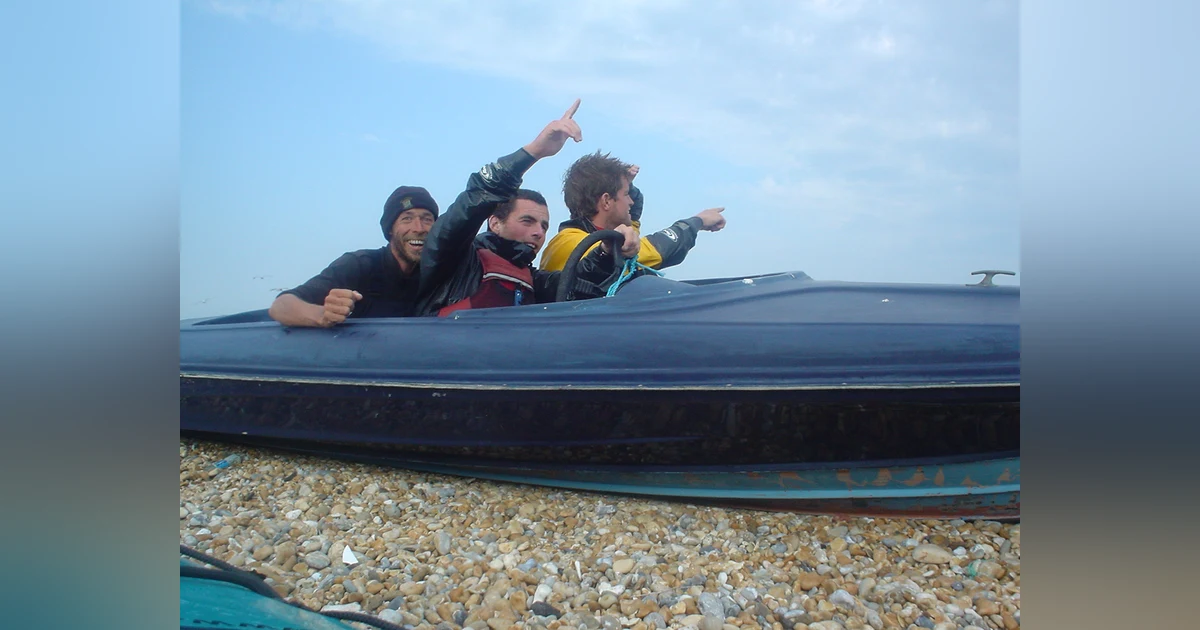
Best friends, bold crossings, and bombs around Britain with Barry Shaw


 Apple Podcasts

 Spotify

 Overcast

 Castro

 PocketCasts

 RSS Feed
In today's episode of the Paddling the Blue podcast, John is joined by the adventurous Barry Shaw, who takes us through his incredible journey from a novice to a seasoned paddler, making bold crossings to Ireland, St. Kilda, and even going around Britain.
Barry shares his experiences of challenges and triumphs on the waters, his strong bond of friendship with fellow kayakers, and the invaluable lessons learned along the way. From gripping tales of surviving drop zones to the joy of exploration in remote coastlines, Barry's stories are sure to captivate and inspire you.
Connect:
00:09 - Introduction to Paddling the Blue
01:24 - Meet Barry Shaw
05:22 - Barry's Paddling Journey
06:26 - Coaching and Leadership
09:25 - Adventures and Crossings
09:34 - From Local to Global Paddling
21:46 - Favorite Crossings and Trips
22:40 - The Round Britain Adventure
33:25 - Unforgettable Experiences
37:30 - Paddling in Scotland vs. Ireland
43:07 - The Allure of New Zealand
0:01 Welcome to Paddling the Blue. With each episode, we talk with guests from the Great Lakes and around the globe who are doing cool things related to sea kayaking. I'm your host, my name is John Chase, and let's get started paddling the blue. Welcome to today's episode of Paddling the Blue. I'm joined today by Barry Shaw, and we cover a lot of ground in this episode, starting with his first crossing a mere four nautical miles, growing to bold crossings to Ireland and St. Kilda, leading up to a trip with great friends around Britain, and more. But before we get to today's conversation with Barry, James and Simon at OnlineSeaKayaking.com continue to produce great content to help you evolve as a paddler and as a coach. You'll find everything from basic strokes and safety to paddling in tides, surfing, coaching, documentaries, expedition skills, incident management, and more.
0:49 And if you're looking to improve your role or find your role, they also have a 36-lesson rolling course, and it's all in one place. So if you're not already a subscriber to OnlineSeaKyking.com, here's your opportunity to get started. Visit OnlineSeaKyking.com, use the coupon code PTBPODCAST to check out and you'll get 10% off just for being a member of the Paddling the Blue community. And a big thanks to everyone who's helped us with contributions to offset the cost of running Paddling the Blue. You can also help out by visiting PaddlingTheBlue.com slash support. Enjoy today's episode with Barry Shaw. Hi, Barry. Welcome to Paddling the Blue. Hi, John. Thanks for having me on. Glad to be able to get together.
1:33 Yeah, likewise. Likewise, yeah. So tell us a little bit, how'd you get your start as a paddler? Oh, I'd never been in the kayak, actually, until I was 38, which was, that was the year 2000. And I did an introduction to, I was actually at an outdoor center and I saw all these sea kayaks on a trailer and they just looked amazing. I thought, oh, I wouldn't mind having to go in one of them. And it was Plasmeni in North Wales. And I booked onto an introduction to sea kayaking, a five-day intro. And day one, we went up to the north coast of Anglesey. We went out to the Scaries, which now I hadn't been, I hadn't really been that truthful about my experience.
2:19 It was supposed to be, I was a beginner and I didn't actually admit that, you know, and we ended up and I hadn't actually realized that the Scaries usually, it's quite an advanced paddle or it can be depending on the conditions. But fortunately it was it was flat as a pancake and i just on the way out to the scaries i was just thinking this is absolutely brilliant it was just amazing i was just i was hooked really from day one and then obviously there were another four days to go in the second day we went to round it's one of the classic trips in anglesey it's the stacks north stack and south stack and. I think my lack of experience showed on that day when I was swimming about next to my kayak.
3:04 But it was just amazing. I just loved it. And after those five days, I went out and bought myself a brand new Romani. And I didn't have any gear, any kit or anything. I borrowed an old paddle from a friend's son. And I'd go out kayaking. No spray deck, no buoyancy aid, nothing. And then um and then i just gradually bit by bit started to pick up bits of equipment, i'd see all the sea kayakers just about to launch or they just landed or something and i'd wait till they'd gone because i was always feeling slightly intimidated because i knew i was under equipped and i'd say the first year of my kayaking i was probably quite lucky to to have not got into any difficulty yeah yeah i think all of us were probably in that situation at some point where we we didn't know what we didn't know and did dumb things to start.
3:59 Yeah yeah i'm sure yeah i certainly did um so that first five days that's quite an introduction for your first five days oh it was it was wonderful it was it was a guy there's a guy did the first two days with a guy who's no longer with us and i thought at the time when i met him i thought i'm not sure this guy knows what he's doing and he seemed quite eccentric but uh he definitely knew what he was doing he was just he just had a wonderful approach very relaxed and casual approach but i really like that i'm not really one for the sort of regimental type of approach when it comes to leading groups so the first two days was this guy drew delaney, like i say he's no longer with us and i never got to know him after that you know which i i thought would have been nice you know to to paddle with him afterwards you know when i became more experienced but that never happened, and then there was a young girl from the centre and she took us out on an overnight trip.
4:59 Which we just borrowed all the kit from the center. And that gave me a taste for camping out of my kayak as well. You know, so there's so much happened in that first five days of my paddling. Yeah. And it just really inspired me to crack on. And I did. I just became obsessed with it really for several years. You know, it changed my life. All for the better. Yeah. So starting at 38, that's pretty unique. Most of my guests seem to get their start in scouts or something like that at a really young age, but it's pretty unique to be able to start at the age of 38. Yeah, well, I thought at the time, you know, I was thinking, I'm a late starter to this. I look back now and I think, wow, I was young.
5:45 But, yeah, it was a lot later. Although I do see a lot more these days. To see a lot of people coming to it later in life yeah some maybe have already had a bit of a background in some other discipline of kayaking but a lot yeah i am starting to notice more people coming to it later yeah it's nice to see definitely so you grew from that from that first five days to then the coaching and everything else so tell me about the progression that you went through to to get to where you are now so i lived on the world which is not too far from liverpool and And we have an estuary there, or had an estuary there called the D-Estuary.
6:26 And I do a lot of paddling on the D-Estuary. I was always on my own and didn't know any other paddlers until I met a guy on the D-Estuary, who became a regular paddling partner we'd got two or three times a week we both had strange shifts work shifts and we'd go out two or three times a week if the tides were right and a guy called ed rowlands who he's i probably you could probably call him a totally unknown sea kayaker and we just had an absolute blast we had so much fun and we you know we were actually you know we were able to rescue each other. And I think we both, it gave us a lot more confidence. He was a solo paddler as well.
7:11 And we started to become a bit more daring, go out in a bit more challenging conditions. And then I started heading out to Anglesey on my own a lot from there. And I'd meet up with, you know, I'd just meet other people on the water and then I'd meet up with the odd coach here and there. And Olly Sanders, I bumped into him and met him several times. And then he just asked me to help him out with the group at one point. And then it became another group and another group. And then I was working for him. And then I started, it was mainly just leading trips. And then I started working for some of the other providers.
7:54 So over the years, I've always been freelance. I've never started my own business, but I've worked for the likes of James, James Stevenson and Phil Clegg and Nick at Cunlifer. Just here and there, picking up days or weekends or the odd week. And bit by bit, I would start doing little bits of coaching. I didn't really know I was coaching at the time. I thought coaching was this, I don't know. I don't know what I thought it was, but then I realized I was actually just coaching, helping people without too much difficulty. I just like helping people, you know, with struggling with certain things, just finding ways to improve.
8:36 Yeah, it doesn't have to be hard. It's just if you've had a knack for it and enjoy it. Yeah well yeah I've definitely enjoyed it especially when I was progressing with my own personal skills I would like to get out with people in the more challenging conditions but I think that was from a selfish point of view because I like the challenging conditions but I started to develop a real liking for working with people who sometimes beginners but also people who they're not beginners but they have maybe confidence issues or they're struggling to pick up certain aspects of paddling. Yeah, I do have a liking for that. Trying to build people's confidence, that gives me a bit of a buzz. Sure. Yeah.
9:20 You help people experience things that they wouldn't be able to experience otherwise. Yeah. And so that's grown to some pretty big things. So crossing things and going around things has been a pretty big deal with you for several years. So what got you started in that kind of paddling? Well the crossings i think the crossings get so i grew up on the wirral which i've already said it's just near liverpool it's on the other side of the river mersey to liverpool now on the other side of the river d is north wales so all my all my sort of growing up years spent looking across to north wales and i had this yearning to paddle across it looked like such a long way to go in a kayak.
10:04 I thought that was real commitment. It was four nautical miles. Okay. At the time, I thought, wow, that would be great. I think I've got the guts to do that. So I did it, you know, it's four miles, four miles back. And then a little bit further along the coast, there's a turn in the coast of North Wales. And that's the point of air. And there's a lighthouse on the end there. And I'd never actually been to the lighthouse by sea or by road. So that was about seven or eight nautical miles. So I decided to do a bigger crossing and that was straight to there and back. I did that one with my mate Ed, Ed Rowland. And then I just started to gradually try to increase the distances.
10:50 And in, what was it, 2003, I met Harry Whelan down in Pembroke. And we seemed to hit it off together. And he asked me if I wanted to paddle to Ireland. And I just said yes. I didn't even think about it. This is from North Wales to Ireland. So, yeah, we decided we would do that the following year. And I went down to London and paddled on the Thames with him. And then he'd come up to Anglesey and we'd paddle together. We'd get out in the tide races and, And then, yeah, and then it was, I can't even remember what month it was, but it was, what was it?
11:32 It was 2004 we decided. In fact, no, it wasn't. It was later on in 2003, September 2003. That's right. I do remember. I was a bit nervous about it. And I know Harry was a lot more experienced sea kayaker than me. So just craftily, I thought, I know, I'll try and paddle around Anglesey to see if I can do the distance. Because if i can't i can always jump off so i did it so i went around anglesey and although it's tidal assisted a lot of it or much well right and then not as much of it if you get it totally wrong but i did okay and i got around it i was absolutely wiped out and the first thing i did was phone harry and said i just paddle around anglesey i think it was two weeks after that he came up to angle seat and we set off we we we decided against it actually in the morning we got up early it was about five in the morning and we went down to the beach the conditions the forecast wasn't it wasn't a good we wanted just a very still forecast you know not much wind not much swell and it was it was a force five from it was sort of on the we were heading west so we decided against it and And then we were sitting talking about it, saying, oh, we should have gone.
12:48 It would have been great and all this. And then I think it was about three hours later, we went down to the beach, drove back down to the beach. And a friend of ours was with us, and he saw us off. And we went. We were about halfway across. We were about 30 miles across to 60 miles. Well, 54 nautical miles, so 60 land miles. And about 30 miles into it, I started feeling sick. And I didn't say anything. I thought if I say something, it's just two of us that are concerned rather than just me. So we carried on going and I was getting slower and slower. I think he must have figured it out that I wasn't feeling brilliant. So he dropped back a bit and then...
13:31 I didn't say anything still. And then we were probably about 20 miles from Ireland. And I just knew I was going to bring up my banana, my banana and my sandwich. And I just shouted. I said, I need your kayak. I landed on the back deck of his kayak and I was sick all over it. And then the next wave came and just washed it all off. And then I felt okay. And we carried on. All right. About another 10 miles. I felt rough. and um anyway we we we got there we got there about 11 o'clock at night and it was in the days of last orders in all the pubs and we missed last orders by about 10 minutes didn't bother me because i wasn't a drinker but harry was a drinker and he loved a kinnis so yeah he wasn't very happy with, and he still hasn't forgiven me.
14:27 Yeah so that was that was the first big you know what i would consider to be a major crossing, and then in the end they just sort of went on from there there was was it the following year i don't know if you've interviewed fiona whitehead she she she used to do a lot of sea kayaking back then and she was doing a trip around britain and ireland and and her as part of that trip she was crossing from the south of wales to the south of ireland and she was reluctant to do that on her own so harry and i agreed to go down and join her so we paddled across we did that one and i think once we'd done two different crossings of the irish sea then there's the temptation then to start looking at other options and, which is something, yeah, something I did. I drove up to Scotland and did that, the North Channel.
15:26 And, yeah, it just happened like that, really. Just ended up doing a few others. The likes of Anglesey to the Isle of Man, which myself, Harry and Phil Clegg did in 2004. And then we had a day off and looked around the island. And the following day, we got back in our car and car back to Anglesey. Yeah and then we did that one again as part of our round britain trip in 2005 yeah your name shows up quite a few times actually with harry and phil but you know your name specifically and a lot of a lot of crossings and circumnavigations and all on the performance ckayak.co.uk right okay a lot of listings there oh yes.
16:15 So now out of curiosity so you went from that from your four nautical miles to then going to the lighthouse to eight nautical miles and then was your next biggest crossing the 98 kilometer from anglesey to irish or to dublin no i did i did some smaller ones but what might not be considered crossings in most people's eyes i suppose so i'd go from across to there's an island off anglesey called puffin island but you can get there from the coast of of wales place called clandidno if i'm saying it correctly and that's probably another eight mile there and eight mile back one so i did that one several times that was just to i suppose it was just to get the feeling of being out there sure it's not it's not a huge distance but so maybe actually yeah you're right then yeah that probably was the net the next the next crossing the next so what's been your your biggest crossing ever i think that was it okay yeah i i think that was it i myself and nick for quite nick couldn't live for quite some time a few years we we were we were interested in doing some crossings up in scotland the likes of i actually forget the name of the islands now i I think it's North Rona is one.
17:35 There are several islands that you could link if you had the conditions and you were fit enough, I suppose you could link, do a few together. But we never actually got around to, it was something that never happened. We did a crossing to St Kilda, which I have to say that was my favorite crossing out of any of them that I've done. We had very glassy conditions, and we did it at nighttime. But it was just, there was something about it. We had a terrible forecast for around a week, maybe more, while we were up in Scotland. And we decided it wasn't going to happen. And then there was a sudden change.
18:18 There was a sudden change in the forecast. And we had this window of opportunity. We camped out on a beach in the dunes, just waiting for the wind to drop. And for it to settle and it did settle and we got on and i think we thought it was going to change at any minute and we were so focused i think that's the most focus i've been on any crossing, even though the conditions were perfect i had a little on my map case i mean i remember i had a bag of boiled sweets i tipped them out into my map case on my cockpit i'd just see how long one could last as i was paddling and it was kill the time and we'd but we'd both do this and we hardly spoke for the it's 40 i think it was 45 was it 45 nautical miles i think it was something like that okay and we got there nick had had a gps so we could time up so we could you know tuck we could sort of put our route in and see how long it took and.
19:25 Just check every now and then we didn't go by the gps but we switched it on at the beginning, and then the plan was to look at it at the end when we got there but the gps died the battery died but my watch said i think we did it in nine hours seven minutes that seemed you just in fairly standard yeah good sea kayaks but they weren't you know sort of fast kayaks with rudders they We were North Shore Atlantics, and it just seemed like we'd done really well, really. Yeah. That distance in that time, you know, and we, yeah, like I say, we hardly spoke. And we got to the island, and we stopped on the beach, and then we just put our arms on each other.
20:06 And then we, and that was it. And then we went and put our tents up. And it was just absolutely fantastic. I love, I get into the zone. and if i'm paddling a distance i like to get into the zone in my head and i love it with no talking don't get me wrong i do like i love a bit of banter and i like a laugh and joke on the water but, there's when i'm in the zone and there's no talking and i'm just focusing on each stroke ah it's just there's just something really special about that for me yeah sounds like a pretty magical time you know like you mentioned silent night time glassy conditions yeah we got But when we arrived, I think I was expecting it to be completely deserted.
20:49 And I suppose it was in some respects, but there were three fairly large boats. There were one fishing boat. I think the others were two sailing boats. One of them certainly was. And it turned out that they were commercial kayak trips. They'd taken a group of paddlers on each boat. And they were paddling around the island during day trips. I think we went for a stroll at one point and got back to our kayaks. And there was a package wrapped up in tinfoil. And it was fudge. Or I think in Scotland they call it, they call it tablet. And I got a Facebook message. Someone had sent me a message via Facebook sometime after saying, did you get the tablet?
21:30 And it was one of these other kayakers from, I think it was Lothian Kayak Club. And yeah, they'd left us this tablet or pack of fudge because they knew we'd just done this long journey. That sounds like it made it even better. Yeah, yeah, yeah. So if that was your favorite crossing ever, what's been your favorite trip ever? Oh, gosh, John, that's a tough one. That's a tough one because there's different reasons for different trips. The most significant trip for me was the Round Britain trip, I think, because that was my first real big trip.
22:18 And it was such an adventure. It was a bit of an unknown, you know, what it was going to be like. It was hard. It was. It was hard physically, which I don't mind. I can deal with that. Most times I can deal with that. I love a bit of torture when it comes to paddling. Adversity is good. But I find it hard mentally, psychologically. And i think when you're when you got three good friends who go out paddling and get on really well on the water together i don't think you're prepared for spending so 80 days with each other constantly it was a real learning experience for me not just for kayaking but just about being in people's company long term you know for long periods of time and how to how to be yourself as well you know obviously.
23:17 We were good friends before the trip. We were good friends after the trip. But at the time, it does become niggles. It taught me a lot about, I think I hadn't realized that. Yeah, I think it's easy to think, that other fellow's a right pain. But then you start, as you look back on it, you think, well, actually, I think I was quite irritating then. Maybe it was me. Yeah, yeah. But it was, we had, although it's on our own home shores and we were never too far away from civilization, it was such an adventure.
23:59 It really was an adventure. It was an adventure that I've never known the likes of before and probably not since. Although I've had adventures on trips, that was my really big introduction to an adventure like that. So it was an eye-opener, and I have such fun memories of that trip. And it's sort of, like I said, I think I might have mentioned it earlier. So Harry, he's a good friend, and we're constantly in touch, but we don't see each other much. And it's the same with Phil, really, these days. I lived close to him for quite a long time, but for the last few years, I haven't lived close by.
24:43 But yeah, I think there becomes a bond when you do a trip like that. It's quite, yeah, quite a special bond, really. And when you can spend 80 days with two other people nonstop and still be really good friends at the end and for years afterwards, that's a win. Yeah. I think we had a couple of weeks break after the trip. So what were some of those favorite memories from that trip? Some of the memories weren't brilliant memories, actually. But looking back, good experiences, but not brilliance at the time. So, I mean, Harry had a really bad accident on the trip on the north coast of Scotland. We don't talk about a huge amount.
25:29 It was just very unfortunate that it was a pretty rough day. And we'd been stormbound for four days on that north coast. Now, I was used to going out paddling in rough conditions, but my paddling was always in the Irish Sea, which is although it's tide races a lot of the time it's tide races with quite big chunky waves my experience in surf was very very limited we we didn't don't get a huge amount of, um swell driven surf in north wales and on the north coast of scotland we we decided that, thing we were all getting quite cold and we've been going for about 25 miles and this is the day after four days off the off the water because of strong winds and my appreciation of swell just wasn't there really and we decided we'd got on the water we did about 25 miles and then we decided we're going to have to go in inland and the only place was that we had available was it a long surf beach and we couldn't go to go any further we had to go around a big headland and we decided against and i think i remember phil as we were going in phil's suggestion was we'll go in one at a time every man for himself and we'll pick up the bits on the beach.
27:02 Which i thought yeah great that'll be exciting and then i really hadn't appreciated the what how that swell that was that was five years into my kayaking and I hadn't appreciated how big swell could impact on the beach and it as we were going in and Harry warned me that there was a big set coming in and I I just made a sprint for it. And I was fortunate that I got ahead of the breaking wave. And I remember turning around and I saw the wave break. And I'd never been in waters like that.
27:42 I thought I'd been in big waves, but that was something totally different to what I was used to. And then I landed. I did capsize on the way in, but I came up. It was just all the white, frothy, broken water. So the power had gone for me in the wave. And i landed and phil was on the beach and we waited and we waited and after some time we i took a sprint up up to the up a bank and along the headland and it was quite a i think we'd been looking for about 20 minutes and what we hadn't realized was harry had been hit by a big wave Now, he went bow first, you know, down, and he completely pitch-polled.
28:29 And unfortunately, that's something that wouldn't be new to Harry. You know, he used to look plain and that kind of stuff. But unfortunately, he came down with a fully loaded boat on a brace of some sort. He completely, you know, pulled his shoulder out of the socket. And so he was in the water, just hanging onto his boat on a toggle. And it took us a long time to find him. So, yeah, so that wasn't, we got him out and that was all sorted. And so that was the unpleasant bit. And Phil and I, Harry went to hospital. They sorted him out. He came back and he was, he was the strongest out of the three of us by a long, a long way.
29:13 So I wasn't, I was, I wasn't expecting that. And he came back from hospital and we, and Phil and I said, yeah, we just thought this there's no way you can paddle after that, you know, and, you know, he was, he was all for carrying on. And we said, well, tell you what, how about we, we go on for a few days and then if you feel you can paddle, we'll wait for you. I think it was four days down the coast. We got a phone call saying I've just done 40 miles. We were just blown away, you know? And yeah. So we said, right, okay, we'll wait here i think it was another i think it was only a couple of days and he caught us up, so that was that and he continued and he didn't have i don't think he had another day off on that trip until weeks and weeks later okay because we always always wanted to do something even if we probably wasn't the best philosophy looking back on it but we always wanted to do something even if it was only a few miles, which my philosophy has changed on that in more recent years.
30:25 I prefer to save my energy and get a big day. Yeah. But we had some good laughs as well. Sometimes you're camping in places where you're not supposed to be camping. For instance, there's an island in the Bristol Channel called Lundy Island. It's off the North Devon coast. and we paddled to it from Cornwall. And it's owned by, I think it's a private organization. I think they call it the Landmark Trust. That's what it used to be anyway. And they have ranges. And it's when you land on a little beach next to a quayside, there's a huge steep path going right up to a campsite.
31:10 And we just thought, there's no way. There's no way we're going. We're not going up there and camping on the campsite and paying to camp as well. So we'll sit down here we'll camp on the beach and um so we started cooking our dinner and then a ranger came down in a land rover and he asked us what we were doing and i was designated we took it in turns if we were confronted by anyone and it was my turn i i said well are we yeah we just kiked across and we're just gonna yeah he said are you going up to the campsite and i said no, we're going to camp here on the beach. And he said, oh, I'm sorry, but there's no camping. You're not allowed to camp on the beach. And I said, oh, okay. All right. I just thought for a.
31:56 Won't get our tents out we'll just sleep on the beach and he said oh sorry no you're not allowed to sleep on the beach and i said all right okay and uh and i thought for a second and the lads were looking at me and i said tell you what we'll stay awake and uh and he just he looked he was stumped he didn't know what to say and uh anyway he just said if anyone anyone says anything to you i haven't seen you and drove off so he wasn't ready for that answer no no no he didn't know no so yeah there's that but there were there were several there were several quite funny things we got we crossed the humber estuary and we went straight into a a military drop zone which we didn't know we were i was still learning about nautical charts and i had a chart on my deck and i didn't know what dz was and it was drop zone and there was a yeah it was actually harry's pretty good on planes and it was an american plane came around it did came along and it was coming over and getting closer and closer then it turned on one side and he fired this missile he obviously hadn't seen us he fired this missile and it landed like i don't know about 100 meters away from us which wow might sound a long way but when you're when you're on the sea and there's a missile lands that close to you no it.
33:25 Was no it was it. Was it was pretty scary yeah and then yeah so we just put a spurt on and he did. This big circle and he came around and he was i thought oh my god here he comes again and he was coming around he's coming around and he he turned onto one side and i thought oh my god there he goes he's gonna fire and i was actually obviously i'm not going to swear on here but i was screaming you're obviously not going to hear me but i was just screaming swearing at him telling him what i wanted him to do and. He veered off and he didn't drop his missile until he got, he dropped it on, he fired it onto the beach.
34:07 So I'm guessing, I don't, I don't know what the ins and outs are of planes and missiles and stuff, but he was obviously going to let it go. And he, but I think he must've, he must've seen us. And then we just carried on paddling like stink, trying to get away from the area. Yeah. We switched our radios off in case the Coast Guard called us and told us to turn back because there was only one way we were going and yeah and it wasn't going to be anti-clockwise well i guess i'm going to have to look out for drop zones i wasn't familiar with that yeah well yeah i'm very familiar with it now wow so how about the people any people experiences that you remember from that one other than the persons in planes absolutely, Yeah, I've noticed it's a bit of a theme, really, on trips.
34:56 I've heard some people say that people in certain countries are so friendly, and in this country they're friendly, and in that country they're friendly. But we, I think we noticed it all the way around Britain. We noticed it, and I've noticed it since. I think when you're coming into a place from the sea, I don't know what it is, but people just seem to be, seem to open their arms up to you, you know, and be very, very friendly and welcoming and hospitable. And we, yeah, we were, we were very lucky and fortunate. You know, we were invited into, you know, we were offered floor space in sailing clubs and yacht clubs and beds in people's houses and people offered to put, let's put our tent up in the gardens and things like that.
35:45 Yeah. Yeah, it was amazing really. I don't know what it is about coming in from the sea. Yeah, there's something special about that that really captures people's imagination and their attention. Yeah, absolutely. Yeah. And they all seem to want to know a bit about your trip. Yeah, it's probably quite an unusual way to travel for most people. So they seem to take an interest in it. So did you find a lot of areas that really felt remote i mean it's a it's a fairly populated area for the most part it is and we i think there are a lot of remote areas and we certainly found some the likes of on the north coast of scotland well up the west coast of scotland as well actually but there was there was often the temptation to land a little bit closer just within walking distance of a town or a village and there's something nice about, I mean I'm.
36:46 I wasn't a drinker. I've never been a big drinker, but I would, there's something nice about in an evening time, just sitting down in a warm pub after you've been working hard, maybe having a, having fish and chips and a, and a, and a drink in a, in a warm pub. That, that is very nice. So Harry and Phil were specially drawn to, to pubs. I actually, I actually worked out how much they'd drunk over the whole, over the course of the trip. I did an estimation. I calculated, really. It was quite a mind-boggling amount of Guinness. It kept them going. It certainly did. Part of the experience. It did, yeah.
37:30 I definitely think it gave them plenty of energy. Favorite place? If you could paddle only one place along the coast of the UK, where would that be? You're testing me out here. Well, I think Scotland is always pretty special for sea kayakers in the UK. You know, it's a go-to place for a lot of paddlers. Yeah. Because of the remoteness, the wildness, the different options, you can almost always find shelter, even if the conditions are bad. I was actually quite taken by a section of the UK coast that I never used to hear people talking about, and that is the east coast of Scotland.
38:18 I think there's some fantastic paddling down the east coast, and it would have been nice to spend more time, but when you're on a circumnavigation, I think a lot of people who do circumnavigations become quite focused, And it isn't about spending time in different places, but it is about traveling and keep going and getting the distance in. However, I have known, I've read some of Chris Duff's books, and he definitely was into the exploring side of things. And he'd spent a long time on a trip, and he definitely saw the places for what they were and experienced them.
39:05 Rather than just paddling past and thinking, oh, it'd be nice to come here one day. Yeah. Yeah. So the East Coast of Scotland is pretty good. Interesting. That's another area. I just spoke with Kiva Connor just recently, and she actually referred you to the show here. And we were talking a lot about the East Coast of Ireland and how it's that area that just doesn't get as much press. And here we are now talking East Side of Scotland and doesn't get as much love. Yeah, East Coast, they're a bit neglected, I think. Yeah. Yeah, no, East Coast of Ireland as well. Yeah, definitely. She's right there. There's some great paddling there.
39:48 So what is it about the east coast of Scotland? It was certainly very cliffy. A lot of cliffs around there. I'm not very good when it comes to geology. So someone else could tell you all about the cliffs there. I can't, but they certainly look very impressive. Yeah, I'm not going to ask you the type of rock, but if they're beautiful, that's great. Yeah, yeah. and and yeah and up by the very top very top right corner my duncan's behead around there that's stunning and and there was a little section of that actually that that on the round britain trip filled that filled it twice because he dropped his keg and he didn't realize and he had to go back for and it was floating on the it's floating on the on the surface wow you know so.
40:41 Yeah yeah so it's interesting that you mentioned duncan's behead too is that i recently spoke with roger chandler and asked him his favorite place and duncan's behead was his all right okay great what i was right then let's shift just a little bit here and i'm going to ask another question kind of a close to the area but since we're talking about you know the uk trip i want to just ask a kind of a parallel question what do you find is a big differences between paddling in the uk or around the uk versus paddling around ireland which you've done also all right okay they're definitely different yeah they are different obviously there's some so similarity in sort of you know when you paddle somewhere and the language is different well that makes a difference but ireland it's ireland is a lot more remote there's a lot more a remote coastline in Ireland than there is in the UK and Britain.
41:41 Okay. Obviously part of Ireland, like the Northern Ireland is part of the UK. And that has some stunning coastline, especially on the North Coast around Rathlin. Rathlin is an amazing place. But Ireland in general, the whole of Ireland, the island of Ireland, it's stunning that Some of the coastline is just amazing. You're not a million miles from things, even though it feels like it. There's plenty of villages dotted around up the coast. And I know I've said that people around Britain were friendly, welcoming, but Ireland, I don't know what it is about Ireland in general, that it is full of people who are just very, very friendly.
42:32 I don't think that's just the coast you know i mentioned about coming in from somewhere from the sea people are you know welcoming but island in general is very friendly place i think i think they've always been known to be friendly obviously it's had its problems but that's doesn't take away that people are incredibly friendly yeah yeah island is an amazing place to paddle especially for a circumnavigation, So Britain is a rough, I can't remember how long, but rough guess. It's roughly 2,000 miles around, whereas Ireland is, I think it was about, I think I measured it.
43:16 Our trip around Ireland was about 870 to 900, something like that. So I think it's more doable because of the time factor. Sometimes someone might be able to get four weeks out of work or six weeks out of work. But if you're going to do something that's 2,000 miles, well, you've probably got to give yourself at least three months to be on the safe side. And that's not that easy for a lot of people to get time out of work. So island is yeah it's more doable for it's doable for more people i think but it is i i don't know when i so i i did it in 2013 and as soon as i finished that trip i i said i'd do that again, and i i did it again with my so my my partner claire she'd always wanted to go around island And she, you know, it's her home ground, you know, she wanted to paddle around home turf.
44:19 And when we got together, she said, oh, you won't want to do that. You've done that. And I said, I blooming well will. So the second time, it was Claire's trip, you know, it was Claire's trip, really. She arranged it all, really. And so we just did it together. And I finished that trip. We finished that trip. and i said again i said i'd do that again i know and i would i'd do it a third time it's i just loved it both times absolutely loved it good and harry wheelan he's done it twice as well, and yeah it hasn't i think he'd do it again now did you go the the same way around both times Yeah, yes, yeah, clockwise, both times. Okay.
45:08 I think I've only done one trip anticlockwise. In fact, no, I haven't. I've done... No, I've done more than one trip anticlockwise, so I apologize about that. Yeah, but clockwise, both times clockwise, yeah. Okay. It seems to be the thing to do. Yeah. And I'm sure if you ask someone who knows what they're talking about, they give you a good reason. I don't. I think it's probably obsessive compulsive disorder with me. It just doesn't seem right going anticlockwise. It doesn't. It's bad. No. Exactly. I think I did ask somebody about that once, and I think it has to do with the currents and the prevailing winds and just kind of easier to push you up that West Coast.
45:52 Right. Okay. Yeah. Fair enough. Yeah. We'll go with that. Sure, right. So now you found yourself now on the other side of the world. Yes. Yeah. I'm in New Zealand at the moment. Yeah, in Christchurch. Yeah, I've been here for a week now. Super. Yeah, yeah. So it's, yeah, I'm looking forward to getting out paddling here. Yeah. And this isn't your first time there. So you've also paddled around the South Island. I have. Yes, I have. That was actually something I wanted to do before going around Britain. I thought, oh, paddle around the South Island in New Zealand. That'd be great.
46:34 An old school friend moved over here a long time ago. And when I got into kayaking, I read Blazing Paddles, a book by Brian Wilson. And I thought, oh, that's great. That's really good. I want to get on some trips. And I thought, I know. If I could get over to New Zealand, I could go and visit my old schoolmate. And I could paddle around it while I'm there. And then I picked up a copy of, what was it called? Chris duff sudden sudden exposure yeah chris duff wrote a book about his circumnavigation, and and i read it and i was gripped when i was reading it and i'm a terrible reader i'm very slow and i don't stick to it but i was gripped by this book and i i read right through it and by the end of it i thought my god that's way beyond me i'm never going to be able to paddle.
47:30 And I thought I need to, I need to brush it upon my skills and I need to, you know, I just need to become a better, stronger paddler. And it sounded scary, you know, just reading the book and, you know, So it sort of went on the back burner, really. And then, obviously, I paddled around Britain. And that was 2005. So 2006, I thought, right, I know. I'll do a trip around Ireland, but I'll start in the wintertime. And that'll get me prepared. There's loads of surf over there. That'll get me prepared for the South Island. And I was left with a bit of a fear of surf after the north coast of Scotland with Harry. Sure.
48:17 Yeah, that left me. Yeah. And I was very apprehensive about surf after that. And so I set off in 2006 to go around Ireland. And unfortunately, I only got two days into the trip and my wrist swelled up and I had tendinitis. And I rested it for a week and then tried to carry on but it was no good so I came home but anyway come 2007, I still had the South Island of New Zealand in the system, and I felt that my paddling was coming on and I was getting closer to the point I felt I was ready for that trip and I decided I was going to do it and I started looking into it, And I was out paddling with just Inca Genvin in 2000. That was 2007.
49:13 And she asked me, she said, what, what, what trip would you want to do? You know, what would be at the top of your list? And I said, the South Island. And she said, oh, yeah, that's, yeah, that, that, that's a trip I wouldn't mind doing as well. And she said, would you, would you do it together? So we, yeah, so we both thought that'd be a great idea. And we started planning and in the meantime we became a couple and then so yeah come the beginning of 2008 we went out went out there or came out here and yeah we set off and it was it's funny it feels completely different when just things like the color of the water or different temperature of the air and just gives you a different feeling about a place and we set off from an estuary called a place called Sumner we set off from this estuary it's just on the outskirts of Christchurch, and we were just paddling out of this the tide was taking us out of the estuary and I took out my camera to take a photograph well the first photograph of the trip actually on the water and there's a bar.
50:27 Bar that the tidal bar and wave broke and honestly 17 minutes into the trip I was upside down holding my kayak and fortunately I rolled up and it was it'd been a while since I'd rolled with a fully loaded kayak and I have to say it wasn't my best roll and yeah I thought oh my god, how did i get up that was a terrible roll and then i realized i looked at my watch i realized we were 17 minutes in and thought i've already capsized and i think justine must have thought who the hell am i paddling with but anyway that was that was that was fine you know soon settled into it and then yeah that was the beginning of the trip and it was it was an amazing trip I was gripped most days I was gripped on the trip because it was a totally different experience to going around Britain.
51:34 As much as the coastline. There's a lot of surf around the South Island of New Zealand. And I think generally the East Coast is steep dumping surf onto steep gravel beaches or steep sandy beaches. And then on the West Coast, there's more open beach surf, which I think I would probably land in dumping stuff and launch through open beach surf. Beach surf, I find it an absolute nightmare for different reasons. Obviously, the timing has got to be spot on. But then once you're on, if it's a gravel beach, you've just got this skeg full of stones.
52:22 And then there's a job for both of you then to get your knife out and start emptying each other's skegs out. Right. Yeah. But I found the South Island of New Zealand to be extremely challenging. Some days, we'd look at the map before we launched, and we'd know that because of the shape of the land, the shape of the coastline, we'd know that the next safe landing could be as much as 50 miles away, you know, 80 kilometers. So there's also very changeable weather conditions here, you know, weather patterns, and you could get on the water knowing that the next safe landing is like 50 miles away, but you get this feeling in your stomach, this pit in your stomach, because you know that the conditions could change any minute.
53:11 And if it changes and becomes a headwind and that's that's a big problem. You've got such a long distance to paddle so i think both of us found it quite challenging, when it comes to the the mental side of it so it could be quite stressful you know certain days you know but but we did it and there was i think we had three capsizes each throughout the whole trip yeah and we certainly had our share of surf landings yeah which wasn't always fun yeah you You got one of them out of the way 17 minutes in. I did. Yeah. So how do you plan a trip like that when you're on the other side of the world and you don't know the terrain and you're thinking about when your next landing might be 50 miles away? How do you even come up with that information?
54:02 Back then. So I was I was fairly late to the Internet. Yeah, I had started by then a little bit, but I I I managed to get a disc from somewhere. I can't remember where it came from. and it was maps of the South Island of New Zealand or a map of the South Island of New Zealand on a disk. And I loaded that into a computer, I think. I can't remember if I went to Google Earth or not, but off those maps, I went. My mum had a printer, and I went up to my mum's, and I printed off all these maps. I printed them on A4 size, And I think that we must have had about 60 or 70 A4 sheets of maps.
54:47 And we used those for the basic coastline and the names of places and all that. We could see shapes. So you get an idea of what was going to be safe to get in behind and all that. But there wasn't a huge amount of detail. I think I went on to Google Earth and I started zooming in and marking things off onto the maps so that we had, there's a lot of likes of, so field land, you get a lot of dock huts, which are Department of Conservation huts. And they're for hikers really, trampers, and it'll be a bunk house.
55:30 It's just a big shed with lots of bunks and a wood-burning stove, and that's it, and there'll be a tank of water outside. So if you get to one of those, you've got great shelter. You've got warmth. You've got shelter, you've got warmth, you can cook on the wood-burning stoves, and you've got a bed for the night, so you're laughing really. We use those quite a few times even quite a few of those those huts and then you can mark off little little rocky outcrops that might give you a little bit of shelter from from some surf, and obviously there's bar mouths there's a lot of rivers coming out the on the south island of new zealand and they create a bar now depending on the tide the state of the tide the time and the tidal system, you know, they can be okay or they can be a nightmare.
56:24 If you go in and you're at the height of the tide, well, then you've probably got more chance of getting in there without getting trashed. Whereas if the river's flying out into the sea there over a bar, well, then the swell going across that, we tended to avoid that. We'd been in touch with Paul Caffin, who he's a local. He's actually an Aussie, but he's a Kiwi these days. He's lived most of his life, I think, in New Zealand. And he's the big name in kayaking in New Zealand, really. Oh, worldwide, certainly. Yeah, absolutely. Yeah.
57:05 So he's very familiar with all the different places around the coast. And he gave us some hints and tips on places that were good to land, places that weren't, places to avoid. And also, something else he did, he contacted other kayakers around the coast. And we were sometimes met by other kayakers when we landed and it was, it was just amazing. People would pile all our stuff into their trucks and they'd take us off home and spoil us. And that was, that was absolutely brilliant. It really was. Yeah, that was great. Good to have friends. Absolutely. Yeah, definitely. So that sounds like a fantastic trip.
57:45 I'd love to hear more about that one, but we'll have to leave that one to a future episode to maybe dig into that even more. But this has been fantastic being able to hear from you and hear about your favorite trips, favorite places. And that UK trip does sound pretty incredible, as does South Island and the others. So appreciate your time. Thank you. Thank you. You're welcome, John. Thank you. Thanks for having me on. Yeah. So a couple of a couple of other questions just as we as we wrap up here. How can listeners reach you? Well, I'm not exactly, I'm not someone who does a lot on social media, but I do have a Facebook page and yeah, so obviously it's Barry Shore.
58:30 You can probably find me on Facebook. Other than that, I don't, I think I keep a fairly low profile. Nothing wrong with that. But if someone wanted to, if someone wanted to ask me something and they wanted to send me an email they would happily send them my email address and they can email away and i'll do my best to answer anything that they might want to know i don't know if i can all right give it a go well you have maybe you may have a small digital footprint but in the kayaking world you've had a big footprint and it's been a pretty impressive run and we'll certainly look forward to following future adventures as well so one other question that i have for you and that is who else would you like to hear as a future guest on paddling the blue i i would like to hear someone who's he's a good friend of mine but i think so i know i know most of the things he has to say but i think it'd be really interesting for people who haven't met him to to hear him and he's he's a guy from from ireland who's lived in london for a long long long long time now it's harry wheelan all right Yeah, you mentioned Harry's name a few times here and a long-time partner of yours on many paddling adventures.
59:46 Yeah, yeah. I've not met Harry. He's taught me a lot. Yeah. I've not met Harry and we've not had a chance to talk before, but the, the one, I guess the exposure that I've had to him is I remember watching a, this is the sea video from many years ago of Harry surfing behind a, a ferry on the Thames. Yeah. That's his, that's his favorite pastime when he's, when he's not working. Yeah. Yeah. He loves to do that and he's very, very good at it. Yeah. Right. Well, great. Barry, thank you very much for the opportunity. I look forward to maybe, maybe having a chance to paddle together in the future that would be great john yeah that'd be great if i'm still in new zealand when you get over here at some point yeah let's get out there sounds good thank you barry okay all right john thank you if you want to be a stronger and more efficient paddler power to the paddle is packed with fitness guidance and complete descriptions along with photos of more than 50 exercises to improve your abilities and enjoy your time on the water.
1:00:47 The concept and exercises in this book have helped me become a better paddler, and they can make a difference for you too. The exercises in the book can help you reduce tension in your shoulders and low back, use the power of your torso to create leverage and use less energy with each stroke, use force generated from your lower body to make your paddling strokes more efficient, have the endurance to handle long days in the boat, drive through the toughest waves or white water, protect your body against common paddling injuries, and while you're at it, you might even lose a few pounds, and who wouldn't mind that? So visit paddlingexercises.com to get the book and companion DVD. When you can paddle for 80 days with two friends and come back even better friends, that is a win.
1:01:27 It was a pleasure to share a few laughs with Barry. He's got some great stories of adventures in great places, and we could have talked for hours on all the places. And now that he's made the move to New Zealand, I'm certain there will be more fun times to come. Thanks again to our partners at OnlineSeaKyaking.com for extending that special offer to you. Visit OnlineSeaKyaking.com, enter the code PTBPODCAST to check out and get 10% off just for being a member of the Paddling the Blue community. Until next time, thanks as always for listening, and I look forward to bringing you the next episode of Paddling the Blue. Thank you for listening to Paddling the Blue. You can subscribe to Paddling the Blue on Apple Music, Google Podcasts, Spotify, or wherever you find your favorite podcasts.
1:02:13 Please take the time to leave us a five-star review on Apple Music. We truly appreciate the support. And you can find the show notes for this episode and other episodes, along with replays of past episodes, contact information, and more at paddlingtheblue.com. Until next time, I hope you get out and paddle the blue. Music.